
Amazon has rules for everything. Some make sense. Others feel arbitrary until you understand the reason behind them. The 50lb box weight limit falls into that second category. It seems strict until you picture a warehouse worker lifting a box that weighs more than they expected. Injuries happen. Claims get filed. Amazon tightens the rules. Sellers pay the price.
If your cartons exceed the limit, Amazon rejects the shipment. That means delays, extra fees, and frustrated customers. An Amazon prep center helps you avoid this headache entirely. They know the rules inside and out. They catch problems before your inventory leaves their facility.
Understanding Amazon’s Box Weight Rules
Amazon’s policy is straightforward. No single carton can exceed 50 pounds unless it contains one oversized item. Even then, special labeling is required. The box must carry a “Team Lift” or “Mechanical Lift” warning. Without that label, the shipment gets flagged.
This rule exists for worker safety. Warehouse employees lift hundreds of boxes daily. A box that weighs 60 or 70 pounds creates a real injury risk. Amazon does not want that liability. So they push the responsibility onto sellers.
An Amazon prep center verifies every carton weight before shipping. They use industrial scales. They document measurements. They ensure compliance with Amazon’s exact specifications.
What Triggers a Weight Violation
Weight violations happen for several reasons. Some sellers do not know the rules. Others know the rules but lack the equipment to check weights accurately. A bathroom scale is not precise enough for commercial shipments.
Dense products create problems too. Books, tools, and electronic components add weight fast. A carton that feels manageable might exceed 50 pounds when fully packed.
Amazon FBA team lift and heavy package warning label prep are essential for boxes that fall into the heavy category. The label must be visible on all sides. Missing labels lead to rejections.
Many sellers discover violations the hard way.
Let Keach Fulfillment verify your shipments before they leave.How an Amazon Prep Center Prevents Violations
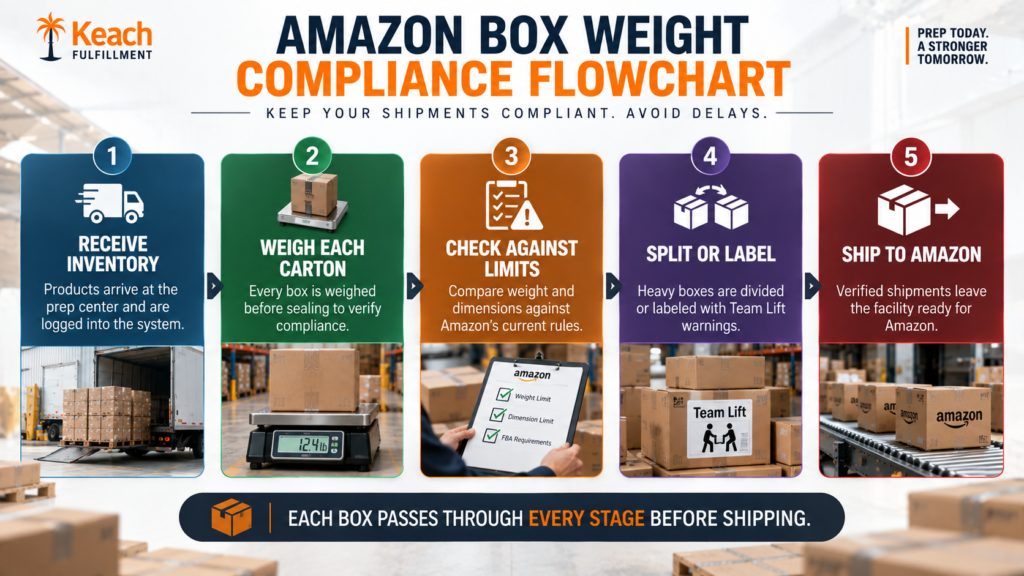
A professional Amazon prep center builds weight checks into their workflow. Every carton crosses a scale. Every measurement gets recorded. This systematic approach catches issues early.
Weight Verification
Each carton is weighed before sealing. If a box approaches the 50lb limit, the prep team flags it.
Carton Splitting
Heavy shipments get divided into lighter boxes. Prep center box split services for heavy e-commerce inventory ensure no single carton exceeds the limit.
Label Application
Boxes that qualify as heavy receive proper Team Lift or Mechanical Lift labels.
Documentation
The prep center records weights and dimensions for every shipment. This creates a paper trail if Amazon questions anything.
Avoiding Amazon Inbound Box Weight and Dimension Violations
Weight is not the only issue. Dimensions matter too. Amazon specifies maximum carton sizes. Oversized boxes create handling problems in fulfillment centers.
Avoiding Amazon inbound box weight and dimension violations requires attention to both measurements. A prep center checks dimensions alongside weight. They know Amazon’s current specifications. They adjust packing methods accordingly.
Master Carton Weight Limits for Amazon FBA Shipments
Wholesale sellers face unique challenges. Master cartons often exceed weight limits because they contain multiple units. Breaking these down into smaller boxes adds labor but prevents rejections.
Master carton weight limits for Amazon FBA shipments apply to both inbound and outbound freight. Understanding these limits helps you plan packaging before inventory arrives at the prep center.
This guide covers FBA prep for wholesale vs arbitrage and the key differences in requirements. Your sourcing model affects how you handle weight limits.
Here is a visual breakdown of the box weight compliance process:
Oversized, Heavy, Bulk, and Box Weight Violation Prep
Some products are simply heavy. There is no way around it. A single unit might weigh 40 pounds. Adding packaging pushes it close to the limit.
Oversized, heavy bulk, and box weight violation prep requires specialized handling. The prep center uses reinforced boxes and proper cushioning. They apply Mechanical Lift labels when required. They ensure the packaging can withstand transit without breaking.
How Weight Compliance Affects Costs
Weight violations cost money. Rejected shipments mean return shipping fees. Delays mean lost sales. Repeated violations hurt your account health.
Working with a prep center reduces these risks. The upfront cost of professional prep is far less than the cost of failed shipments.
This resource breaks down FBA prep service fees explained so you understand the value.
Shipping Method Considerations
How you ship affects weight compliance. SPD shipments have stricter per-box limits. LTL shipments allow heavier pallets but still require individual cartons to meet standards.
This blog explains SPD vs LTL prep for Amazon FBA and when to switch from cartons to pallets. The right shipping method simplifies compliance.
Transparency Codes and Weight Rules
If your products require Transparency codes, weight compliance gets more complex. Each unit needs individual labeling before packing. The prep center must balance code application with weight limits.
Learn how FBA prep centers handle Amazon transparency barcodes and serialization with precision. Getting both right protects your account.
Inbound Placement and Weight Strategy
Weight affects inbound placement too. Heavier shipments sometimes route differently than lighter ones. Strategic planning reduces fees and simplifies logistics.
Here is how FBA prep centers help reduce Amazon inbound placement fees through smart routing and consolidation.
Common Mistakes Sellers Make
Many sellers assume their boxes are fine. They do not weigh them. They guess at dimensions. They skip the Team Lift labels. These assumptions lead to rejected shipments.
Another mistake is using weak boxes. Heavy products need sturdy packaging. A box that collapses during transit creates a mess at Amazon’s receiving dock. Professional prep centers use appropriate materials for heavy items.
Why Professional Prep Matters
Amazon’s rules keep changing. Staying compliant requires constant attention. An Amazon prep center does this work for you. They monitor policy updates. They adjust processes accordingly. They protect your account from preventable violations.
This is not just about avoiding problems. It is about building a reliable operation. When your shipments arrive without issues, your inventory moves faster. Your sales flow smoothly. Your business grows.
Conclusion
Box weight violations are preventable. The right Amazon prep center catches issues before they become problems. Keach Fulfillment verifies every carton, applies proper labels, and ensures compliance with Amazon’s requirements. Do not wait for a rejected shipment to learn the rules. Partner with professionals who already know them.
Stop guessing if your cartons meet Amazon’s standards.
Partner with a prep team that verifies every single box.