
Amazon selling has many types. There are those who purchase in bulk from brand owners and distributors. This is known as wholesale. Others seek out deals from physical stores and even websites. This is known as online arbitrage and retail arbitrage. Both strategies work; both can be profitable. However, they demand a vastly different preparation process.
The way you prep inventory for Amazon depends on how you source it. Wholesale shipments arrive in uniform cartons with consistent SKUs. Arbitrage hauls arrive as a mixed bag of random products. A prep center handles both, but the process looks completely different. Understanding these differences helps you choose the right partner and avoid costly mistakes.
Why FBA Prep Matters for Both Models
Amazon has strict receiving requirements. Every unit needs a scannable barcode. Loose items need polybagging. Fragile products need protection. If you skip these steps, Amazon rejects your shipment. That means delays, extra shipping costs, and frustrated customers.
Amazon FBA prep services exist to handle these details. They inspect your products, apply labels, and package everything correctly. For wholesale sellers, this means processing hundreds of identical units quickly. For arbitrage sellers, it means handling unique items with individual attention. The goal is the same. Get inventory Amazon-ready without eating up your time.
How Wholesale Prep Works
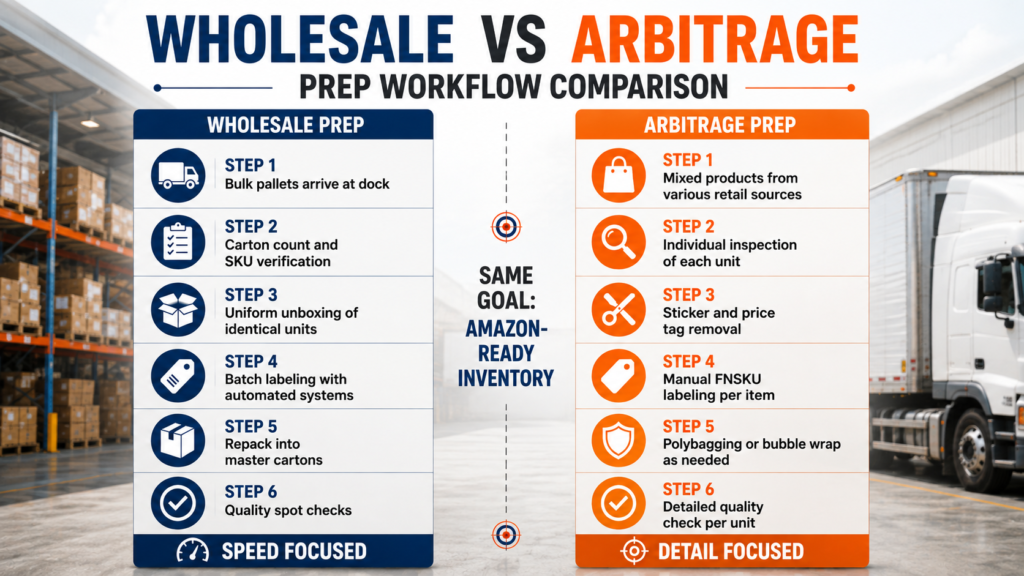
Wholesale sellers buy directly from manufacturers or authorized distributors. Products arrive in master cartons. Each carton contains the same SKU. The prep process is straightforward. Open the box, inspect for damage, label each unit, and repack.
Because the products are identical, the workflow is fast. A prep center can process thousands of units in a day. Speed matters. Wholesale margins are often thin. The faster you move inventory, the faster you get paid.
How Arbitrage Prep Works
Arbitrage sellers source from retail stores, clearance aisles, and online sales. Each unit might be different. A single shipment could contain toys, kitchen gadgets, and electronics. This creates chaos for prep centers.
Every item needs individual inspection. Barcodes must be covered with FNSKU labels. Some products need polybagging. Others need bubble wrap. The process is slower and more labor-intensive. Amazon FBA prep services for online arbitrage sellers must handle this variety without missing details.
Wholesale and arbitrage both have unique needs.
Get matched with the right prep solution today!Bulk Inventory Receiving and Prep for Amazon Wholesale
Wholesale sellers deal with volume. A single purchase order might include thousands of units. Bulk inventory receiving and prep for Amazon wholesale requires warehouse space and organized systems. The prep center must unload pallets, count cartons, and verify SKUs.
Accuracy matters at scale. A mistake in counting creates inventory discrepancies. A mislabeled carton causes receiving delays at Amazon. Good prep centers use barcode scanners and digital checklists. They track every unit from arrival to departure.
Prep Center Requirements for Retail Arbitrage Inventory
Retail arbitrage inventory is unpredictable. You never know what condition products will arrive in. Prep center requirements for retail arbitrage inventory include thorough inspection protocols. Each item must be checked for damage, missing parts, and expiration dates.
The prep center also needs to handle sticker removal. Retail products often have price tags or clearance stickers. These must be removed cleanly before labeling. Some items need repackaging if the original box is damaged. This level of attention takes time but prevents Amazon rejections.
High Volume FBA Prep Centers for Wholesale Distributors
Wholesale distributors need capacity. High-volume FBA prep centers for wholesale distributors invest in conveyor systems, automated labelers, and efficient workflows. They process containers, not just boxes. This scale keeps costs down.
Speed is critical. A distributor might send multiple truckloads per week. The prep center must keep up. Delays in prep mean delays in revenue. Look for a partner with proven capacity and reliable turnaround times.
Here is a detailed visual comparison of the two prep workflows:
Understanding the Cost Factor
Prep costs vary based on the model. Wholesale prep is usually cheaper per unit because the work is repetitive. Arbitrage prep costs more because each item requires individual attention. Understanding this helps you price your products correctly.
This blog breaks down Amazon FBA prep service fees so you know exactly what to expect. Transparency matters when margins are tight.
Choosing the Right Prep Partner
Not every prep center handles both models well. Some specialize in wholesale volume. Others focus on arbitrage detail. You need a partner that matches your sourcing strategy.
Ask about their experience. Have they handled your product category before? Do they understand Amazon’s current requirements? A good partner stays updated on policy changes. They adapt quickly when Amazon updates its rules.
Location also matters. A prep center near your suppliers reduces inbound shipping costs. It also speeds up the entire process.
Common Mistakes to Avoid
Many sellers underestimate prep requirements. They send products without labels. They forget polybags. They use the wrong box sizes. These mistakes cause Amazon rejections and wasted money. Another mistake is waiting too long to find a prep partner. During Q4, prep centers fill up fast. If you wait until November, you might struggle to find capacity. Secure your partnership early.
Why Sellers Switch to Professional Prep
The reasons are simple. Time. Accuracy. Scalability. Professional prep frees you to focus on sourcing and selling. It reduces errors that hurt your account health. It allows you to scale without hiring staff or renting warehouse space.
Both wholesale and arbitrage sellers benefit. The key is finding a partner who understands your specific needs.
Conclusion
FBA prep for wholesale and OA/RA sellers looks different on the surface. Wholesale demands speed and scale. Arbitrage demands attention and flexibility. But both require accuracy and consistency. Keach Fulfillment handles both models with equal care. Whether you are shipping pallets or mixed boxes, the goal remains the same. Get your inventory into Amazon’s warehouses without the headache. That is what professional prep delivers.
Let a professional team handle the details.
Your inventory will be Amazon-ready with Keach Fulfillment.