
Every Amazon seller starts small. A few boxes here. A handful of units there. You pack them up, slap on a label, and send them off. This is SPD shipping. Small parcel delivery. It works fine when you are moving twenty units a week.
But then something changes. Orders pick up. Inventory grows. Suddenly you are shipping fifty boxes a week. Then a hundred. The process that felt manageable now feels chaotic. That is when smart sellers start asking a different question. Should they switch from cartons to pallets? The answer depends on volume, cost, and how your Amazon FBA preparation service handles the transition.
Understanding SPD Shipping
SPD stands for small parcel delivery. It means shipping individual cartons through carriers like UPS or FedEx. Each box gets its own label. Each box travels separately. This is the default method for most new sellers.
SPD works well for low volume. You pay per box based on weight and dimensions. There is no need to fill a pallet. You can ship as soon as inventory is ready. The flexibility is appealing when you are just starting out.
But SPD has limits. Costs add up quickly as volume increases. Every box is a separate shipment. Every shipment has a base fee. Those fees multiply fast when you are sending dozens of boxes.
Before diving deeper into logistics, it helps to understand the baseline costs involved. This piece breaks down FBA prep service fees so you know what to expect from professional prep.
Understanding LTL Shipping
LTL stands for less than truckload. It means shipping pallets instead of individual boxes. You stack cartons on a pallet, wrap it securely, and ship it as one unit. The carrier charges based on pallet space, not individual boxes.
LTL becomes cost-effective at higher volumes. Instead of paying per box, you pay for the space your pallets occupy. This often saves significant money when you are shipping enough inventory to fill multiple pallets.
The tradeoff is preparation. Pallets must be built correctly. They need proper wrapping, corner boards, and labels. Mistakes cause delays or rejections at Amazon’s fulfillment centers.
Many sellers struggle with this decision.
Get expert guidance with Keach Fulfillment.When to Make the Switch
There is no magic number that works for everyone. But some clear signals indicate it is time to switch from SPD to LTL.
Volume Threshold
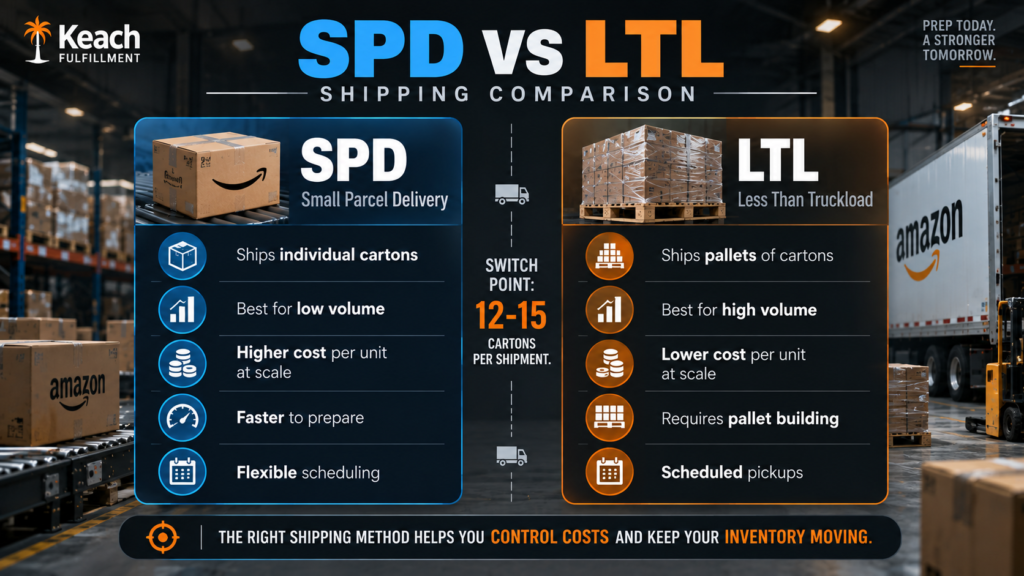
If you are consistently shipping more than 12 to 15 cartons at a time, LTL usually makes sense. The cost savings start to outweigh the extra preparation.
Weight Considerations
Heavy shipments cost more through SPD. LTL spreads that weight across a pallet. The heavier your products, the sooner LTL becomes economical.
Frequency
If you ship weekly, SPD might work. If you ship daily, LTL reduces complexity. Fewer shipments means fewer labels, fewer tracking numbers, and fewer headaches.
How an Amazon FBA Preparation Service Helps
A professional Amazon FBA preparation service handles the complexities of both shipping methods. They know when SPD makes sense and when LTL saves money. They also handle the prep work required for each.
For SPD shipments, they ensure each carton meets Amazon’s requirements. Proper labels, correct dimensions, adequate protection. For LTL shipments, they build pallets correctly. They know Amazon’s pallet specifications inside and out.
Here is a visual comparison of the two shipping methods:
Sourcing Model Affects Shipping Strategy
Your sourcing model plays a big role in this decision. Wholesale sellers often ship large volumes from the start. They transition to LTL quickly. Arbitrage sellers ship smaller, more frequent batches. They might stay on SPD longer.
This article covers FBA prep for wholesale vs arbitrage and the key differences in requirements. Understanding your model helps you plan logistics better.
Compliance Requirements for Pallets
Pallet shipping comes with strict requirements. Amazon specifies pallet dimensions, weight limits, and wrapping standards. Getting these wrong means rejected shipments.
Pallets must be 40 by 48 inches. They cannot exceed certain height and weight limits. The stretch wrap must be secure but not excessive. Labels must be placed on all four sides. An experienced Amazon FBA preparation service knows these rules and follows them precisely.
Transparency Codes and Palletized Shipments
If your products require Transparency codes, palletized shipping adds complexity. Each unit still needs its unique code. The prep center must apply codes before palletizing. Verification happens at the unit level, not the pallet level.
Check out how FBA prep centers handle Amazon transparency barcodes and serialization. Accuracy matters more when you are shipping large volumes.
Inbound Placement Fees and Shipping Method
Amazon’s inbound placement fees add another layer to the decision. Shipping method affects where your inventory lands. It also affects how many locations receive your shipment.
Our blog explains how FBA prep centers help reduce Amazon inbound placement fees through strategic routing. The right prep partner optimizes both shipping method and destination to minimize costs.
Common Mistakes to Avoid
Many sellers switch to LTL too early or too late. Switching too early means paying for pallet building without enough volume to justify it. Switching too late means wasting money on SPD fees that could have been avoided.
Another mistake is building pallets incorrectly. Unstable pallets collapse during transit. Weak wrapping causes cartons to shift. Poor labeling creates confusion at Amazon. Professional prep eliminates these risks.
Why Professional Prep Matters for Both Methods
Whether you ship cartons or pallets, preparation matters. Amazon rejects shipments that do not meet requirements. Rejections cost time and money. They also hurt your account health. A professional Amazon FBA preparation service ensures compliance. They verify labels, check dimensions, and build pallets correctly. This reliability protects your business as it grows.
Conclusion
Switching from SPD to LTL is a milestone. It means your business is growing. But the transition requires planning. The right Amazon FBA preparation service makes the shift smooth. Keach Fulfillment handles both methods with equal care. We help you decide when to switch and manage the details when you do. Smart logistics is not about choosing one method over another. It is about knowing when each one serves your business best.
Stop guessing whether SPD or LTL is right for your business.
Partner with a prep team that helps you save money at every step.