
Amazon’s fee structure keeps evolving. Just when sellers think they understand the costs, a new charge appears. Inbound placement fees are the latest headache. You ship inventory to Amazon, and they charge you based on where it lands. Some shipments go to one warehouse. Others get split across multiple locations. The difference in cost is significant.
Smart sellers are fighting back. They are using Amazon prep centers to strategically route inventory. Instead of accepting whatever placement Amazon assigns, they take control of the process. This approach saves money and reduces complexity. Understanding how it works gives you an edge over competitors who just pay the fees without question.
What Are Amazon Inbound Placement Fees
Amazon used to distribute your inventory across their network for free. You shipped to one location, and they handled the rest. Those days are gone. Now Amazon charges for this service. The fee varies based on where your inventory goes and how many locations receive it.
A shipment to a single warehouse costs less. A shipment split across multiple regions costs more. Amazon decides the placement. You pay the price. This feels frustrating, but there are ways to work within the system.
How Prep Centers Change the Game
An Amazon prep center acts as a middleman. You ship bulk inventory to the prep center. They handle labeling, polybagging, and inspection. Then they forward the inventory to Amazon using the most cost-effective routing strategy.
This changes everything. Instead of shipping directly from your supplier to Amazon’s assigned locations, you control the flow. The prep center can consolidate shipments and choose optimal timing. This reduces the number of split shipments and minimizes inbound placement fees.
Sellers everywhere are looking for smarter ways to ship.
Discover how Keach Fulfillment can help you keep more of your revenue.Partial Shipment vs Minimal Shipment Splits: FBA Prep Strategy
Amazon gives sellers two options for inbound placement. You can choose minimal shipment splits or partial shipment splits. Each has different costs and benefits.
Minimal shipment splits send your entire shipment to one location. The fee is higher per unit, but logistics are simpler. Partial shipment splits allow Amazon to distribute your inventory across multiple locations. The fee is lower, but you deal with more complexity.
Partial shipment vs minimal shipment splits: FBA prep strategy depends on your volume and product type. A prep center helps you analyze the numbers. They determine which option makes financial sense for each shipment.
How Prep Centers Reduce Amazon Inventory Placement Costs
The math is simple. Shipping to one location costs less than shipping to five. A prep center consolidates your inventory and ships strategically. They might hold inventory until they have enough volume for a full truckload to a single warehouse.
How prep centers reduce Amazon inventory placement costs comes down to logistics expertise. They understand carrier rates, warehouse locations, and Amazon’s fee structure. They use this knowledge to route shipments efficiently.
Here is a visual breakdown of cost-saving strategies:
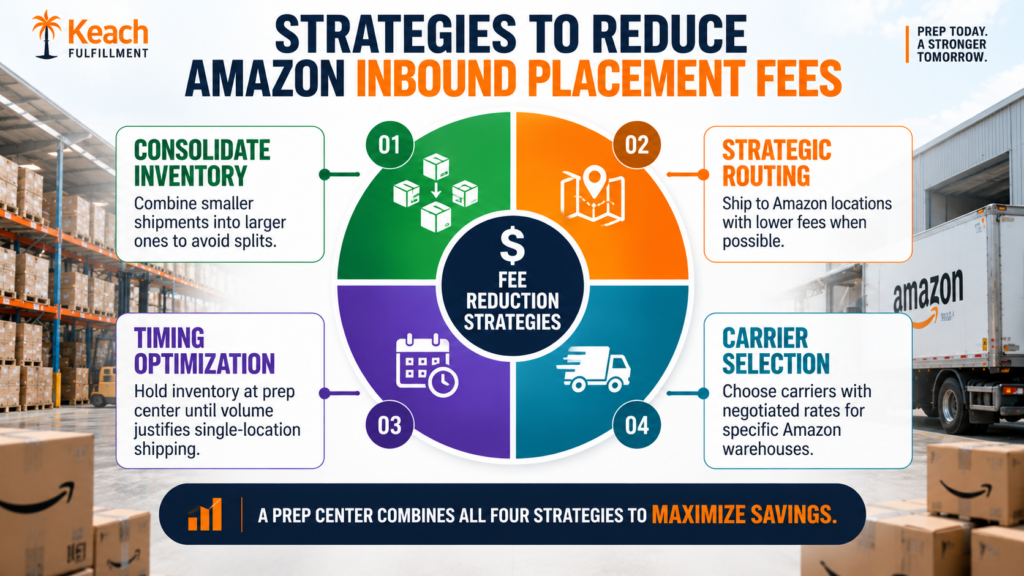
Strategic Multi-Location Prep to Bypass Amazon Inbound Surcharges
Location matters more than most sellers realize. A prep center on the East Coast might be perfect for shipments to East Coast Amazon warehouses. But if your inventory needs to reach the West Coast, shipping from the East is expensive.
Strategic multi-location prep to bypass Amazon inbound surcharges involves using multiple prep centers. You store inventory closer to Amazon’s major hubs. When it is time to ship, you route from the nearest location. This reduces carrier costs and sometimes avoids Amazon’s inbound fees entirely.
FBA Inbound Placement Service Fees (2024-2026 Amazon Fee Changes)
Amazon updates its fee structure regularly. FBA inbound placement service fees (2024-2026 Amazon fee changes) have been significant. Sellers who ignored these changes saw their margins shrink. Sellers who adapted found ways to offset the costs.
A prep center stays current on Amazon’s fee updates. They adjust strategies accordingly. This proactive approach protects your bottom line. You do not need to track every policy change. You just need a partner who does.
Understanding the Cost Equation
Prep services cost money. That is true. But the savings often outweigh the costs. You pay for prep labor, but you save on inbound fees, shipping, and rejected shipments. The math works in your favor when you use the right partner.
This blog breaks down FBA prep service fees so you know exactly what to expect. Transparency matters when calculating your true costs.
Wholesale vs Arbitrage: Different Prep Needs
Your sourcing model affects your prep strategy. Wholesale sellers deal with large volumes and consistent SKUs. Arbitrage sellers handle varied products and smaller batches. Both benefit from prep centers, but the approach differs.
This guide covers FBA prep for wholesale vs arbitrage and the key differences in requirements. Understanding your model helps you optimize routing and reduce fees.
Transparency Codes and Serialization
If you sell products enrolled in Amazon’s Transparency program, prep gets more complex. Each unit needs a unique code. Getting this wrong means rejected shipments and wasted money.
This blog explains how FBA prep centers handle Amazon transparency barcodes and serialization with precision. A prep center that understands serialization protects your account health.
The Hidden Costs of Getting It Wrong
Many sellers underestimate the cost of prep errors. A rejected shipment means return shipping fees. It means lost sales while inventory is in limbo. It might even mean account health warnings.
Professional prep eliminates these risks. They catch issues before inventory leaves their facility. They verify labels, codes, and packaging. This attention to detail saves money in the long run.
Why Sellers Are Making the Switch
The trend is clear. More sellers are using prep centers than ever before. They see the value of professional handling. They appreciate the strategic routing. They enjoy the peace of mind that comes with knowing their inventory is compliant.
The best prep centers become true partners. They understand your business goals. They suggest improvements. They help you scale. This is not just outsourcing. It is building a competitive advantage.
Conclusion
Optimizing Amazon inbound placement service fees with prep centers is not just about saving money. It is about running a smarter business. You gain control over inventory flow. You reduce complexity. You protect your margins. Keach Fulfillment understands the challenges sellers face. Our team handles the details so you can focus on growth. Do not let Amazon’s fee structure dictate your profitability. Take control with professional prep services that work for you.
Inbound placement fees are here to stay. But you do not have to accept them quietly.
Partner with a prep center that fights for your margins.