Pop-up events and experiences are among the most interesting things an emerging online company can do. They get your product seen face-to-face by potential customers, which cannot be accomplished even on your website. They get you coverage, help develop your community, and usually give rise to an increase in orders that persists even after the event ends.
However, they give you the logistics challenge that most companies fail to anticipate before facing it. Imagine how things happen. There needs to be inventory delivered to a specific location at a specific moment. There have to be orders processed during a period that does not coincide with your regular order processing cycle. You need returns handled differently because half the buyers are standing right in front of you. And you need everything reconciled afterward so the books make sense.
That’s not a normal fulfillment process. It’s a different beast entirely, and a fulfillment center that understands events treats them as a distinct project rather than a variation on regular shipping.
Why Standard Fulfillment Doesn’t Fit Events
Standard fulfillment runs on a predictable rhythm. Orders come in through a sales channel, get queued, picked, packed, and shipped. Inventory sits in one place, and the whole system is optimized for that pattern.
Events break every part of that rhythm. Inventory has to move to a temporary location, sometimes hundreds of miles away. Orders get placed in person, over the phone, or through a mobile POS system that isn’t connected to anything. Shipping happens on a timeline that doesn’t match normal processing. And returns often happen on the spot, which means inventory counts change instantly in ways the warehouse doesn’t see until much later.
How a fulfillment center adapts to these conditions is where event fulfillment services for ecommerce brands start making sense. The work isn’t harder in a technical sense. It’s just different, and the difference has to be planned for rather than improvised.
How Fulfillment Centers Support Temporary Retail
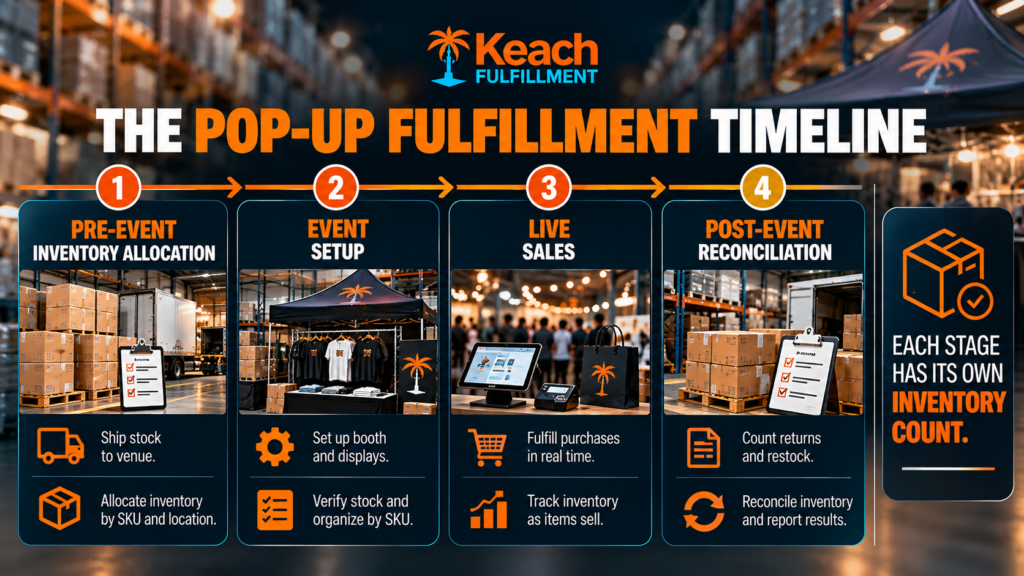
Logistics in organizing a pop-up shop begin well in advance, weeks before the opening. The inventory should be allocated from the warehouse to the event space, and hence there will be a separate SKU count and a separate receiving schedule. The warehouse should be aware of what to expect in terms of inventory to be sent, when, and what to do with unsold stock.
In the pop-up event, orders placed via the mobile phones have to be synchronized with the stock available in the warehouse in order to prevent overselling and complaints from customers. In case the customer purchases an item in the pop-up event and places an order online the following day, it becomes necessary to know how many units are in the inventory.
Pop-up shops involve reverse logistics, whereby whatever is not sold must be sent back to the warehouse where the stock is checked and recorded. In addition, unsold items are restocked again. This process should be done accurately since there is rarely agreement between the number of units that were unsold and the number received.
Keach Fulfillment handles event inventory from allocation to reconciliation.
Stock where it needs to be, counted when it comes back.Setting Up Event Fulfillment Without Losing Inventory
The primary concern when dealing with events is knowing exactly where the inventory stands. Each and every time units of the inventory are transferred out, sold, returned, lost, damaged, or even used as a sample, a transaction must be created for it. Otherwise, the discrepancy between the number of units that came out and the number of units received back is impossible to determine.
The solution here is treating the event itself as another location in the warehouse. Whenever a unit is sent to the event from the warehouse, it is recorded as a transfer and not a sale. All sales made at the event are processed at that particular location. And finally, whatever remains at the event will become the basis for how much is being received back in the warehouse.
As you can see, it is rather simple and works perfectly as long as the setup was made in such a way from the very beginning. Most of the brands that don’t do it this way try to process all transactions manually, resulting in numerous errors.
Pop-Up Fulfillment: From Stock to Sale
Handling Trade Shows and Larger Events
Trade shows and conferences add another layer of complexity because the product usually isn’t being sold directly. It’s being displayed, sampled, or used for lead generation. That changes what fulfillment needs to handle.
Fulfillment of events includes setting up display units, assembling sample kits, and delivering goods to an event venue that has its own guidelines for deliveries and times for delivery. Trade show venues have very specific delivery schedules; failure to adhere to the schedule will result in a display-less booth when the event opens.
Order fulfillment of temporary events manages this situation by considering the trade show a project that has a schedule and timelines. Inventories are packed in advance, labeled for the venue, and delivered following a schedule that takes into consideration the guidelines of the venue. Sample kits are put together in advance so as not to require any construction once at the venue. And after the event is over, returned items are handled as in the case of a pop-up.
When Events End: Reconciliation and Recovery
The closing hours of an event are the most important part of the fulfillment process, even though they feel like an afterthought. Everything that’s left has to be accounted for, packed, and shipped back. Sales need to be reconciled. Damaged goods need to be documented. And the inventory count that goes back to the warehouse has to match the actual physical units.
This is where most brands discover the value of working with a fulfillment partner who’s done events before. The reconciliation process isn’t complicated, but it requires discipline. Every unit has to be tracked from the moment it leaves the warehouse until the moment it returns. Sloppy accounting at the event stage creates problems that take weeks to untangle.
Once the event is over, the inventory goes back into regular circulation. Units get restocked. Damaged items get processed according to whatever return or disposal policy applies. And the whole event gets closed out in the system so the numbers reflect reality rather than the estimate.
Managing Returns and Customer Service During Events
Events create a strange mix of customers. Some are buying on the spot and taking products home. Others are ordering for delivery. Some want to return something they bought before the event. And a few will reach out weeks later with questions about an order they placed at the event itself.
All of these, without making a mistake in anything, demand coordination between the event management team and the fulfillment partner. Returns should be logged against the order, which can be done even when the order was made in person. Customer service inquiries should get routed correctly, and the follow-up communication, which should be provided post-event, should be consistent with the experience of the customer.
The technology behind this operation is the same which takes care of the regular fulfillment process. The only thing that differentiates this from the regular process is the connection to the temporary location besides the main warehouse. It is this that gives the feeling of a seamless experience for the customer despite the complexity of operations involved.
Where Events Connect to Other Fulfillment Challenges
A few connections are worth acknowledging because they all draw on the same infrastructure.
Understanding how crowdfunding fulfillment works after a campaign ends clarifies how orders get bundled, tracked, and shipped against a hard deadline, which is exactly what happens at a pop-up when the event closes, and everything has to move at once.
Learning what oversized product fulfillment is helps brands plan for booths that display furniture, equipment, or anything else that requires special handling from warehouse to venue.
Knowing how fulfillment centers handle product recalls matters when the same inventory that just came back from a pop-up needs to be pulled from sale, and the process for tracking units gets put to a very different kind of test.
What white-glove fulfillment is helps brands plan for events where the customer experience includes setup, installation, or in-home placement rather than a simple drop-off. The same care that goes into an event’s presentation should carry through to how the products arrive at the customer’s door.
That’s how e-commerce brands can protect shipments; shipping insurance becomes relevant here. Coverage that’s optional for standard orders becomes essential when the shipment is tied to a specific date and a specific event.
Conclusion: Events Are Projects, Not Exceptions
There is no need for pop-ups and live events to be a headache for fulfillment services. All they require is that they be planned like any other project with their own stock of items, a schedule, and the process of reconciliation.
Keach Fulfillment helps brands organize pop-up shops, trade shows, and live events using our fulfillment center facilities to manage inventory, sales, and the entire process of reconciliation. No matter if it is a weekend pop-up shop or a multi-city tour, the objective will not change.
Keach Fulfillment handles the logistics from allocation to reconciliation.
Get in touch now!