The campaign hits its goal. Backers are celebrating in the comments. Your inbox fills up with congratulations. And then, about forty-eight hours later, the realization hits. You promised physical rewards to hundreds or thousands of people, and now you actually have to deliver them.
Crowdfunding fulfillment is where most projects either earn their reputation or lose it. The campaign itself gets all the attention, but fulfillment is what determines whether backers ever trust you again, and whether the reviews they write end up helping or hurting whatever you launch next. Understanding how it works before the campaign ends is the difference between a smooth delivery and a public relations disaster.
Why Crowdfunding Fulfillment Is Different From Regular E-Commerce
Standard e-commerce assumes inventory exists, orders come in one at a time, and shipping happens the day after purchase. Crowdfunding inverts all of that. Orders arrive in a rush the day the campaign closes. Inventory usually doesn’t exist yet. Shipping dates are estimates made months in advance, and product specs sometimes change between the campaign and production.
The scale is also different. A single campaign can generate thousands of orders across dozens of countries, each with its own shipping rules, customs requirements, and delivery expectations. Most creators haven’t handled anything remotely like that before, which is why the fulfillment phase trips up so many projects that otherwise ran flawlessly.
And then there’s the reward structure. Crowdfunding campaigns often have multiple backer tiers, each with different reward combinations. A backer who pledged for a single unit and one who pledged for a bundle with a T-shirt and a sticker pack need completely different fulfillment. Multiply that across a dozen tiers, and you get a shipping puzzle that a basic spreadsheet can’t solve. That’s part of why experienced creators bring in fulfilment services before the campaign ends rather than after.
From Campaign to Customer: The Crowdfunding Fulfillment Journey
What Happens Between Campaign Close and First Shipment
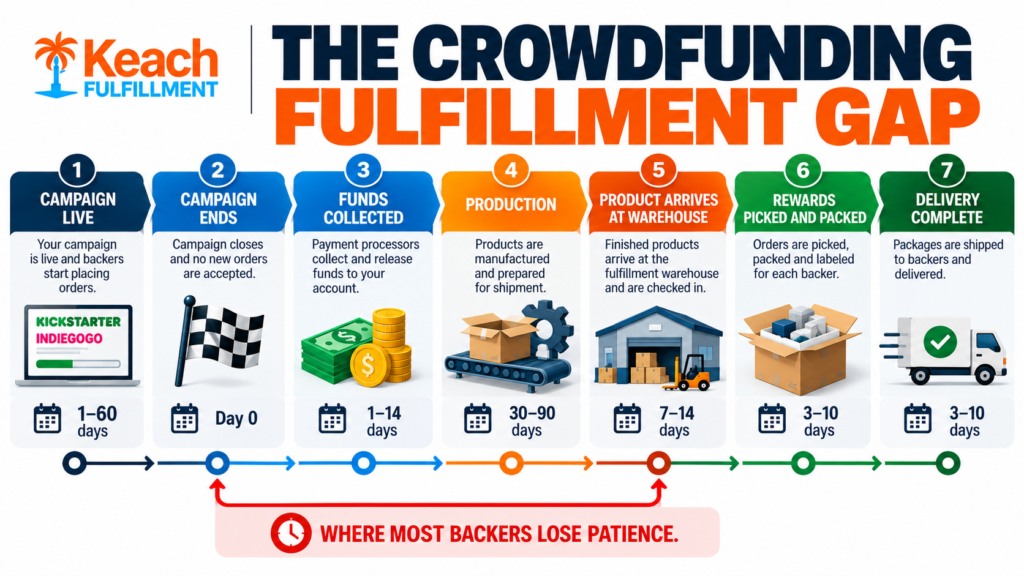
The gap between a funded campaign and the first package leaving the warehouse is where most crowdfunding projects run into trouble. Here’s what actually happens during that stretch.
Funds get collected from the platform, which usually takes a week or two depending on the payment processor. Production begins. Manufacturing timelines slip, because they always do. Samples get approved, revised, and re-approved. A shipment date gets pushed once, then twice. Meanwhile, backers are checking the updates page and refreshing their email, wondering when anything is going to arrive.
When the product finally lands in a warehouse, the work shifts from production to distribution. Every backer’s pledge has to be matched to a physical shipment. Reward tiers get translated into picking instructions. Addresses get validated, and a surprising number turn out to be wrong. International shipments need customs paperwork. And every single package has to be tracked and accounted for so backers can see where their reward actually is.
This is where crowdfunding order fulfillment services make the biggest difference. The process isn’t complex in theory, but at scale, with thousands of backers spread across the world, small inefficiencies compound into weeks of delays and hundreds of support emails.
Keach Fulfillment handles crowdfunding backers at any scale.
From pick and pack to international delivery, we handle it all.Why Backer Communication Matters as Much as Shipping
Fulfillment isn’t just a logistics problem. It’s a communication problem. Crowdfunding backers are unusually patient compared to normal customers, but only if they’re kept informed. Silence during the fulfillment phase reads as a red flag, and that perception spreads fast on Reddit and in campaign comments.
The projects that come out of fulfillment with their reputation intact tend to share a few habits. They post updates with real numbers and real dates. They acknowledge delays before backers notice them. They use tracking information proactively rather than waiting for a backer to ask. And they treat the post-campaign period as part of the campaign itself, not as a separate project that backers aren’t part of.
This is where fulfillment services that understand crowdfunding can help beyond the logistics. A fulfilment services team that’s handled crowdfunding projects before knows what backer communication looks like at each stage, which means fewer surprises when the inevitable delays show up.
How to Ship Rewards Without Losing Track of Anyone
The actual mechanics of how to ship crowdfunding rewards to backers come down to a few pieces working together properly.
The first is data. Every backer’s pledge has to be exported from the platform, mapped to a specific reward combination, and merged with a shipping address that’s been validated before anything ships.
The second is staging. Rewards get picked and packed according to the tier each backer selected, which means the warehouse needs to know the difference between a base pledge and a deluxe bundle without needing to look anything up manually. Kit-based fulfillment is a specialty on its own, and not every warehouse handles it well.
The third is shipping. Domestic backers can ship through the same carriers as any e-commerce order. International backers need customs forms, duty calculations, and often a shipping method that won’t cost more than the reward itself. That’s where Kickstarter product fulfillment services typically earn their keep, since international shipping is where most crowdfunding projects lose the most time and money.
Choosing a Fulfillment Partner for Crowdfunding
The right partner makes the process feel manageable. The wrong one turns a funded campaign into a year of frustration. A few things worth checking before signing with anyone. Whether they’ve handled crowdfunding projects specifically, since the workflow is different from regular e-commerce. Whether they can handle kitting and multi-item rewards without charging per-piece rates that balloon the cost. How they handle international shipping and customs. And whether they can integrate with the crowdfunding platform’s backer data directly, because manual entry at scale introduces errors that surface weeks later.
Working with fulfilment services that have done this before usually means the difference between a campaign that lands on backers’ doorsteps on schedule and one that becomes a case study in what not to do.
Conclusion: The Last Mile of a Successful Campaign
A funded campaign is only half the success. The other half is getting rewards into backers’ hands without turning the process into a months-long ordeal. That’s where fulfillment stops being a logistics problem and starts being part of the product experience itself.
Keach Fulfillment works with creators to handle backer rewards at any scale, from single-tier campaigns to complex multi-item bundles shipping internationally. Whether you’re planning fulfillment before the campaign launches or figuring out what to do after it ends, the goal stays the same. Every backer gets what they pledged for, on a timeline that doesn’t damage the reputation you just spent months building.
Keach Fulfillment handles crowdfunding at any scale.
Give us a call.