
The majority of e-commerce deliveries are straightforward, a parcel is shipped, a delivery person leaves it at the buyer’s doorstep, and then the buyer gets it there. This process works great for T-shirts, phone cases, and any other product that can survive a delivery by being thrown around inside a delivery van.
However, not all items can be delivered like that. A bespoke dining table, an artwork, and a medical instrument that needs installation before use fall into another category. Leaving a package at someone’s doorstep is no delivery in such situations but a potential source of issues. This is when a white glove service becomes necessary, and knowledge about what it really means will help sellers to understand if they need it.
What White Glove Fulfillment Means
The phrase gets thrown around loosely, and some providers use it to mean almost anything. In practice, white glove fulfillment refers to a delivery service that goes well beyond standard shipping. It usually includes careful handling, scheduled delivery windows, in-home placement, assembly, setup, and sometimes removal of packaging materials afterward.
The defining trait is that the customer doesn’t have to do anything once the delivery arrives. The item shows up, gets placed where it belongs, gets assembled or installed if needed, and the delivery team handles cleanup. From the customer’s perspective, the product simply appears, ready to use.
That’s a very different service than parcel delivery, and it requires a very different operational setup. Standard shipping runs on volume and speed. White glove runs on care, coordination, and trained personnel who know how to handle products that can’t be replaced easily. It’s one of the reasons companies offering fulfillment services usually treat white glove as a separate offering with its own pricing and process.
Keach Fulfillment handles white glove delivery from warehouse to placement.
Careful handling, real setup, no damaged arrivals.Why Some Products Can’t Use Standard Shipping
The reasons a product needs white glove delivery tend to fall into a few categories. Some items are simply too big or too fragile to survive a standard courier network. Others require assembly that the customer can’t reasonably do themselves. And some of them must be installed by a competent person due to their nature or requirements of the warranty.
The first one is furniture. Although a couch or a table may technically be transported on the back of a truck, this process does not include delivering it to the customer properly. It needs to be assembled and put in place for the customer’s satisfaction; otherwise, this product turns into an extra burden rather than a purchase.
Art objects and valuable collectibles are the second type of products. This type of products cannot be replaced and does not allow regular shipping, as they need special care and appropriate insurance. One scratch while transporting can spoil their value which can be higher than the cost of delivery itself.
Finally, medical equipment and specialized instruments make up the third type. This type requires a trained specialist to install the products, either due to complexity of installation process or the necessity to provide warranty. Premium product delivery services appear just because of the needs of these types of products.
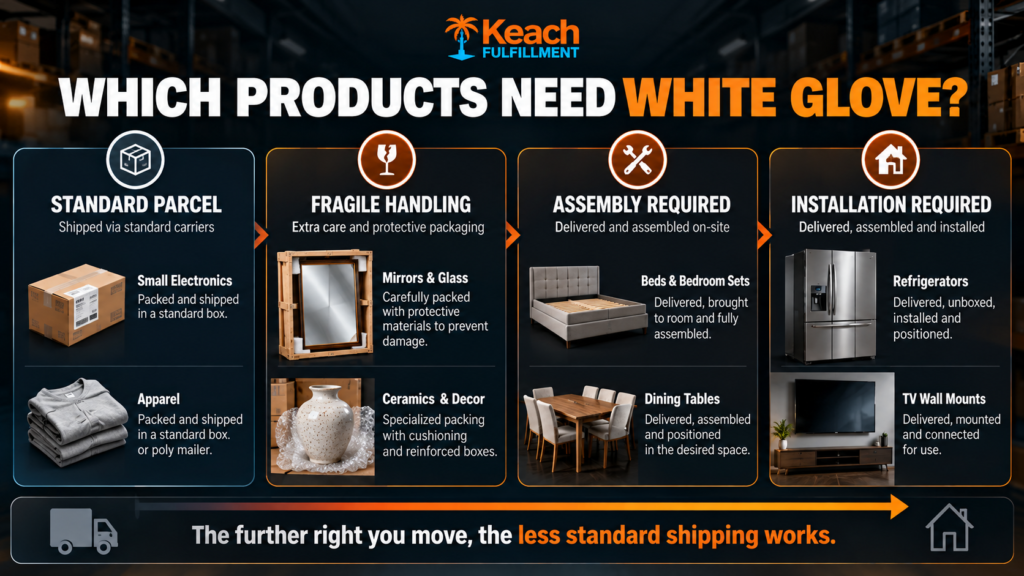
4 Levels of Product Fulfillment
The White Glove Delivery Process From Start to Finish
White glove fulfillment looks simple from the customer side. Behind the scenes, it involves several coordinated steps that all have to go right.
It starts when the order comes in. The warehouse picks the item, inspects it, and prepares it for transport using packaging designed for that specific product. This is not a one-size-fits-all approach. A marble tabletop needs different protection than an upholstered chair, and both need different protection than a piece of framed art.
Then comes scheduling. Unlike standard shipping, white glove delivery usually involves a scheduled window that the customer has to confirm. The delivery team coordinates directly with the recipient, which requires more communication but produces a much better experience.
On delivery day, the team arrives, brings the item inside, unpacks it, places it where the customer wants it, and assembles or installs it as needed. Packaging materials get removed, and the customer signs off on the delivery. Any issues get noted immediately rather than reported weeks later.
That whole process requires trained personnel, specialized equipment, and a level of coordination that standard fulfillment centers aren’t set up for. This is part of why white glove delivery fulfillment services tend to be more expensive per order than standard fulfillment. The cost reflects real labor and real care.
Which Products Genuinely Benefit From White Glove
There are high-value items that don’t necessarily need white glove delivery and items that may look simple but require more than standard delivery. In this regard, several questions should be asked:
Is the item assembled or installed by experts? If yes, then white glove delivery is required. Should it be located at a certain place within the building? Curbside delivery is not enough. Is the item fragile and hard to replace? In this case, more attention and care are needed.
Products which might benefit from such delivery include furniture, mattresses, big appliances and electronics, fitness equipment, medical devices, works of art, as well as products made on customers’ order. Fulfillment of high-end items sold online includes white glove service as high-level expectations of customers coincide with the purchase itself.
In contrast, items which are small, durable and easy to install are likely to do without white glove service. For example, a phone case, a book, or a kitchen tool don’t need to be delivered in a special way. It’s only reasonable to use white glove when it is really necessary.
How White Glove Fulfillment Fits Into a Broader Operation
White glove delivery doesn’t exist in isolation. It’s one piece of a fulfillment operation that might also include standard parcel shipping, oversized item handling, and returns processing. Companies that offer white glove well usually offer the full range, because their customers sell products that fall into multiple categories.
For example, a furniture brand might use standard shipping for accessories and white glove for the big pieces. A medical device company might use white glove for installation and standard shipping for replacement parts. The fulfillment partner has to be able to handle both without treating one as a special case.
Brands that also run crowdfunding campaigns often face a related challenge, since understanding how crowdfunding fulfillment works after a campaign ends clarifies how backer rewards get shipped once production wraps. Those rewards sometimes need white glove treatment too, especially when they’re high-value or require assembly. The same infrastructure handles both.
When White Glove Isn’t the Right Answer
White glove isn’t always the right call, even when the product seems like a fit. Sometimes the cost outweighs the benefit. Sometimes the customer doesn’t actually need in-home placement. Sometimes a simpler service, like threshold delivery or room-of-choice delivery, gets the job done for less.
The key is matching the service level to what the customer actually expects. A customer buying a low-end piece of furniture might be fine with curbside delivery, while one buying a custom dining table expects the whole experience. Getting the match wrong in either direction creates problems.
This is where experienced fulfillment partners earn their keep. They’ve handled enough products to know which ones need white glove, which ones need something in between, and which ones can go through standard channels without any complaints.
Conclusion: Delivery as Part of the Product
For certain products, delivery isn’t just how the item gets to the customer. It’s part of the product experience itself. A beautiful piece of furniture that arrives damaged or unassembled on the curb isn’t the same product the customer thought they were buying.
Keach Fulfillment provides services to brands that require more from their deliveries than normal shipment can provide. Right from the packaging process through to the setting up and clean-up process, everything involved in these fulfillment services is geared towards the understanding that delivery influences customer experience. Regardless of whether the shipment involves furniture, art, medical equipment or any other sensitive item, the objective remains the same. Every delivery is guaranteed to arrive in its original condition.
Keach Fulfillment handles white glove delivery end to end.
Careful, scheduled, and set up properly on arrival.