
A product recall has the power to ruin a brand instantly. It is an extremely complicated operation that makes every operations manager shudder. What really takes place when the danger of the goods is discovered? It is more than just publishing a press release. A product recall is a race against time that needs accuracy, speed, and logistics of a war campaign.
In the case of a product recall, a fulfillment center becomes a place where the process of contamination has to be stopped at all costs. It means that no more contaminated products should reach customers while dealing with the flow of the returned goods.
Knowing the process of product recall in fulfillment centers is the key to surviving the recall operation. People get the headlines. People get the apology of the CEO. But people don’t see the thousands of man-hours that go into digging through inventory boxes and separating the goods by barcodes.
The Immediate Operational Freeze
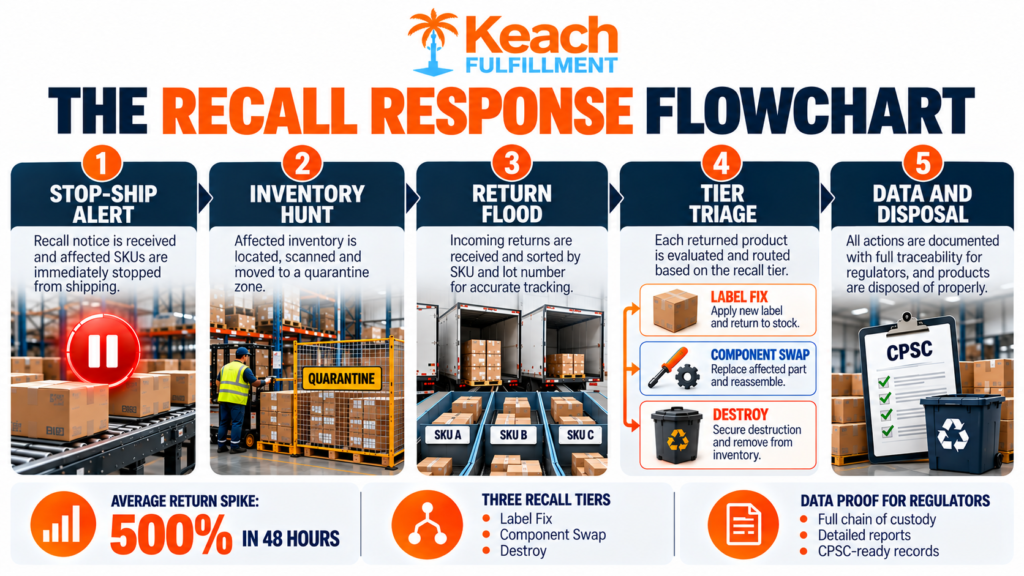
The moment a recall is announced, everything stops. Well, almost everything. The fulfillment center initiates a “stop ship” order immediately. Software systems are updated instantly.
If a customer tries to buy the recalled item, the website should block them. But what about the inventory already sitting on the shelves? Warehouse staff receive a list of affected SKUs and lot numbers. They must locate every single unit. Speed is the priority here. If a batch of defective space heaters is recalled, the center cannot wait for a scheduled inventory cycle. Staff are pulled from their normal picking routes. They fan out across the warehouse to hunt down the specific pallets.
Once found, these items are flagged. They are moved to a designated “quarantine zone.” This area is usually caged or taped off. No one touches these items without authorization. It is evidence. It is liability. It is hazardous waste waiting to be processed. The mechanics of how fulfillment centers recall fulfillment start with this freeze. This process is known as inventory quarantine during product recalls. For e-commerce product recall fulfillment, speed here prevents bad reviews and injuries.
Our team can step in fast and protect your customers.
Stop guessing. Get a plan with Keach Fulfillment.The Reverse Logistics Battle
Handling the inventory you already have is the easy part. Handling the inventory that is currently in the mail or in a customer’s home is a different beast entirely. This is where reverse logistics kicks in. The fulfillment center becomes a return-processing machine. Packages start arriving by the truckload. Each package contains a potentially dangerous item. The staff cannot just toss these boxes into the normal returns pile. They need to be segregated.
Imagine a fulfillment center that handles thousands of packages a day. Now, add a recall for a baby stroller with a faulty brake. The volume of returns can spike by 500% in 48 hours. The receiving dock becomes a bottleneck. Staff have to scan each return specifically against the recall list. They must verify that the customer returned the correct model and the correct batch. This is tedious work. It requires focus. Mistakes here can be costly. If a recalled item gets mixed back into good inventory, it could be resold. That creates a legal nightmare.
Once confirmed, the items can be rendered useless. They may be required to be destroyed at the fulfillment center. On other occasions, they may be asked to remove some component, such as the battery, before disposing of it. In some cases, the brand may send their crew to repair the items directly at the fulfillment center. This is done by the brand through the fulfillment center, which provides space and manpower, but is not responsible for the process.
For product recall logistics for e-commerce brands, the return flow is the true test. You might wonder how crowdfunding fulfillment works after a campaign ends. It faces a similar sudden wave, but recalls add legal urgency. Understanding how fulfillment centers recall fulfillment means mastering this reverse flow.
The 5-Step Product Recall Response Process
Deep Dive: The Three Tiers of Recall Response
Not all recalls are created equal. The response depends heavily on the severity of the risk. The Consumer Product Safety Commission (CPSC) generally categorizes these, and fulfillment centers adapt their SOPs (Standard Operating Procedures) accordingly. The complexity of how fulfillment centers recall products scales with the danger.
The “Just a Label” Recall:
This is the most common and least severe. Perhaps a toy is missing a choking hazard warning. The product itself is fine. The packaging is the problem. In this case, the fulfillment center might not even recall the item. They might “rework” it. Staff open the boxes, apply a new sticker, seal the box, and put it back in inventory. It is a simple fix that saves the brand from destroying perfectly good merchandise. For e-commerce product recall fulfillment, this rework tier is a relief.
The “Component Failure” Recall:
This is the middle ground. A blender has a blade that might crack. A chair has a leg that might snap. The product is unsafe, but it is not going to explode. Here, the fulfillment center usually quarantines the goods. They wait for instructions.
Often, the brand will send replacement parts. The fulfillment center then acts as a repair shop. They open the box, swap the bad part for a good one, and repackage the item. This is labor-intensive. It ties up warehouse space and manpower. But it salvages the value of the product. Inventory quarantine during product recalls keeps suspect units away from good stock.
The “Immediate Danger” Recall:
This is the worst-case scenario. A lithium-ion battery is catching fire. A food product is contaminated with bacteria. There is no fixing this. The product must be destroyed. The fulfillment center’s job is containment. They must ensure these items do not touch the general waste stream until they are neutralized.
This often involves coordinating with hazardous waste disposal companies. The logistics are complex. The liability is enormous. Every unit must be accounted for. If one unit goes missing, it could end up on eBay and hurt someone. The fulfillment center acts as the gatekeeper, ensuring the dangerous goods are eliminated from the supply chain permanently.
Advanced Insights: Data and Disposal
The most overlooked aspect of a recall is the data. A fulfillment center is not just moving boxes. It is moving information. During a recall, the data flow is just as important as the physical flow. Every scanned return generates a data point. The center needs to report back to the brand. How many units are accounted for? How many are still in the wild? This data helps the brand decide when to close the recall. It also helps with regulatory compliance.
The CPSC wants to know that the recall was effective. The fulfillment center provides the proof. The data side of how fulfillment centers recall products is often ignored until audit day. Then there is the question of disposal. You cannot just throw a thousand recalled toasters in a dumpster. That is illegal in many jurisdictions. The fulfillment center must follow specific disposal guidelines. Sometimes this means recycling. Sometimes it means incineration. Sometimes it means returning the goods to the manufacturer for analysis. The center coordinates all of this. They handle the paperwork. They handle the trucking. They handle the sorting.
Product recall logistics for e-commerce brands also demands clear data trails. Reverse logistics for recalled products does not end at the dock. What is oversized product fulfillment and how does it work? Large items like furniture require special handling, and recalls on them can cost even more. This is where a specialized partner makes a difference. A generic 3PL might stumble here. They might not have the relationships with waste management companies. They might not have the insurance coverage for high-value recalls.
A specialized fulfillment partner, like Keach fulfilment, understands that a recall is not just a return. It is a crisis management event. They have the infrastructure to segregate inventory, the manpower to process mass returns, and the experience to handle the disposal correctly. The process is never fun. It is a race against time and liability. But when handled correctly by a competent fulfillment team, it is a controlled burn. It stops the damage and allows the brand to live another day. That is how fulfillment centers recall fulfillment without burning the brand to the ground.
One bad batch should not sink your business.
Let Keach Fulfillment build a recall plan before you need it.