
Each e-commerce brand has this order. This is the order that ships perfectly and never makes it there. The customer contacts you asking about their whereabouts, the delivery is shown to be successful, and now you have to make up your mind on what to do, whether to offer a refund or ship another product. Whichever option you choose, you bear the burden of cost in any case, and your relation with customers gets hurt in any case.
This is the time when most e-commerce sellers realize the importance of shipping insurance. It does not mean that you will be concerned with each and every package shipped, but it means that losing even a single high-value order due to a loss will hurt you a lot more than paying a little fee for shipping insurance on all of your orders.
What Shipping Insurance Covers
Shipping insurance serves as protection for the price of the shipment against the risk of loss, damage, or theft. Should anything go wrong, the claim is made by the buyer or the seller, and the payment is received based on the insured amount.
There are many types of shipping insurance offered by various providers, and there are different things covered by them. Normally, the coverage will include lost, damaged, or stolen packages. Some insurances will also have delay clauses past a certain period of time. Carriers have their own limited insurance available, and some third-party insurance that normally offers more coverage at lower rates.
The key is knowing the limitations of the policy. Poor packaging, wrong address, or any prohibited material shipped is not covered. If the package arrives broken due to bad packaging, it will be the seller’s problem, not the insurance’s. Reading the terms before making the claim saves you from having to find out that the loss was not even covered by the insurance.
Keach Fulfillment handles shipping protection as part of the fulfillment process.
Real coverage, real claims support, no surprises.Why High-Value Orders Need Extra Protection
Standard carrier coverage is usually capped at a low value, often less than what a single mid-range product costs. That default limit exists for a reason, and it’s not designed to cover the actual value of what most e-commerce brands are shipping.
This is where insurance for lost e-commerce packages becomes relevant. Brands that ship electronics, jewelry, custom furniture, or anything else with real value per unit need coverage that matches what they’re actually sending. Without it, a single lost shipment can wipe out the margin on twenty successful ones.
There’s also the customer side. A buyer who paid for a product and never received it doesn’t care whose fault it was. They want their money back, or the product resent. Without insurance, that cost comes straight out of the seller’s pocket, and it happens often enough that many brands build it into their pricing from the start.
Shipment Insurance: When Is It Worth It?
When Shipping Protection Is Worth the Cost
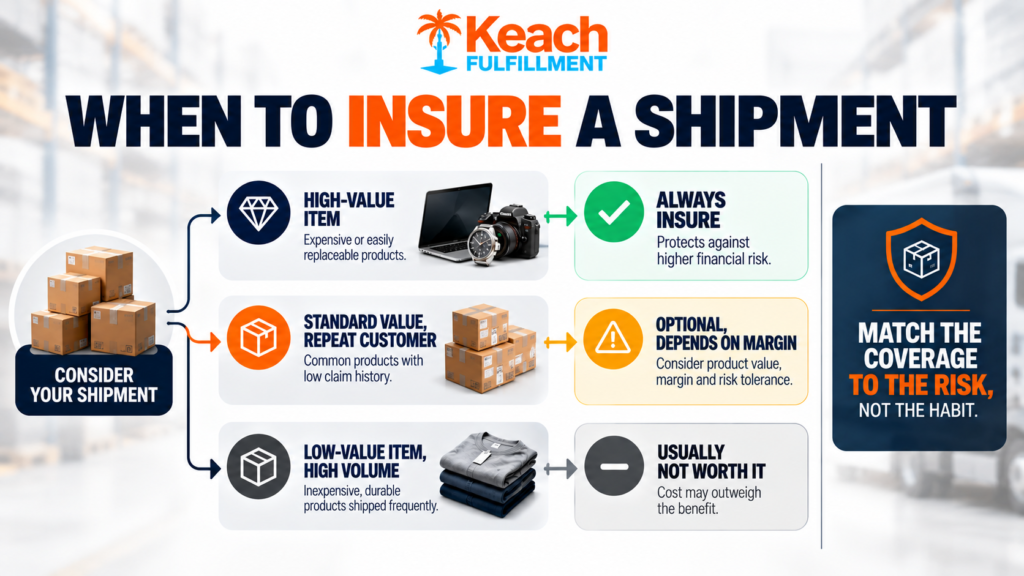
Shipping protection isn’t free, and adding it to every order changes the economics of a business. The question isn’t whether insurance is good in theory. It’s whether the cost per shipment is lower than the expected loss from uninsured incidents.
Where products being shipped by brands have a high value, the answer to this question is definitely “Yes.” The cost of losing a package far exceeds the total cost paid for all packages that have been shipped safely, not to mention that the peace of mind that comes along is well worth paying the additional percentage on each shipment.
Where brands are shipping products that are of lower value but shipped in large quantities, the need for insurance doesn’t add up. The cost involved in the insurance of such shipments is higher than the loss and is not worth the time in filing claims.
The middle ground is where most e-commerce brands actually live. Some orders need coverage, some don’t, and the decision should be made order by order rather than applied uniformly. This is why whether online stores insure shipments is a question without a single answer, and why the right approach depends entirely on what’s being shipped.
How Insurance Fits Into the Fulfillment Process
Insurance does not function effectively if it is added on as an afterthought. The ideal insurance system becomes an integrated element of the fulfillment process, such that any order requiring insurance gets insured in the process without the need for people to do anything.
It would then be the case that the warehouse management software identifies valuable orders and ensures that there is coverage during the labeling process. It will be the case that the claims are made by the company without the seller having to search for the necessary receipts and tracking numbers weeks later. Finally, it would be the case that the process of making the claims is done by the fulfillment company rather than having the seller spend hours on the phone with the insurance agency.
This is the kind of expertise that the fulfillment companies bring to the table. The carrier agreements come with insurance terms, while their processes make claims submission automatic and not exceptional.
Where Shipping Protection Connects to Broader Operations
Insurance protects against loss during transit, but a lot happens before a package ships and after it arrives. Brands that think about protection as a single piece of a larger operation tend to see better outcomes than ones that treat it as a checkbox.
For example, some products can’t survive standard shipping at all, which is where knowing what white glove fulfillment is and which products need it becomes relevant. White glove delivery includes careful handling and sometimes installation, which changes the insurance picture because the risk profile is different.
The same applies to oversized items, where what oversized product fulfillment is and how it works explains how large products get shipped and what kind of protection they need.
And then there are the situations where something goes wrong after delivery. How do fulfillment centers handle product recalls matters here because a recall turns into a reverse logistics project, and insurance doesn’t cover that. The brand needs a fulfillment partner who can manage the recall process, not just the initial shipment.
Crowdfunding campaigns add another layer, since backers expect rewards to arrive safely and often have no patience for delays or losses. Understanding how crowdfunding fulfillment works after a campaign ends helps creators plan protection into the process rather than scrambling after the fact.
Every one of these scenarios touches shipping protection in some way, and brands that plan holistically save themselves the trouble of patching holes after incidents happen.
Filing Claims Without Losing Your Mind
When filing a claim becomes necessary, it should be a simple process. Documentation is everything in this case. Keeping the history, photographs of the damage, original shipping receipt, and all correspondence with the customer is essential. Otherwise, claims will not be processed or approved.
The best fulfillment partners handle this on the brand’s behalf. They document the shipment at the point of dispatch, know exactly what proof the insurer requires, and file claims as part of their regular process. This is one of those areas where the difference between a good fulfillment partner and a mediocre one becomes very visible very quickly.
Claims also need to be filed within a window. Every insurer has a deadline, and missing it means the claim becomes worthless. That’s why having a partner who tracks these timelines automatically is worth more than most sellers initially expect.
Conclusion: Protection Matches the Risk
Shipping insurance is no magic pill that will solve all issues of lost shipping. Rather, it is an option that becomes practical when the value of the item that you are shipping is worth insuring against the potential risk. Shipping insurance allows brands who require this option to change the nature of uncertain losses to an anticipated cost, making it far easier to manage.
In the case of Keach Fulfillment, shipping insurance services are incorporated into the broader services that the company provides as a fulfillment company for its clients. No matter whether you are shipping standard parcels or organizing white-glove shipping, the objective remains the same. Each shipment arrives at the designated destination, or the brand does not pay for it.
Keach Fulfillment handles insurance and claims as part of the process.
Prioritize Your Shipping Protection.