
It is inevitable for any thriving e-commerce company to reach its ceiling at some point. Orders come faster than they can be processed, errors begin to add up, and delays in shipping happen. The company appears successful based on its numbers, but in reality, it’s all duct tape.
That wall isn’t a sign of failure. It’s a sign that the operation has outgrown the setup it was built on. And the specific problems that show up at this stage tend to repeat across brands of every size. Understanding how fulfillment centers fix operational bottlenecks starts with recognizing which bottlenecks you’re actually dealing with, because the fix for one doesn’t always solve the other.
The Bottlenecks Most Brands Run Into
Most fulfillment problems trace back to the same handful of causes. Volume outpaces capacity. Inventory records drift away from reality. Picking errors increase as order counts rise. Shipping costs creep up with no clear explanation. And during peak season, everything that was already strained finally snaps.
These aren’t separate issues. They’re symptoms of the same underlying problem, which is that manual processes don’t scale. A team that handles fifty orders a day beautifully will struggle at five hundred, and fall apart at five thousand. Not because the people are worse, but because the system behind them wasn’t built for that volume.
A dedicated fulfillment warehouse solves this by replacing manual workarounds with real infrastructure. The systems, the staffing, and the physical layout are all designed around processing individual orders at speed, which is a fundamentally different job than storing inventory in bulk.
Keach Fulfillment replaces the workarounds with real infrastructure.
Built for volume, accuracy, and on-time shipping.What a Storage Warehouse Can’t Fix
To begin with, it should be noted that it is important to differentiate between a storage warehouse and a fulfillment warehouse before discussing anything else. In order to understand what is the distinction between a standard warehouse and a fulfillment center, it is essential to understand why using the former will not help fix any issues.
A storage warehouse stores products and does not process orders on a large scale. Fulfillment systems such as order picking, packing systems, and carrier integration are not present in a storage warehouse, which means that the building cannot ship many items. Companies that attempt to perform all their operations in a storage warehouse end up hitting a brick wall, since the building was not designed for it. A fulfillment warehouse is designed in the reverse manner. All processes in it are designed to get orders out on time and in full measure.
Manual Fulfillment vs. Professional 3PL Operations
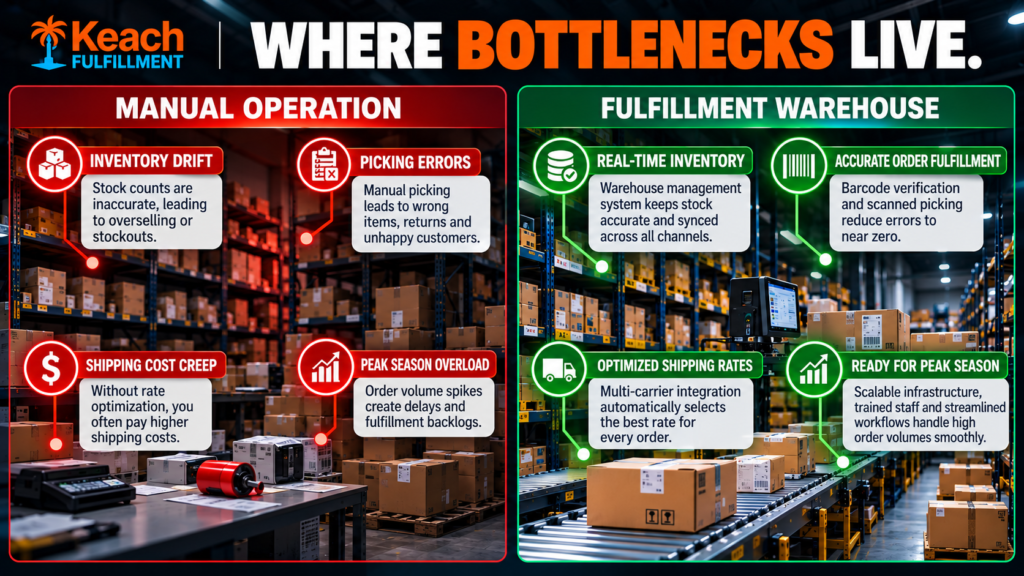
How Common Bottlenecks Get Resolved
The recurring challenges faced by growing e-commerce businesses are not arbitrary. They center around certain failure points, and there is a well-known resolution for each one of them.
The first challenge centers around inventory drift. When the data does not match the physical stock on hand, every order becomes a treasure hunt. In a fulfillment warehouse, every transaction includes barcode scanning throughout the entire process in order to ensure synchronization of the record with the actual stock, which is why it is rare to find instances of misinventory within a fulfillment warehouse. The problem is discovered through the barcode scan before it turns into a bigger problem.
The second recurring problem concerns mispicks. The mistake costs much more than the value of the order itself since it results in loss of the refund, re-shipment, and loss of the client. Dedicated fulfillment warehouses use their accuracy technology to check the picked product against the order prior to picking it off of the shelves, which is why they avoid shipping mispicks.
Shipping cost creep is the third, and it’s the quietest. Costs rise without anyone noticing because carrier selection happens by habit rather than by data. This is where acknowledging how a warehouse fulfillment center saves money with multi-carrier shipping becomes relevant, since rate shopping across carriers on every order pulls cost out of the process without slowing anything down.
Where Peak Season Breaks Everything
Bottlenecks only get worse during the holidays. There are twice as many orders as usual. There is not enough staffing. Systems that are already running slowly break down completely, and the customer experience breaks down just when it needs to be perfect.
Solving the problem of holiday order fulfillment backlogs and delays means having the capacity to scale quickly, something that a fulfillment warehouse is perfectly suited to handle. The staffing, the storage, and the shipping are already designed for volume. More orders do not stop the system. They simply make it busier.
This is just one of the many reasons why brands choose to go to fulfillment partners before the first busy season, not afterwards. If a season goes badly, the reviews have already been written, and the customers have left. It is better to prevent a breakdown than fix it.
Speed, Accuracy, and the Systems Behind Both
Same-day shipping only works if the entire process is built to hit a cutoff every day. Understanding how a warehouse fulfillment center processes same-day pick and pack shows how much of that speed comes from sequencing rather than effort. Orders queue instantly. Pickers get routed efficiently. Packages get scanned, packed, and staged before the carrier arrives. Every step is timed.
None of that works without the software underneath, which is why technology that powers a high-speed modern fulfillment warehouse is worth knowing alongside the physical operation. Warehouse management systems route orders. Scanners verify picks. Carrier integrations handle labels and service levels automatically. The speed comes from the system, not the hustle.
Why Location and Shipping Choices Matter Too
Bottlenecks aren’t just about internal capacity. Where inventory sits and how it gets shipped both affect how fast orders move and what they cost. That’s why fulfillment center location impacts your overall shipping costs as part of the bigger picture. Shorter zones mean faster delivery and lower cost, and both improve the operation without adding work.
And then there’s the customer side. A slow or unreliable fulfillment process shows up in cart abandonment, which is why order fulfillment services that reduce cart abandonment tend to focus on delivery speed and tracking accuracy. Both reduce friction at checkout and improve conversion as a direct result.
Conclusion: Infrastructure Beats Effort
Every bottleneck that slows a growing e-commerce brand traces back to the same root cause. A manual operation trying to do a job that requires infrastructure. More effort doesn’t fix it. Better systems do.
Keach Fulfillment operates a fulfillment warehouse where workarounds are made into actual processes, from barcode-verified picking and automated carrier selection to same-day processing. If you find yourself struggling with holiday order volumes, or are just tired of order volume slipping through the cracks, the end goal is always the same: an operation that grows with your business.
Keach Fulfillment runs the infrastructure your orders need.
Schedule a consultation now!