
Shipping invoices are strange documents. They look simple enough. A rate, a weight, a destination, maybe a fuel surcharge. But underneath that simplicity sits a pricing system most sellers never fully understand, and that lack of understanding is exactly where money gets quietly wasted every single month. The rate you pay isn’t fixed. It changes based on which carrier you use, which service level you pick, how far the package travels, and how much volume you’re pushing. Get any of those wrong, and you’re overpaying before the box even leaves the dock.
Multi-carrier shipping is the fix most sellers eventually stumble into, usually after watching their fulfillment costs creep upward for a year and finally deciding to do something about it. But the real savings don’t come from just having multiple carriers available. They come from using them intelligently, which is where a warehouse fulfillment center earns its keep.
Why Using One Carrier Quietly Costs You Money
The default habit for most small sellers is to pick one carrier and stick with it. Usually whoever they signed up with first, or whoever offered a decent discount when they started shipping. It works fine at low volume, so nobody questions it.
Here’s the problem with that. Carriers aren’t uniformly cheap across all routes and package types. One carrier might be the best option for a two-pound package heading to a nearby state. A different one wins on five-pound packages going cross-country. A third might dominate on residential deliveries in rural areas where the others charge a premium.
When you only use one carrier, you’re essentially accepting whatever rate they offer for every shipment, including the ones where a competitor would have been cheaper. Over hundreds of orders a month, that difference adds up to real money. Not a dramatic amount on any single package, but enough to matter over a year.
Keach Fulfillment runs multi-carrier selection on every single order.
Get in touch now!What Multi-Carrier Shipping Means
Multi-carrier shipping means having agreements with several carriers and choosing the best option for each order rather than defaulting to one for everything. It sounds obvious when it’s stated plainly, but the execution is where things get complicated.
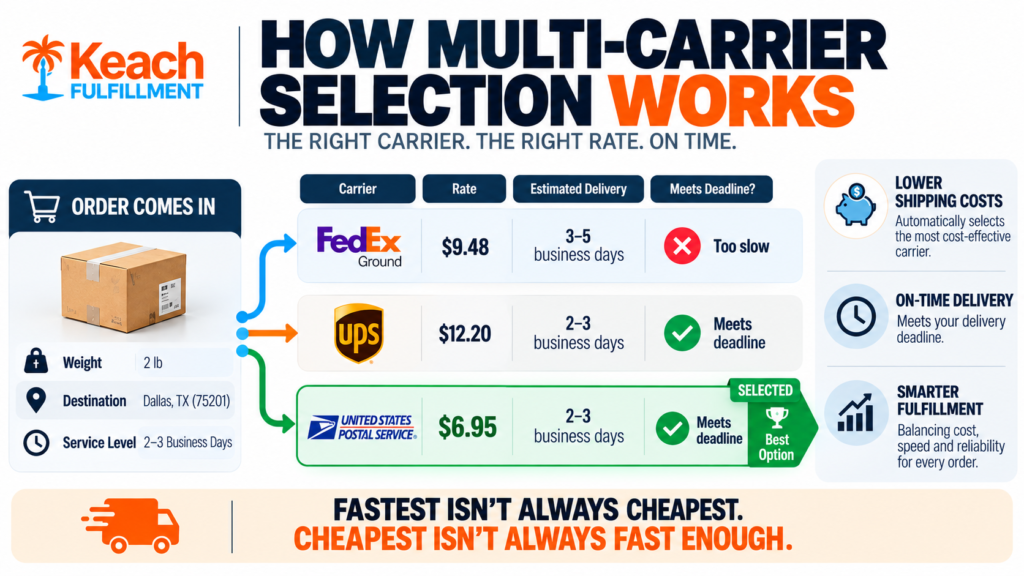
Automating shipping carrier selection in a fulfillment warehouse is what makes this practical. Every time an order comes in, the system evaluates the destination, the package weight and dimensions, the service level the customer paid for, and the delivery deadline. Then it picks the cheapest option that still meets the promise. No human makes that call. It happens automatically, in seconds, on every order.
Without automation, multi-carrier shipping isn’t really multi-carrier. It’s a warehouse worker picking whichever carrier feels right that day, which means inconsistent choices and money left on the table every time someone defaults to habit instead of data.
How 3PLs Choose the Right Carrier for Every Order
Where Regional Couriers Beat National Carriers
There’s a bias in shipping that favors the big names, and it makes sense on the surface. FedEx and UPS are everywhere. They’re reliable. They’re familiar. But they aren’t always the cheapest option, and using regional couriers vs. national carriers in fulfillment warehouse operations is one of the clearest ways to cut costs without sacrificing anything.
Regional couriers operate in specific parts of the country and can often deliver faster and cheaper within their territory because their network is smaller and more focused. A package going from Ohio to Michigan might cost noticeably less through a regional carrier than a national one, and it might even arrive sooner.
The catch is that you can’t manage a dozen regional relationships on your own. That’s where a fulfillment center’s existing carrier agreements come in. The warehouse already has the rates negotiated, the pickups scheduled, and the software integrated. A growing brand gets access to all of that without doing any of the setup work.
Rate Shopping Without Slowing Down
Multi-carrier rate shopping in e-commerce fulfillment centers sounds like it should slow things down. Checking four carriers instead of one takes longer, right? Not when it’s handled by software.
The rate shop happens instantly. Every order triggers the same comparison, and the result gets printed on the label before anyone lifts a finger. That speed matters because slower processes create bottlenecks, and bottlenecks kill same-day shipping. The systems that make rate shopping possible also make it invisible to the person packing the box.
This is where the technology behind a fast operation becomes relevant, and it’s worth understanding what technology powers a high-speed modern fulfillment warehouse to see how much of the cost savings comes from software rather than human decisions. Rate shopping, label generation, carrier selection, and even service-level upgrades all happen automatically in the background.
Why This Isn’t a Feature of Storage Warehouses
Not every facility can offer this kind of shipping optimization. Knowing what the difference is between a regular warehouse and a fulfillment center clarifies why. A storage warehouse holds inventory. It doesn’t process individual orders at volume, which means it has no reason to build carrier relationships or run rate-shopping software. A warehouse fulfillment center exists specifically to move orders out the door efficiently, and multi-carrier shipping is one of the primary tools it uses to do that.
Where Speed and Cost Intersect
Multi-carrier shipping isn’t just about finding the cheapest option. It’s about finding the cheapest option that still hits the delivery promise. Those two goals pull in opposite directions sometimes, and the skill is in knowing when to trade one for the other.
A customer who paid for two-day shipping needs a carrier that can actually deliver in two days, even if a slower carrier would have been cheaper. A standard order with no rush can go the economical route. Every order gets evaluated on its own merits, which is something a manual process can’t replicate consistently.
The same principle applies to how the warehouse handles the pick side of the operation. Understanding how a warehouse fulfillment center processes same-day pick and pack shows how the picking, packing, and shipping steps all fit together. If the pick is slow, no amount of carrier optimization saves the day. Speed has to be built into every step, not just one.
Location and the Cost Equation
Carrier selection matters, but so does where the warehouse physically sits. A package going from coast to coast crosses more zones than one shipping locally, and no carrier choice fully erases that cost.
That’s why how fulfillment center location impacts your overall shipping costs is worth understanding alongside multi-carrier strategies. Location sets the baseline. Carrier selection optimizes what’s possible within that baseline. Both matter, and neither one alone produces the full result.
The Bottom Line on Shipping Costs
Cheaper shipping isn’t about finding one magic carrier or negotiating a single great rate. It’s about having options and using them intelligently on every order. That kind of consistency is nearly impossible to manage manually, which is why it usually takes a fulfillment partner to make it work.
There’s also a conversion angle worth mentioning. Lower shipping costs mean more competitive pricing at checkout, and faster delivery windows reduce hesitation. That’s why order fulfillment services that reduce cart abandonment tend to focus on shipping as a lever that affects both cost and conversion at the same time.
Conclusion: Options Are the Real Savings
Every dollar saved on shipping is a dollar that stays in the business, and multi-carrier shipping is one of the few cost reductions that doesn’t come with a tradeoff. It’s faster, cheaper, and more reliable, all at once, provided the systems behind it are actually being used well.
Keach Fulfillment runs multi-carrier selection on every order, with regional and national carriers negotiated, integrated, and automated through the same software that handles picking and packing. Whether you’re shipping a hundred orders a month or ten thousand, the goal stays the same. Lower costs, faster delivery, and a shipping invoice that stops being a monthly headache.
Keach Fulfillment uses every carrier available to find the best rate.
Cheaper shipping, faster delivery, no extra work on your end.