
Most sellers treat shipping costs like weather. Something that happens to them, not something they control. They see the invoice, they sigh, they move on. But here’s the thing nobody tells you when you start selling online. Where your inventory physically sits in the country has more impact on what you pay to ship it than almost anything else you can change.
Not the carrier you use. Not the box you pick. Not even the discount you negotiated. Location. It’s the invisible line item on every shipping invoice, and it’s the one most sellers never think to question.
Why Location Matters More Than Most Sellers Realize
The shipping cost is not fixed but rather zoned. The carriers charge according to the distance the parcel will cover from its starting point to its end point. This determines the base cost before all other charges, such as surcharges and fuel costs, are added to it. Therefore, when you store your stock in one place, you incur the cost to all others.
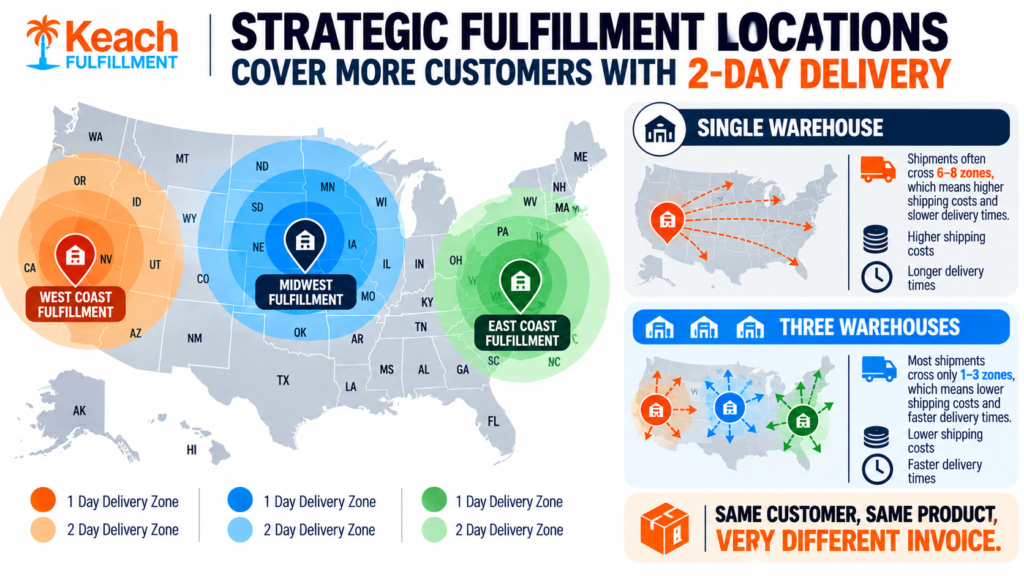
This is why location matters for fulfillment shipping in a way that catches new sellers off guard. A package heading from New Jersey to California crosses the entire zone map. The same package shipped from a warehouse in Nevada barely crosses two zones. Same product. Same customer. Very different invoice.
And it compounds. Every order going to the far side of the country carries that penalty. At volume, those penalties add up to real money. Money that could be going into marketing, product development, or literally anything else.
Keach Fulfillment places inventory closer to your customers.
See How We Handle Shipping.How Zones and Distance Drive Your Shipping Bill
Carriers divide the country into numbered zones, and the rate climbs with each zone crossed. Zone two is cheap. Zone eight is not. The exact boundaries vary by carrier, but the principle is universal. Shorter distance, lower cost. Longer distance, higher cost. There’s no workaround.
Understanding how fulfillment center locations reduce carrier shipping zones is really about this one idea. Put inventory closer to customers, and every shipment crosses fewer zones. That’s it. That’s the whole strategy. It’s not glamorous, but it’s the single most effective lever most e-commerce brands have when it comes to shipping costs.
A single warehouse can only cover so much ground before every order becomes a zone-seven shipment. Two or three strategically placed facilities change the math entirely. Suddenly most of the country sits inside a two-zone radius, and the average cost per package drops in a way that shows up immediately on the invoice.
How 3 Fulfillment Locations Reduce Shipping Zones
The Difference Between a Warehouse and a Fulfillment Center
Here’s a distinction that matters more than people realize. A storage warehouse holds inventory. A fulfillment center holds inventory and ships it, one order at a time, with the systems needed to hit cutoffs and manage carriers efficiently.
Knowing the difference between a regular warehouse and a fulfillment center matters for cost because the two operate on completely different cost structures. A storage warehouse can’t optimize zones. It can’t route packages intelligently. It just holds things. A fulfillment center is built around the shipping process itself, which is where the savings actually come from.
What Multiple Warehouses Change
The question of multi-warehouse fulfillment vs. shipping cost comes up constantly, and the answer is more nuanced than people expect. Adding a second location doesn’t automatically cut costs in half. It cuts costs on shipments that cross the most zones, usually a significant portion, but not all of them.
The math works like this. If most of your customers are within a two-day radius of a single warehouse, adding another one only helps the outliers. But if your customers are spread across the country, a second location changes everything. It reduces the average zone crossing, shortens transit times, and gives you options for routing based on where each order is headed.
Does warehouse location change shipping rates? Absolutely. But the amount it changes depends on how spread out your customer base is. A brand selling mostly to one region doesn’t need a second facility. A brand selling to all fifty states probably does.
Speed and Same-Day Processing
Zone optimization isn’t just about cost. It’s also about how fast orders actually move. A package crossing four zones takes longer than one crossing two, and customers notice. That’s where understanding how a warehouse fulfillment center processes same-day pick and pack becomes relevant, because faster processing at the origin point compounds with shorter zones at the destination to create a delivery window that customers actually trust.
Technology That Keeps Costs Down
Location is the single most important leverage point, but not the only one. The software inside a modern fulfillment center determines which carrier delivers each package, which shipping service level is optimal, and whether there is a way to save money on a less expensive alternative while still meeting the shipping deadline.
To better understand just how much is handled automatically, understanding how a high-speed modern fulfillment center operates is very worthwhile. Rate shopping among the carriers, real-time zone determination, and automatic service level assignment take place behind the scenes for every single shipment. It may not be glamorous, but every step eliminates costs without sacrificing speed.
When Shipping Costs and Cart Abandonment Collide
Reducing shipping costs is not just a matter of profit margins. It is a matter of converting sales. When customers see a charge for shipping that was not expected, or a delay in delivery that is not acceptable, they abandon the sale. This is why order fulfillment companies minimize cart abandonment and pay attention to two things at the same time. Cost reductions and delivery speed.
Conclusion: Location Is Strategy, Not Logistics
For most retailers, location is an operational issue. In fact, it is the largest strategic decision involved in online retailing. Location determines how much one pays, how quickly the orders get fulfilled, and whether there will be any resistance when processing payments.
Keach Fulfillment creates strategies for fulfillment based on the location right from the onset. We strategically place our inventory depending on where customers are found in order to ensure reduced costs, quicker delivery, and elimination of shipping line items. It doesn’t matter whether it is a single facility or multi-warehouse environment; we’ve got your back.
Keach Fulfillment puts inventory where your customers actually are.
Shorter zones, real savings, faster delivery.