Seventy percent of online carts get abandoned. You’ve probably heard that stat so many times it’s stopped meaning anything. But sit with it for a second. Seven out of ten people who wanted your product enough to click “add to cart” walked away before paying. That’s not a marketing problem. That’s a “something scared them off” problem.
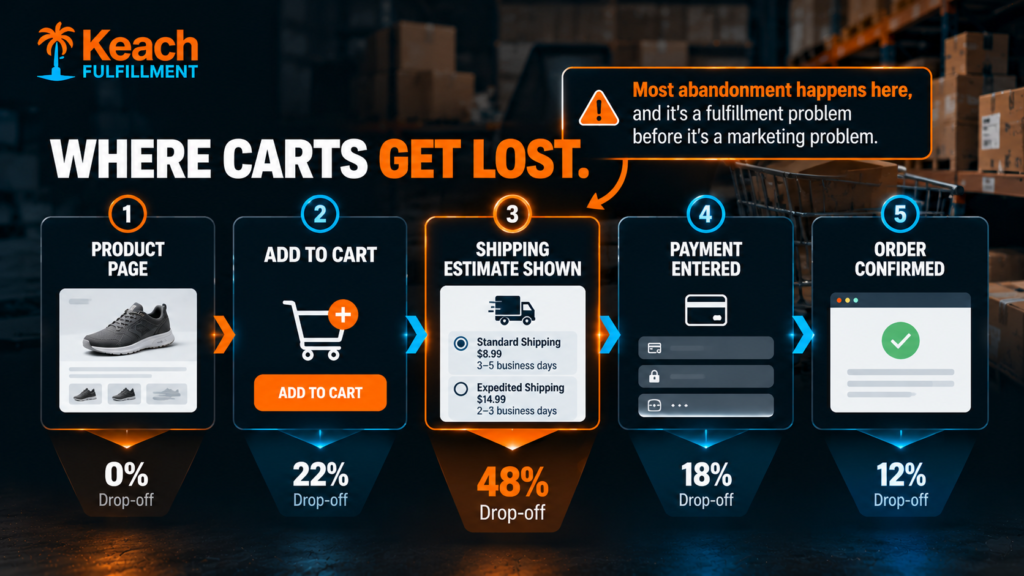
And nine times out of ten, what scared them off wasn’t the price. It was the delivery estimate sitting right there on the checkout page. Five to seven business days. No tracking info yet. Maybe a shipping fee that showed up out of nowhere. Shoppers don’t abandon carts because they stopped wanting the thing. They abandon because the last step felt risky, and the brand didn’t do enough to make it feel safe.
Which is where fulfillment quietly enters the picture. Not as a marketing tactic, but as the operation sitting behind every promise the checkout page makes.
Why Shoppers Actually Bail at the Last Second
Ask people why they abandoned a cart and they’ll give you the usual answers. Shipping costs too high. Delivery too slow. Didn’t trust the site with a credit card. But underneath all of that is one word: uncertainty.
A shopper who doesn’t know when their order will arrive is a shopper who starts inventing reasons not to buy. Maybe the package gets lost. Maybe it shows up damaged. Maybe the store is one of those fly-by-night operations that takes your money and disappears. None of that is rational, but none of it has to be. The buy button is one click, and walking away is zero clicks. Guess which one wins when doubt creeps in.
Sellers who try to fix this with discounts are basically paying customers to ignore a problem they could solve for free. The uncertainty isn’t about price. It’s about whether the brand can actually deliver what it’s promising.
Keach Fulfillment keeps delivery promises accurate so carts actually convert.
Faster shipping, cleaner tracking, fewer drop-offs.Where Fulfillment Quietly Shapes the Checkout
Here’s what most sellers miss. Fulfillment doesn’t show up anywhere in a cart abandonment report. It’s invisible. But it’s the thing that determines what promises the checkout page can make in the first place.
A brand relying on a robust fulfillment process can promise a delivery time of two days with proper tracking. But a brand that packages its orders from a garage cannot. The impact of the difference is felt in the form of conversion rates, despite nobody linking the conversion to fulfillment.
Rapid order fulfillment services have the effect of increasing conversions because of a very simple reason. Faster order fulfillment decreases uncertainty. Instead of being uncertain about whether the item will arrive after five to seven business days, the customer knows exactly how long the wait will be. Order fulfillment services that run on real infrastructure give a store the ability to make promises it can actually keep. That’s the whole game.
The 5 Stages of Cart Abandonment
Warehouse vs Fulfillment Center: Why It Matters for Abandonment
Quick clarification that trips up a lot of sellers. Warehouses store items. On the other hand, a fulfillment center stores items and distributes them on a one-by-one basis in systems geared toward that very purpose.
Knowing the difference between a regular warehouse and a fulfillment center is important in this context since the guarantees that you provide during your checkout process are completely contingent on whether you are using a fulfillment center or not. That first delivery experience decides whether they come back. And “come back” is the metric that actually matters, not the single sale.
The Tech Behind the Speed
Fulfillment speed doesn’t come from warehouse workers moving faster. It comes from software doing the routing, tracking, and verification automatically.
If you want to see how much of it is technology-driven, what technology powers a high-speed modern fulfillment warehouse is worth digging into. Warehouse management systems route orders. Scanners verify every pick. Carrier integrations handle rate shopping and label printing without anyone typing a thing. None of it is exciting to look at, but every piece removes friction from a process that has to run at the same pace every day.
Trust Gets Built Before the Cart Ever Gets Filled
Here’s the part sellers don’t usually connect. The trust that reduces abandonment starts way before checkout. It starts with the tracking email from the last order. The accuracy of the last delivery window. Whether the last return went smoothly or turned into a fight.
Trust built through automated fulfillment tracking builds up over time in ways that are difficult to quantify yet easily felt. Customers remember stores that were transparent about their deliveries. Customers will not forget stores that forced them to refresh a tracking page for four days before seeing any updates. And those memories dictate whether or not a future cart ends up checked out or abandoned.
But is it the speed of delivery alone that reduces cart abandonment rate? Not really. It is the ability to deliver faster that shows the competence of the store. And that makes a difference when viewed on an aggregated level.
Conclusion: Fulfillment Is Part of the Funnel
Cart abandonment gets treated like a marketing problem that needs more retargeting and better emails. A lot of it isn’t. It’s an operations problem, and the fix usually lives in how orders actually get fulfilled once they leave the checkout page.
Keach Fulfillment exists to remove that doubt. From same-day processing to accurate tracking and delivery windows that hold up under pressure, the order fulfillment services here are built around the exact moment a shopper decides whether to finish the purchase. When that moment goes smoothly, the cart gets completed. When it doesn’t, it becomes a number in someone else’s report.
Keach Fulfillment keeps every delivery promise accurate.
Fewer abandoned carts, more completed orders.