
Entering a modern fulfillment center doesn’t mean entering an enormous space first of all; it means hearing sounds. Scanning beepers, conveyor belts working and making noises, printers printing labels, and somewhere in the background a steady work rhythm of human beings and equipment working together. For the outsider, everything seems like controlled chaos. For management, however, every noise proves that things are going as planned.
The difference between a high-performance fulfillment center sending thousands of orders daily and a poor fulfillment center failing to cope lies mostly in the technological aspect. Not only in hardware, but in software, too. Systems determining priorities of picking, destination of the packages and its speed are the main things in the operational process of operation. Knowing about technologies used by fulfillment centers makes it easy to understand their performance.
The Software Layer That Runs Everything
Typically, the fulfillment center is visualized as a warehouse filled with shelves and forklifts. In fact, the physical infrastructure is the surface part of a software program whose functioning will define the success of the day.
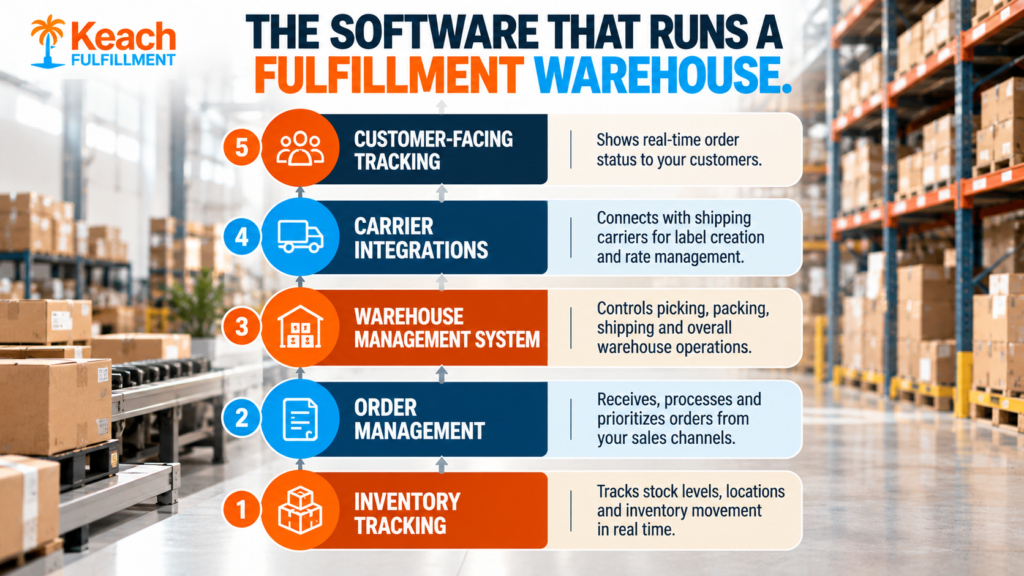
It starts with the warehouse management system, which accepts orders from all sales channels, controls inventory of all warehouse locations, prepares picking lists, and controls the process of receiving, packing, and shipping. Without the warehouse management system, the process will run on guesswork about what to pick, what the location of each item is, and what orders have already been placed by customers.
The thing that makes the picture more complicated is the difference between warehouse management system versus fulfillment technology difference which confuses people at the beginning of choosing a provider. The former deals with inventory control and order routing. The latter offers real-time carrier integration, rate shopping among different shipping carriers, returns management, and special packing and labeling according to the needs of specific marketplaces.
That extra layer is what makes a fulfillment warehouse genuinely capable of running high-volume operations rather than just tracking boxes.
5 Systems That Keep a Fulfillment Warehouse Moving
How Scanners Keep the Whole Operation Honest
If software is the brain in today’s warehouses, scanners represent the nervous system. Each pick, pack, and shipment passes through several scanning checkpoints and gets registered in the system right after scanning to make sure nothing gets missed between the shelves and the truck.
When learning about the use of robots and scanners in fulfillment centers, one should start by figuring out that scanners represent the most important part of this duo. Robots are more interesting and get most of the attention, but scans are responsible for avoiding all the mistakes that are costly.
Once an item is picked, it gets scanned against the order prior to leaving the aisle, so any wrong-item mistake gets detected right away. The package gets scanned once again in the packing station and for the last time at the carrier hand-off point.
This history is crucial in case of problems. For example, in case a customer says he never got the package, scan history can show when the package was sent, by which carrier, and whether it actually left the center or not. Also, if cycle count reports inventory shortfalls, scans can help to figure out which orders these items were picked for.
Without that visibility, every discrepancy turns into a mystery that costs hours to untangle, and that’s why understanding how a warehouse fulfillment center processes same-day pick and pack starts with the scanning layer rather than the equipment on the floor.
Keach Fulfillment runs software that keeps every order moving.
Real-time tracking, accurate picks, on-time shipping.Where Automation Fits In
There is much discussion about automation when talking about fulfillment processes, and rightly so, but the truth of the matter is much more subtle than marketing would make you believe. Most fulfillment centers today apply automation on a selective basis, utilizing technology to accelerate processes only where it actually makes sense, and not trying to automate the entire process at once.
Automated conveyor systems transfer parcels between stations automatically, thus reducing the walking distance tremendously for a whole workday. Automated storage and retrieval systems transfer shelves to pickers instead of taking pickers to aisles, thus saving on picking times significantly when dealing with high-density systems. Robots are used in facilities with large volumes to perform repetitive tasks such as sorting or labeling.
However, fast order fulfillment warehouses operate with technologies that go unnoticed because of their relatively small size. For example, electronic scales that transmit weight information directly to shipping processes. Print and apply devices that automatically label parcels.
Dimension scanners that measure packages instantly and prevent carriers from upcharging for incorrect dimensions. None of these are flashy, but each one removes seconds from every order, and across thousands of orders those seconds add up to hours.
Choosing the Right System for the Job
The question of the best warehouse management system technology for order fulfillment doesn’t have a universal answer, because the right system depends entirely on what the warehouse is actually shipping.
A facility handling large, palletized goods needs different software than one shipping thousands of small parcels a day. A warehouse supporting multiple sales channels has to track inventory across marketplaces, direct store orders, and wholesale accounts simultaneously. One focused on subscription boxes needs kitting and recurring shipment support built in. Choosing a system without those specifics in mind usually means paying for features nobody uses while missing the ones that would actually help.
This is also where the difference between a storage warehouse and a fulfillment warehouse becomes most obvious. Understanding what’s the difference between a regular warehouse and a fulfillment center comes down largely to software. Storage warehouses can operate with basic inventory tracking because their job is holding goods. A fulfillment warehouse needs the full technology stack because its job is moving individual orders out the door on a schedule that doesn’t slow down.
Where Technology Meets Human Judgment
Even the most automated warehouse relies heavily on its employees, and it is the interplay of technology and human efforts that will make the warehouse succeed or fail.
Software deals with the route selection, product tracking, and reporting, but software cannot determine the course of action when the product is damaged, substitute goods are required, or the customer changes his packaging demands midweek. This decision requires people’s participation, while technology supplies all information that people require to make such decisions fast without browsing the archives.
Thus, a successful warehouse operation requires a split of responsibilities where people deal with tasks that require human intervention and software takes care of all automatic tasks. This split makes it possible to increase the number of orders and customers while adding fewer people because the cost of operating one order declines with the increase in volume of the fulfillment warehouse.
Conclusion: Systems Build Speed, Not Hustle
Speed in fulfillment isn’t about working harder. It’s about building a system where the technology handles the routing, the tracking, and the repetition, and the people handle the judgment calls that technology can’t make. That’s what separates a warehouse that scales from one that burns out.
Keach Fulfillment runs on software and hardware built for exactly that balance. Whether you’re watching scan data move across a dashboard or tracking an order from checkout to doorstep, the goal stays the same. Accurate picks, honest records, and packages that leave the building on time, every time.
Keach Fulfillment uses systems built for speed and accuracy.
Talk to Us About Fulfillment.