
You hear these terms constantly. Logistics. Supply chain management. People use them interchangeably. But they mean different things. Understanding the difference matters for your business. Confusing the two leads to poor decisions. You might invest in the wrong solutions or hire the wrong partners.
Supply chain logistics connects these two worlds. It sits at the intersection of planning and execution. Let us break down what each term actually means.
Learn the difference so you can make smarter business decisions.
Get Started!What Is Logistics and Supply Chain Management?
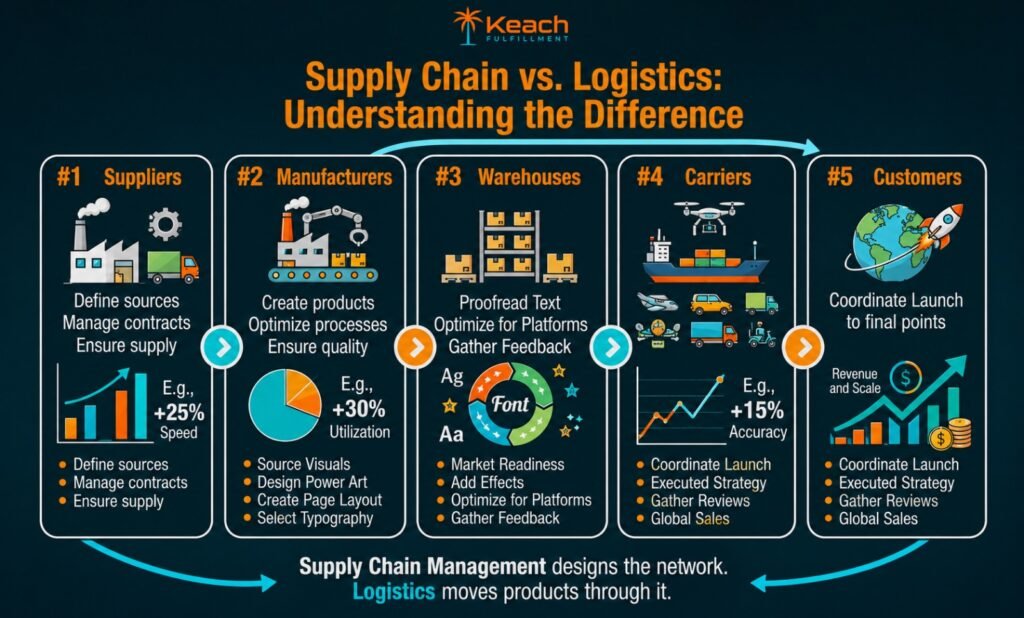
What is logistics and supply chain management? The question comes up frequently. The answer requires distinguishing between two related concepts. Logistics and supply chain management focus on different scopes. Logistics handles the physical movement of goods. Supply chain management oversees the entire network of suppliers, manufacturers, warehouses, and carriers.
Think of supply chain management as the architect. They design the overall system. Logistics acts as the construction crew. They execute the physical movements. A supply chain includes sourcing raw materials, manufacturing products, managing inventory, coordinating warehouses, and delivering to customers. Logistics focuses specifically on transportation and warehousing within that larger system.
How Does Supply Chain Management Differ from Logistics?
Supply chain management takes a big picture view. It considers every partner involved in getting products from raw materials to customers.
This includes suppliers who provide components. Manufacturers who assemble products. Warehouses that store inventory. Carriers that transport goods. Retailers who sell to customers. And finally, the customers themselves. Supply chain management optimizes the entire network. It answers strategic questions. Where should we source materials? How much inventory should we hold? Which carriers should we use?
Logistics handles the tactical execution. It moves products between each link in the supply chain. Logistics coordinates trucks, ships, planes, and warehouses. Good supply chain logistics aligns both perspectives. The strategy guides the execution. The execution informs the strategy. Businesses looking to improve efficiency often rely on supply chain performance management to better align operations with long-term goals.
Great supply chain logistics connects your plans to real results.
Contact NOW!Why Does Supply Chain Logistics Matter for Ecommerce?
Supply chain logistics directly impacts your customer experience. Every delay or error reaches your customer eventually. Consider what happens when you receive an order. Your supply chain determines if that product sits in a warehouse nearby or across the country. It decides which carrier handles delivery. It sets your shipping costs.
Poor logistics creates problems you cannot hide. Late deliveries frustrate customers. Damaged packages generate returns. High shipping costs drive away price sensitive buyers.
Effective logistics prevents these issues. Products arrive quickly because warehouses sit close to customers. Packages arrive intact because handling processes protect them. Shipping costs stay reasonable because carriers compete for your business.
For deeper insights on building effective logistics, explore our guide on Supply Chain Coordination for Ecommerce and Retail Businesses. You can also learn how global supply chain services for ecommerce logistics help brands manage growth across multiple regions more efficiently.
What Are the Key Components of Supply Chain Management?
Successful supply chain management includes several critical components working together.
Planning Starts The Process.
You forecast demand, plan inventory levels, and schedule production. Good planning prevents both stockouts and excess inventory.
Sourcing Follows.
You select suppliers, negotiate contracts, and manage relationships. Reliable suppliers prevent production delays.
Finished Products
Manufacturing transforms raw materials into finished products. This step applies primarily to brands that make their own goods.
Warehousing Stores
Warehousing stores products between production and sale. Efficient warehouses organize inventory for quick retrieval.
Transportation
Transportation moves products between each stage. Carriers handle everything from supplier to warehouse to customer.
Finally Returns
Returns complete the loop. Reverse logistics processes customer returns efficiently.
Each component connects to the others. Improving one area often benefits the entire system. In our guide on What Is Supply Chain Coordination in Ecommerce, we explore how these components communicate effectively. Many ecommerce businesses also improve efficiency through supply chain optimization and process improvement strategies that reduce delays and operational waste.
How Do You Improve Logistics and Supply Chain Management?
Improvement starts with visibility. You cannot fix what you cannot see. Track key metrics like order accuracy, on time delivery, and inventory turnover. These numbers reveal problem areas.
Map your current process.
Document every step from supplier to customer. Identify bottlenecks and delays.
Communicate with partners.
Your suppliers, warehouses, and carriers need clear expectations. Regular check-ins prevent surprises.
Build redundancy.
Have backup carriers and alternative suppliers. When problems occur, you need options.
Partner with experts.
Professional fulfillment providers bring established systems and relationships. They handle logistics so you focus on growth.
Conclusion
Logistics and supply chain management work together as strategy and execution. Supply chains design the overall network. Logistics moves products through that network. Supply chain logistics connects both worlds into a cohesive operation.
At Keach Fulfillment, we provide the logistics expertise your supply chain needs. Our warehousing, picking, packing, and shipping services execute your strategy flawlessly. We help you deliver faster, cheaper, and more reliably.
Contact Keach Fulfillment today.
Let us handle your logistics.