Your ecommerce business is growing. Orders are coming in faster than ever. But something feels off. Orders take too long to ship. Inventory counts never seem accurate. Customers complain about delayed deliveries. You are working harder, but things are not getting smoother.
This is a common story. Growth exposes weaknesses in your supply chain. Processes that worked at fifty orders a week break at five hundred. What used to be minor annoyances become major bottlenecks.
The good news is that you can fix these problems. Supply chain process improvement is about finding those broken processes and rebuilding them to work at scale. It is not about working harder. It is about working smarter.
Keach Fulfillment At The Rescue
We handle warehousing, picking, packing, and shipping. You get faster delivery and happier customers.
Let us show you how.What Is Supply Chain Process Improvement?
Supply chain process improvement is the practice of analyzing your logistics operations, identifying inefficiencies, and making changes that increase speed, reduce errors, and lower costs.
Think of it like tuning a car. A stock engine runs fine. But with the right adjustments, it runs smoother, faster, and more efficiently. The same is true for your supply chain. Small changes in how you receive inventory, manage stock, or process orders can have enormous effects on your overall performance.
Most improvements fall into three categories. Eliminating unnecessary steps. Automating manual tasks. And creating better communication between different parts of your supply chain. You do not need to overhaul everything at once. Start with the biggest bottleneck and work from there.
Why Is Supply Chain Optimization Critical for Ecommerce?
Supply chain optimization is the goal of process improvement. An optimized supply chain delivers the right products to the right customers at the right time, while using the fewest resources possible. For ecommerce brands, optimization is not a luxury. It is a competitive necessity. Customers expect fast, reliable shipping. They compare your delivery times to Amazon’s. If you cannot keep up, they will shop elsewhere.
Optimization also protects your margins. Every delay, error, and inefficiency costs money. Rushed shipping to fix a mistake. Extra labor to hunt for misplaced inventory. Customer discounts to apologize for late orders. These costs add up fast. An optimized supply chain reduces these costs while improving customer experience. It is a rare business improvement that saves money and makes customers happier at the same time.
Let us help you find the bottlenecks holding your business back.
Contact Us TodayWhere Do Most Supply Chain Bottlenecks Occur?
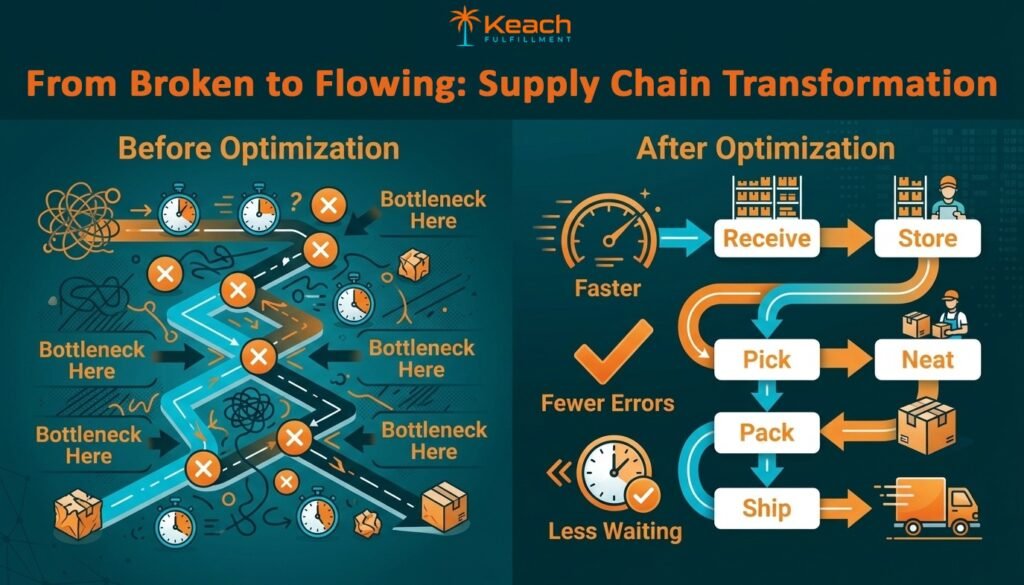
Receiving : Inventory arrives but sits on the dock for days before being logged into your system. During that time, it is not available for sale. You miss orders. Customers wait.
Storage : Products are stored randomly or in hard-to-reach locations. Pickers waste time walking and searching. Orders take longer to process than they should.
Inventory accuracy : Your system says you have ten units. The shelf has seven. You oversell. Customers are disappointed. You rush to find the missing units or cancel orders.
Order processing : Orders sit in your system for hours before being sent to the warehouse. Every hour of delay pushes delivery back a day.
Picking and packing : Pickers make mistakes. Wrong items. Wrong quantities. Poor packing leads to damage. Returns increase.
Shipping : You use the wrong carriers for different package sizes. You pay too much. Delivery takes too long.
Each of these bottlenecks has a solution. But you cannot fix what you cannot see. Start by measuring. How long does receiving take? How accurate is your inventory? How fast do orders ship? Data shows you where to focus.
What Does a Healthy Supply Chain Process Look Like?
Visibility: You know where every product is at all times. Inbound shipments. Warehouse storage. Outbound delivery. No black holes.
Speed : Products move from receiving to storage quickly. Orders move from placement to shipping quickly. Delays are measured in hours, not days.
Accuracy : Inventory counts match physical stock. Orders contain exactly what customers requested. Returns are processed correctly.
Consistency :The process works the same way every day. No surprises. No fire drills. You can predict how long things will take.
Scalability :The process works at your current volume and will work at a higher volume. Adding more orders does not break the system. If your supply chain lacks these characteristics, you have opportunities for improvement.
How Can You Improve Logistics Efficiency?
Logistics efficiency comes from eliminating waste. Waste is anything that does not add value for your customer. Wasted motion. Pickers walking long distances. Reduce travel time by organizing your warehouse based on product velocity. Fast-moving items go in easy-to-reach locations. Slow movers go in the back.
Wasted waiting : Inventory sitting idle. Reduce waiting by synchronizing your inbound and outbound processes. Schedule receiving appointments. Plan your picking waves.
Wasted errors : Mistakes that require rework. Reduce errors with barcode scanning, double checks, and clear procedures. Every error you prevent saves time and money.
Wasted space : Underutilized warehouse areas. Use vertical space. Implement better racking. Remove slow-moving products to secondary locations.
Wasted complexity :Too many steps in a process. Map your current process. Eliminate steps that do not add value. Combine steps where possible. Small improvements in each area add up to massive gains in overall efficiency.
What Is Workflow Optimization in Supply Chain?
Workflow optimization means designing your processes so that work flows smoothly from one step to the next. No bottlenecks. No backlogs. No waiting. In a fulfillment context, workflow optimization might look like this. Orders are automatically sent to the warehouse in waves. Pickers receive their assignments on scanners. They follow optimized pick paths that minimize walking. Packing stations are stocked with boxes and tape. Shipping labels print automatically. Carriers are scheduled for daily pickup. Each step feeds into the next. The output of picking becomes the input of packing. The output of packing becomes the input of shipping. When each step is balanced, work never piles up.
Poor workflow looks different. Pickers wait for orders to print. Packing stations run out of boxes. Carriers arrive before orders are ready. Work piles up between steps. Everything takes longer than it should. The solution is mapping your workflow, identifying where work piles up, and rebalancing the steps. Sometimes this means adding resources at the bottleneck. Sometimes it means changing how work is assigned. Sometimes it means automating a manual step.
In our previous guide, Supply Chain Outsourcing Benefits for Growing Brands, we discussed how outsourcing can transform your logistics operations. Process improvement is the foundation of successful outsourcing. You cannot hand off broken processes to a partner and expect magic. Fix what you can first, then bring in experts for the rest.
What Are the First Steps to Better Supply Chain Process?
Map your current process. Write down every step from the supplier to the customer. Be detailed. Include waiting time and handoffs between people or systems. Measure everything. How long does each step take? How often do errors happen? What is the cost of each activity? Data guides your decisions.
Identify the biggest problem. Pick one bottleneck to fix first. Usually, this is the step that takes the longest or causes the most errors. Test a solution. Make one change. Measure the result. Did it help? If yes, keep it. If no, try something else.
Standardize what works. Once you find a solution, document it. Train your team. Make it the new normal. Repeat. Move to the next bottleneck. Continuous improvement means you never stop finding and fixing problems.
Wrap Up
Supply chain process improvement is not a one-time project. It is an ongoing discipline. Your business changes. Your volume changes. Your customers’ expectations change. Your processes need to change with them. The brands that master this discipline pull ahead of competitors. They ship faster. They make fewer errors. They spend less money on logistics. And they have more time to focus on growth.
At Keach Fulfillment, we have built our entire operation around process improvement. Our receiving, storage, picking, packing, and shipping workflows are designed for speed, accuracy, and scalability. We continuously measure and refine our processes to deliver better results for our clients. Whether you need help with a specific bottleneck or want to outsource your entire fulfillment operation, we have the expertise and systems to make it happen.
Let Us Help You Build A Faster, Smoother Supply Chain.
Contact Keach Fulfillment Today