
You ship orders every day. Your team works hard. But how do you know if your supply chain is actually performing well? Are orders shipping fast enough? Are there too many errors? Are your costs where they should be?
Without measurement, you are guessing. Guessing is dangerous. Small problems grow into big ones. Costs creep up. Customers drift away. And you never see it coming. Supply chain performance management is the practice of measuring, tracking, and improving your logistics operations. It turns guessing into knowing. It turns hope into data.
Keach Fulfillment The Helper
We track the metrics that matter. We find the bottlenecks holding you back. We deliver faster, more accurate fulfillment.
Let us show you how.What Is Supply Chain Performance?
Supply chain performance is a measure of how well your logistics operation is working. It answers questions like: How fast do orders ship? How accurate is your inventory? How much does each order cost to fulfill? Good performance means orders go out quickly and correctly. Customers receive what they ordered when they expected it. Your costs are under control. Problems are rare.
Poor performance means delays, errors, and unhappy customers. You spend your days putting out fires. Margins shrink because of rush shipping and returns. Growth stalls because your operation cannot handle more volume. Performance is not just about speed. It is about reliability, accuracy, and cost. The best supply chains balance all four.
What Does a 3PL Logistics Company Measure?
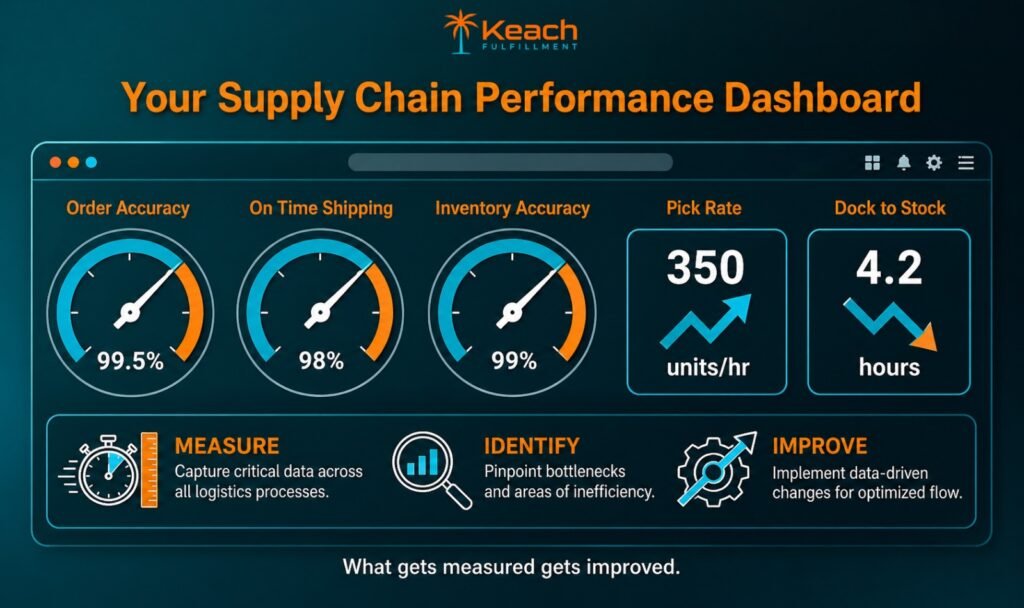
A professional 3PL logistics company tracks performance obsessively. Their business depends on delivering reliable service to clients like you. Order accuracy is typically measured at 99.5 percent or higher. That means fewer than five wrong orders out of every thousand. Professional systems, barcode scanning, and quality checks make this possible.
On-time shipping is measured against agreed service levels. If you promise two-day handling, the 3PL should meet or exceed that at least 98 percent of the time. Inventory accuracy is measured through cycle counts and reconciliation. A good 3PL maintains 99 percent or higher accuracy. You should be able to trust your inventory numbers.
Warehouse efficiency metrics track how quickly staff pick and pack orders. Measured in units per hour, these metrics show if the operation is running smoothly. When you partner with a 3PL, ask for their performance data. A good partner will share their metrics openly. A bad partner will make excuses.
Let us track your supply chain performance
So you can focus on growth.What Are the Signs of Poor Supply Chain Performance?
Poor performance shows up in many ways. You might notice some of these signs in your own operation. Customer complaints about late orders. A few complaints are normal. A pattern of complaints is a warning sign. Your fulfillment process is breaking down.
Rising return rates. Some returns are normal. Sudden increases often mean picking errors or shipping damage. Both point to process problems. Frequent stockouts. Running out of bestsellers means your inventory planning or receiving process is failing. You are missing sales you could have made.
Overselling across channels. Selling the same product twice because your systems do not sync fast enough. This frustrates customers and costs you money. High fulfillment cost per order. If your costs are rising faster than volume, something is inefficient. Too much labor. Too much packaging. Too many rush shipments.
Your team is always putting out fires. If every day brings a new crisis, your processes are broken. Good supply chain performance is boring. Things just work. Any of these signs means it is time to examine your supply chain performance. Measure the metrics. Find the root causes. Fix the problems.
In our previous guide, Global Supply Chain Services for Ecommerce Businesses , we discussed how international expansion adds complexity to your supply chain. Performance management becomes even more critical when you operate across borders. More moving parts mean more potential failure points. Your metrics help you spot problems before they hurt customers.
How Can a 3PL Help with Performance Management?
A professional 3PL brings systems and expertise that most ecommerce brands cannot build in-house. Built-in metrics. Good 3PLs track performance automatically. You get reports on accuracy, speed, and cost without doing any manual work.
Benchmark data. A 3PL works with many clients. They know what good performance looks like across different industries. They can tell you if your metrics are where they should be.
Continuous improvement. Professional 3PLs have dedicated teams for process improvement. They are always finding ways to pick faster, pack smarter, and ship cheaper.
Scale. The systems and processes a 3PL builds work at any volume. You do not need to redesign your operation when sales spike. For many ecommerce brands, partnering with a 3PL is the fastest path to better supply chain performance.
Wrap Up
Supply chain performance management is not complicated. Measure what matters. Track it consistently. Fix what is broken. Repeat. The brands that master this discipline pull ahead of competitors. They ship faster. They make fewer errors. They spend less money on logistics. Their customers stay happy.
At Keach Fulfillment, performance management is built into everything we do. We track order accuracy, on-time shipping, inventory accuracy, and warehouse efficiency. We use these metrics to continuously improve our operations. And we share them with you so you always know how your fulfillment is performing.
Let us show you what great fulfillment looks like.
Contact Keach Fulfillment today.