
You have mastered your local market. Sales are strong. Customers are happy. Now you are ready to go global. New customers in new countries. The opportunity is enormous. But here is the challenge. Every new country means new complexities. Different shipping carriers.
Different customs regulations. Different customer expectations. What works in your home market may fail across borders. Global expansion is not just about translating your website. It is about building a supply chain that can move products across oceans, through customs, and to foreign doorsteps. This is where global supply chain services become essential.
We handle international logistics so you can focus on growth. Let us show you how global fulfillment should work.
Contact us today.What is Ecommerce Logistics on a Global Scale?
Ecommerce logistics on a global scale includes everything involved in getting products from your warehouse to customers in other countries. This includes international freight, customs clearance, cross-border carrier management, and last-mile delivery in foreign markets.
Domestic logistics is challenging enough. Global logistics adds layers of complexity. Different countries have different import rules. Different carriers have different service levels. Different customers have different delivery expectations.
A global ecommerce logistics operation must be flexible enough to handle these variations while maintaining consistent service. Your customer in Germany should have the same positive experience as your customer in Texas. That requires systems and partners who understand international operations.
Why Do You Need Global Supply Chain Management?
Global supply chain management is the discipline of overseeing your logistics operations across multiple countries. Without it, you risk delays, extra costs, and unhappy international customers. Consider the challenges. Customs documentation must be perfect. A single error can hold your shipment for weeks. Duties and taxes vary by product category and country. Misclassify an item, and you pay penalties.
Shipping times are longer. Customers expect tracking visibility across borders. Returns are more complicated. Language barriers exist with carriers and customs officials. Global supply chain management addresses each of these challenges. It ensures you have the right partners in each market. It creates consistent processes across borders. It gives you visibility into your international operations.
How Can Supply Chain Consulting Services Help You Expand?
Supply chain consulting services provide expertise that most ecommerce brands lack when going global. Consultants have done this before. They know the pitfalls. They know the best practices. A consultant might start by auditing your current operations. Where are your products made? Where are your customers located? What are the most efficient shipping routes between them?
They then design a global logistics strategy. Which carriers should you use in each country? Where should you hold inventory? How should you handle returns? Finally, they help you implement the strategy. They introduce you to vetted partners. They help negotiate rates. They set up systems for tracking and reporting. For most ecommerce brands, hiring a consultant is cheaper than learning these lessons the hard way. One major customs mistake can cost more than a year of consulting fees.
Let our supply chain expertise guide your international expansion.
Reach Out To Us TodayWhat Does Cross Border Ecommerce Require?
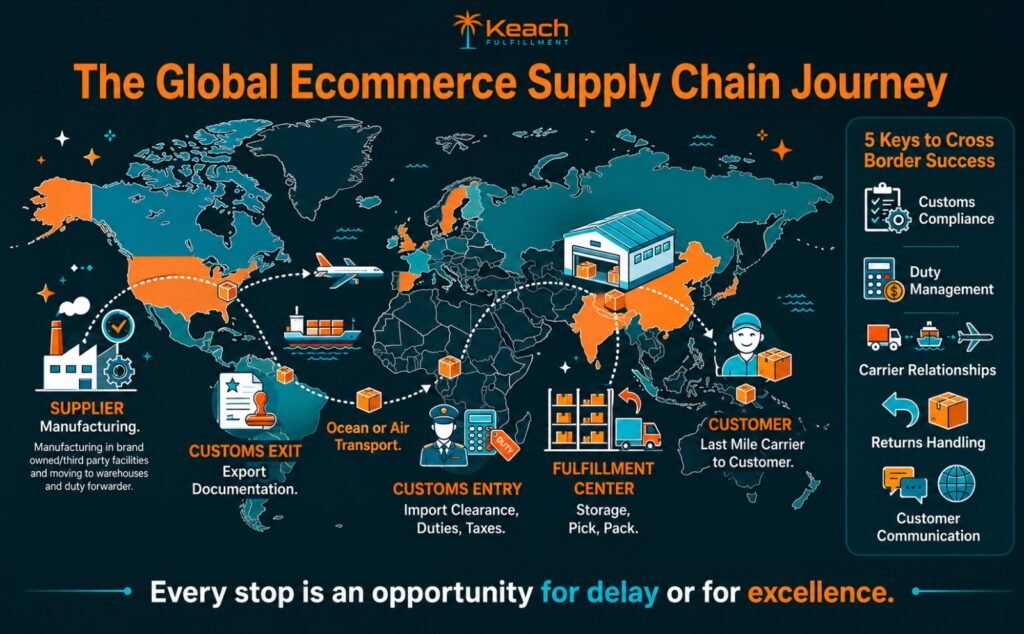
Cross-border ecommerce requires more than a translated website and international shipping options. It requires a logistics strategy built for borders. Customs compliance. Every shipment crossing a border needs accurate customs documentation. This includes product classifications, declared values, and country of origin information. Mistakes cause delays and penalties.
Duty and tax management. Different countries charge different duties and taxes. You need to decide who pays. Will you include duties in the product price? Will customers pay at delivery? Each approach has trade-offs.
International carrier relationships. Not all carriers are equal in all countries. DHL might be best for Germany. FedEx might be best for Canada. Royal Mail might be best for the UK. You need partners in each market.
Returns handling. International returns are expensive. You need a clear policy. Will customers return to your domestic warehouse? Will you use a local returns partner? Will you offer refunds without a return?
Customer communication. Your customers need tracking information in their language. They need delivery estimates that account for customs delays. They need clear instructions if duties are owed. Each of these requirements adds complexity. But they are all solvable with the right partners and processes.
What Are Global Fulfillment Services?
Global fulfillment services combine warehousing, picking, packing, and shipping across multiple countries. Instead of shipping every international order from your domestic warehouse, you hold inventory closer to your customers. Here is how it works. You ship bulk inventory to fulfillment centers in key markets. Europe. Asia. Australia. When a customer in Germany orders, the order is fulfilled from your European center. Shipping is faster and cheaper.
Global fulfillment reduces transit times from weeks to days. It reduces shipping costs because packages travel shorter distances. It reduces customs complexity because you are shipping within trade zones. The trade-off is inventory investment. You need more total stock to stock multiple locations. But for brands with significant international volume, the benefits outweigh the costs.
What Are the Biggest Challenges in the Global Supply Chain?
Even with good planning, global supply chains face challenges. Knowing them helps you prepare. Customs delays. A single incorrect document can hold your shipment for days or weeks. The solution is working with customs brokers who know the rules.
Inventory visibility. When your inventory is spread across multiple countries, tracking it becomes harder. The solution is a centralized system that shows stock levels everywhere. Returns complexity. International returns are expensive. Often, the cost of return shipping exceeds the product value. The solution is clear policies and local returns partners.
Currency fluctuations. Exchange rates change. Your margins can change overnight. The solution is building a buffer into your pricing and hedging when appropriate. Communication gaps. Different time zones, languages, and business cultures create misunderstandings. The solution is documented processes and regular check-ins with partners.
In our previous guide, Supply Chain Process Improvement for Ecommerce Operations, we discussed how to identify and fix bottlenecks. Global supply chains have more potential bottlenecks than domestic ones. The same principles apply. Measure. Identify. Fix. Repeat.
How Do You Start Building a Global Supply Chain?
You do not need to go from zero to global overnight. Start small and expand strategically. Test first. Choose one new country. Canada is often a good first choice for US-based brands because shipping is straightforward and customers are similar.
Find local partners. Research fulfillment providers, carriers, and customs brokers in your target country. Talk to other brands selling there. Get recommendations. Start with direct shipping. Before investing in local inventory, ship from your domestic warehouse. Learn the customs process. Understand the costs. Prove there is demand.
Measure everything. Track delivery times, costs, and customer satisfaction. Use this data to decide if and where to add local inventory. Expand methodically. Add one country at a time. Perfect your processes in each market before moving to the next. Global expansion is a marathon, not a sprint. Brands that rush usually stumble. Brands that plan succeed.
Wrap Up
Global supply chain services open doors to millions of new customers. But only if you get the ecommerce logistics right. Customs delays, high shipping costs, and poor tracking visibility can destroy the international customer experience. The good news is that you do not have to figure this out alone. Experienced partners exist who have already solved these problems for hundreds of other brands.
At Keach Fulfillment, we help ecommerce brands expand globally with confidence. Our team understands customs compliance, international carrier relationships, and cross border logistics. Whether you need help with one country or twenty, we have the expertise and systems to make it work.
Let us build your international supply chain.
Contact Keach Fulfillment today