
You have been waiting weeks for this shipment. Three pallets of your newest product finally arrive at the warehouse. You are excited to start selling. Then the emails start coming. Customers are receiving items with missing parts. The packaging is torn. One unit arrived looking like it had been dropped from a truck.
Returns pour in. Your profit margin shrinks with every refund. Your seller rating takes a hit. And you have no idea how many defective units are still sitting in your inventory, waiting to disappoint the next customer.
This scenario plays out every day for ecommerce sellers who skip proper inspection. A few minutes of checking products when they arrive could prevent weeks of headaches. But without a system in place, problems go unnoticed until customers find them.
Inspection is not an extra step. It is protection for your brand, your margins, and your peace of mind.
Keep reading to learn how inspection catches
problems before they become returnsWhat is Ecommerce Product Inspection?
Ecommerce product inspection is the process of examining products when they arrive at a warehouse to verify they meet quality standards. It happens before inventory goes into storage and certainly before any products ship to customers.
Inspection serves several purposes. First, it catches damage that occurred during transit. Second, it verifies that quantities match what was ordered. Third, it confirms that products meet your specifications for quality, packaging, and labeling.
Think of inspection as your quality gate. Nothing passes through to your sellable inventory without being checked. This gate protects your customers from receiving defective products and protects your brand from the fallout of bad experiences.
Without inspection, you are trusting your supplier and every carrier in between to deliver perfection. That trust is rarely justified. A proper inspection program gives you verification, not just hope.
Why Product Quality Inspection Services Matter
Professional product quality inspection services go beyond what most sellers can do on their own. When you outsource inspection, you gain trained eyes that know what to look for and systems that document everything.
Here is what professional inspection typically includes. Visual checks for obvious damage like crushed boxes, torn inner packaging, or broken seals. Quantity verification to confirm that what arrived matches the packing list. Random sampling to catch defects that might not be visible on every unit.
For products with specific requirements, inspection may also include testing. Does the electronic device power on? Does the bottle seal properly? Are all components present in kit style products?
Professional inspectors also document their findings. You receive reports showing what was inspected, what passed, what failed, and what action was taken. This documentation is valuable for filing claims with suppliers or carriers.
Common Defects Caught During Inventory Inspection Services
Professional inventory inspection services catch a wide range of problems. Here are some of the most common issues discovered during inspection.
Transit damage: Boxes get crushed. Pallets get dropped. Products shift during shipping. Inspection identifies which units were affected so they never reach customers.
Packaging defects: Seals that are not fully closed. Labels that are peeling off. Boxes that were crushed during manufacturing rather than transit. These defects make products look cheap and damage brand perception.
Missing components: Kit products are missing pieces. Electronics without cables. Furniture without assembly hardware. Inspection verifies that every unit has everything it should.
Cosmetic flaws: Scratches, dents, discoloration, or misprints that make products look damaged or defective. These flaws may not affect function but still lead to customer disappointment and returns.
Incorrect items: The right product in the wrong color. The wrong size was packed in the right box. A completely different item was sent by mistake. Inspection catches these mismatches before storage.
Expiration date issues: Products nearing or past their expiration date. Missing or illegible date stamps. Units with inconsistent dates across a single shipment.
| Inspection Type | What Is Checked | When to Use It |
|---|---|---|
| Visual Inspection | Obvious damage, packaging condition, seal integrity | Every shipment, every time |
| Quantity Verification | Unit counts against the packing list | Every shipment |
| Random Sampling | Defect rates across a representative sample | Large shipments, ongoing supplier relationships |
| 100% Inspection | Every unit is checked individually | High-value products, new suppliers, history of problems |
| Functional Testing | Products that power on, seal, or assemble correctly | Electronics, mechanical products, kitted items |
How Warehouse Quality Control Prevents Returns
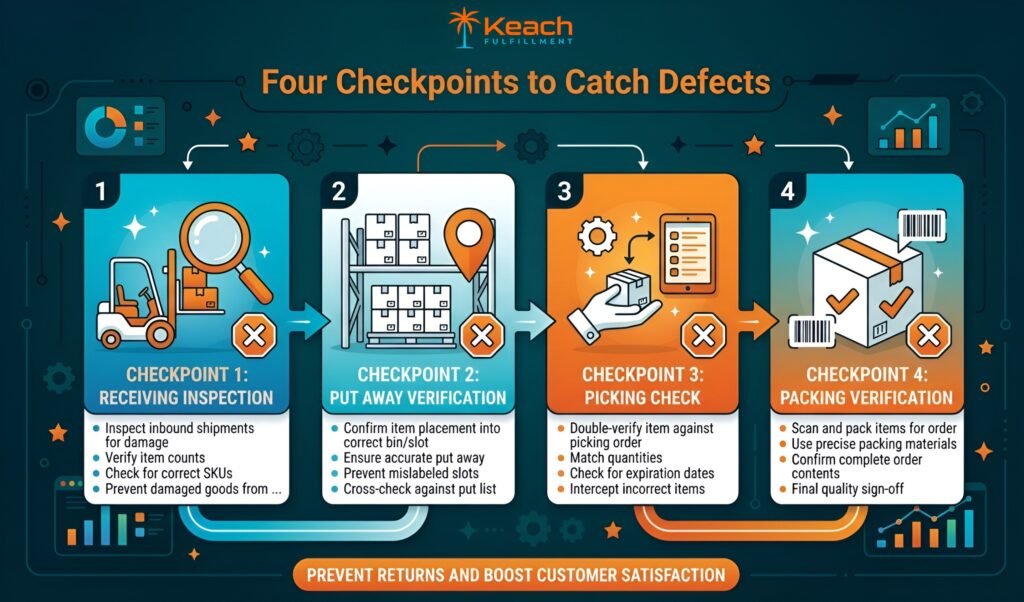
Warehouse quality control is the systematic approach to catching defects before products ship. It is not a single event but a series of checks throughout the fulfillment process.
The first check happens at receiving. Products are inspected before they ever enter your inventory. Damaged or defective units are set aside immediately. Only acceptable products get stored.
The second check happens during put-away. As products move to their storage locations, staff verify that they are going to the right places. This prevents the problem of good products being stored in the wrong locations.
The third check happens at picking. When an order is picked, the picker does a quick visual check. Does the product look right? Is the packaging intact? This last line of defense catches anything that slipped through earlier.
The fourth check happens at packing. Before sealing the box, the packer verifies that the correct product is in the correct quantity. They also ensure the product is still in good condition.
When all four checks are in place, the chances of a defective product reaching a customer drop dramatically. Each check is an opportunity to intercept a problem.
The True Cost of Skipping Inspection
Skipping inspection seems like a time saver. You receive products, log them into inventory, and start selling. But the costs of skipping this step are substantial and often hidden.
Return shipping costs: When a customer returns a defective product, you pay for that return shipping. Multiply that by dozens or hundreds of returns, and the cost adds up quickly.
Refund losses: Many returns result in full refunds. You lose the product value and the shipping cost. If the product cannot be resold, you lose everything.
Packaging waste: Returned products often need new packaging if they are resold. That is an expense that inspection could have prevented.
Customer acquisition waste: Every return represents a customer who probably will not buy from you again. All the money you spent acquiring that customer is wasted.
Seller rating damage: Marketplaces track return rates. High return rates lead to lower search rankings, higher fees, or even account suspension.
Supplier dispute costs: Without inspection documentation, you cannot prove that defects were present when products arrived. Your ability to recover costs from suppliers is severely limited.
A proper ecommerce quality control program costs a fraction of what returns cost. The math is simple. Inspection pays for itself many times over.
How to Set Up an Effective Inspection Process
You do not need a massive operation to implement good inspection. Here is a practical approach that works for businesses of any size.
Start with receiving: When products arrive, do not just sign and store. Set aside time to examine what came in. Check a sample of units. If you find problems, expand the sample.
Document everything: Take photos of the damage. Note quantities. Keep records of what you found. This documentation protects you when filing claims.
Establish acceptance criteria: Decide what counts as acceptable and what does not. Small cosmetic flaws might be fine for some products but not for others. Be specific.
Train your team: Everyone who touches incoming inventory should understand the inspection process. They should know what to look for and what to do when they find problems.
Follow up on issues: When you find defects, do not just discard the bad units. Investigate the root cause. Is it a supplier problem? A carrier issue? An internal handling problem? Fix the source, not just the symptom.
In our previous guide, Product Labeling for Ecommerce: Best Practices, we discussed how labeling and inspection work together. Proper labeling helps inspectors verify that the right product is in the right package. The two processes complement each other.
Professional inspection services catch problems early
Saving you money and protecting your reputation.When to Outsource Inspection
Many sellers start by handling inspections themselves. That works when volume is low. But as you grow, inspection becomes a significant time commitment.
When you are receiving multiple pallets weekly, inspecting every unit yourself is not feasible. You need help. That help can come from employees you hire or from a professional inspection service.
Outsourcing makes sense in several situations. High volume is the most obvious reason. Professional inspectors work faster because they are trained and focused. What takes you an hour might take them fifteen minutes.
Complex products are another reason. If your products have many components or require functional testing, professional inspectors bring expertise you may not have in-house.
Geographic distance matters too. If your products ship directly from a supplier to a fulfillment center, you cannot inspect them yourself. An inspection service at the fulfillment center solves this problem.
Professional product quality inspection services also provide documentation that is harder to produce internally. Detailed reports with photos and counts give you leverage when disputing supplier issues.
The Connection Between Inspection and Customer Satisfaction
Inspection is not just about preventing returns. It is about delivering the experience your customers expect. When a customer opens a box, they should find a product that matches the listing, works as expected, and looks good doing it.
Every defective product that slips through erodes trust. The customer may return it and get a refund, but they will think twice before ordering from you again. Some will leave negative reviews that affect future sales.
On the other hand, consistent quality builds loyalty. Customers who receive exactly what they expected, in perfect condition, are more likely to order again. They are more likely to recommend your brand to others.
Inspection is the mechanism that ensures quality consistency. Without it, you are gambling that every shipment from every supplier will be perfect. That is a losing bet.
Wrap Up
Product inspection might not be glamorous. It does not drive traffic or increase conversion rates. But it protects everything you have built. Your brand reputation. Your customer relationships. Your profit margins.
Skipping inspection saves a little time today. But it costs far more tomorrow in returns, refunds, and lost trust. A proper inspection program catches problems before they reach customers. It gives you documentation to hold suppliers accountable. It provides peace of mind that the products leaving your warehouse are products you would be happy to receive yourself.
At Keach Fulfillment, we treat inspection as nonnegotiable. Every shipment that enters our facility goes through a thorough check. We look for damage, verify quantities, and confirm that products meet quality standards. Our inventory inspection services are designed to catch problems early, before they become your problems.
Let us show you how professional inspection protects your brand.
Contact Keach Fulfillment today