
You have a product ready to sell. It is high quality. It is priced right. Your listing is optimized. Then you hit an unexpected roadblock. The fulfillment center rejects your shipment because a label is half an inch off from where it should be.
Labeling seems like such a small detail. But in ecommerce, it is anything but trivial. A label that won’t scan, a barcode placed incorrectly, or missing compliance information can stop your products cold. Shipments get returned. Deadlines get missed. Customers get frustrated.
The truth is that proper labeling is the difference between smooth operations and constant headaches. When you get it right, your products move seamlessly from your supplier to your customer. When you get it wrong, everything slows down or stops.
Let’s walk through best practices for product labeling, common requirements to watch for, and how to build a labeling process that scales with your business.
Keep reading to learn the exact requirements that keep your products moving through fulfillment centers.
Book Your Exclusive CallWhy Product Labeling Matters More Than You Think
Most sellers underestimate the importance of labeling until something goes wrong. A single mislabeled unit can trigger a chain reaction of problems. The fulfillment center can’t scan it, so it doesn’t get picked. Or worse, it gets picked but sent to the wrong customer. Either way, you lose time, money, and trust.
Good labeling serves three critical purposes. First, it enables tracking. Every scan tells you where a product is in the fulfillment process. Second, it ensures accuracy. The right label on the right product means the right item reaches the right customer. Third, it maintains compliance. Marketplaces like Amazon and Walmart have specific product labeling requirements that you must meet.
When labeling is done correctly, you gain visibility into your inventory. You can track products from receiving to storage to shipping. You know what is in stock, what is moving quickly, and what needs reordering. That visibility is the foundation of good inventory management.
Understanding Product Labeling Requirements Across Marketplaces
Different marketplaces have different rules. What works for Amazon may not work for Walmart. Understanding these differences is essential if you sell on multiple platforms.
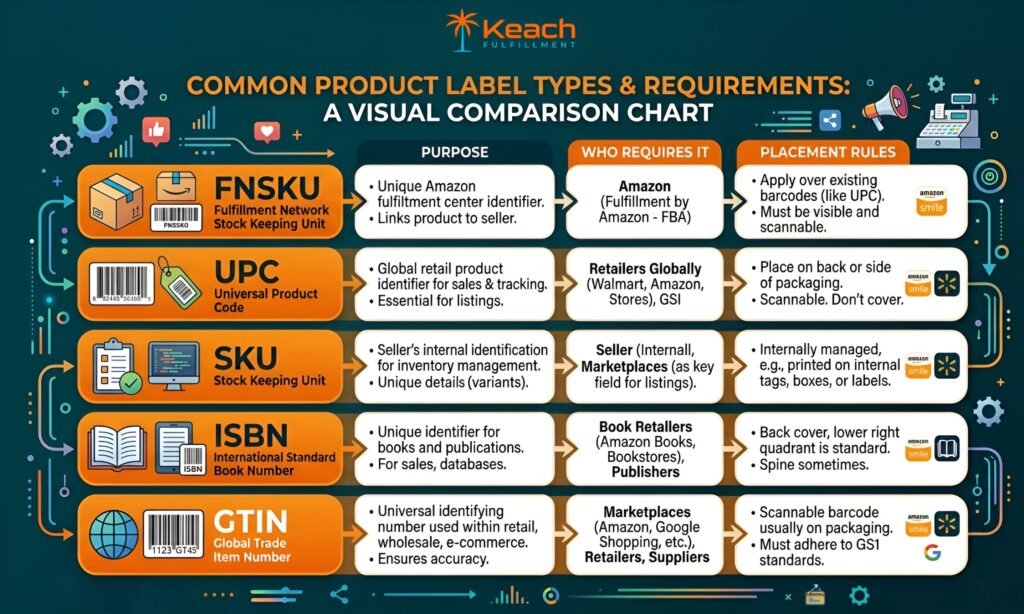
Amazon requires FNSKU labels on every individual unit sent to their fulfillment centers. These labels must be placed on the outside of the product packaging, not on the poly bag covering it. They must be scannable and free from wrinkles or damage. The barcode must be clearly visible without unfolding or opening anything.
Walmart has its own labeling standards. Their requirements for barcode placement and formatting differ from Amazon’s. Products sold through Walmart Fulfillment Services need specific labels that Walmart provides.
Target, eBay, and other marketplaces each have unique specifications. This complexity is why many sellers turn to professional packaging and labeling services rather than managing everything in house.
The key takeaway is simple. Before you ship anything to a fulfillment center, know the labeling requirements for that specific marketplace. Assumptions will cost you.
Barcode Labeling Services: What They Include
Professional barcode labeling services take the guesswork out of compliance. Instead of printing labels on your office printer and hoping they scan, you work with providers who use industrial equipment and verified processes.
Here is what professional labeling typically includes. First, they receive your products and verify what needs to be labeled. Then they print high quality barcodes using thermal transfer or direct thermal printers. These barcodes are tested to ensure they scan properly. Finally, they apply each label in the exact position required by your marketplace.
The quality difference matters. Office printers cannot produce the same crisp, durable barcodes as industrial equipment. Professional labels resist smudging, tearing, and environmental damage. They scan reliably every time.
For sellers moving hundreds or thousands of units monthly, professional labeling is not an expense. It is insurance against rejected shipments and compliance violations.
SKU Labeling Services for Internal Tracking
Beyond marketplace requirements, you also need internal tracking. SKU labeling services help you manage your own inventory, separate from what marketplaces demand.
SKU stands for stock keeping unit. It is your internal code that identifies each unique product. While marketplace barcodes like FNSKU are for Amazon’s system, your SKU labels are for your system.
Good SKU labeling helps you track products across your entire operation. You know which batch a product came from. You know when it arrived. You can connect it to purchase orders and cost data.
Professional labeling services can print both marketplace barcodes and your internal SKU labels simultaneously. This streamlines receiving and put away because every product arrives with everything it needs. Your warehouse team scans once and has all the information required.
Common Product Labeling Mistakes to Avoid
Even experienced sellers make labeling errors. Here are the most common ones to watch for.
Wrong label placement: Amazon requires FNSKU labels on the outside of the product packaging, not on the poly bag. Many sellers put labels on bags, which leads to rejection. The label must be on the actual product packaging.
Poor label quality: Faded, smudged, or wrinkled labels may not scan. Use thermal transfer labels rather than inkjet. Thermal printing produces durable, high contrast barcodes.
Covering existing barcodes: If your product already has a UPC, do not cover it with an FNSKU label unless Amazon specifically instructs you to. Covering the wrong barcode can cause scanning confusion.
Incorrect label size: Barcode labels must meet minimum size requirements. Too small, and scanners cannot read them. Follow marketplace specifications for label dimensions.
Missing suffocation warnings: For poly bagged products, the bag must include a suffocation warning if the opening is larger than a certain size. This warning can be printed on the bag or on a label applied to the bag.
How to Set Up an Efficient Labeling Process
Whether you handle labeling in house or outsource it, having a clear process matters. Here is a simple framework.
Step one, know the requirements: Before any product arrives, research the labeling specifications for every marketplace where you sell. Document these requirements clearly.
Step two, prepare your labels: Order labels in advance. Keep inventory of different label types if you sell across multiple marketplaces. Run test prints to verify quality.
Step three, label at receiving: The best time to label products is when they arrive, before they go into storage. Labeling after storage means pulling products back out, which wastes time.
Step four, verify before shipping: Before any shipment leaves your facility or your prep center, spot check labels. Scan a sample to ensure barcodes read correctly.
Step five, track errors: When a labeling mistake happens, document it. Look for patterns. If the same error recurs, adjust your process.
In our previous guide, What Are Ecommerce Prep Services and Why Sellers Need Them, we discussed how professional prep services handle labeling along with inspection and packaging. For many sellers, outsourcing labeling is the most reliable path to consistency.
Professional labeling services eliminate the guesswork and keep your compliance on track.
Reach Out Today!When to Outsource Product Labeling Services
Deciding whether to handle labeling internally or outsource depends on several factors. Volume is the biggest one. If you ship a few hundred units monthly, you might manage with a good label printer and careful processes. But as volume grows, the case for outsourcing strengthens.
Time is another factor. Labeling is repetitive work. Every unit needs individual attention. If you or your team spend hours each week applying labels, that time is not available for higher value activities like marketing or product development.
Complexity matters too. Selling across multiple marketplaces multiplies your labeling requirements. What works for Amazon may not work for Walmart. Keeping track of different specifications for different channels becomes its own job.
Professional product labeling services solve these problems. You send your inventory to a prep center. They handle everything. You get back ready to sell products that meet every requirement.
The cost is predictable. You pay per unit labeled. There is no equipment to buy, no staff to train, no compliance research to conduct. You simply budget the per unit cost into your margins.
How Labeling Connects to Customer Experience
Labeling affects more than just compliance. It also touches how customers perceive your brand. A product that arrives with a crooked, peeling, or poorly printed label feels cheap. Customers notice these details, even if they do not consciously think about them.
Professional labeling looks professional. Labels are straight, clean, and securely attached. Barcodes scan easily at every point in the fulfillment process. There is no guessing or second guessing.
When labeling is done right, the entire fulfillment process runs more smoothly. Products get picked correctly. Orders ship on time. Customers receive exactly what they ordered. That consistency builds trust and encourages repeat business.
Skipping corners on labeling might save a few cents per unit. But the cost of rejected shipments, customer complaints, and lost sales far outweighs any small savings.
Wrap Up
Product labeling might seem like a small detail in the grand scheme of running an ecommerce business. But small details have a way of becoming big problems when they are ignored. A label that does not scan. A barcode placed half an inch too low. A missing suffocation warning. Any of these can stop your products from reaching customers.
The best approach is to treat labeling as a core process, not an afterthought. Know the requirements for every marketplace where you sell. Use quality labels and proper equipment. Verify before you ship. And when volume or complexity outgrows your internal capacity, do not hesitate to bring in professionals.
At Keach Fulfillment, we take labeling seriously because we know what is at stake. Our packaging and labeling services are designed to meet marketplace requirements while keeping your products moving efficiently. From barcode application to SKU labeling, we handle the details so you can focus on growth.
Let us show you how professional labeling makes a difference.
Contact Keach Fulfillment today