
A customer presses the ‘buy’ button, and after two days, the box arrives at their door. It sounds magical, but it is not. What happens behind that one act of buying something is an entire process that takes into account keeping track of inventory, picking from warehouses, coordinating carriers, and around a dozen other things.
If the process goes well, nobody thinks about it, but when it fails, then the complaints and bad reviews start coming in fast and furious. Knowing how the actual processes of fulfillment logistics operate allows growing companies to identify issues ahead of time and determine when it is time for professionals to step in.
Order Fulfillment Logistics and Why It Matters More Than You Think
The definition of order fulfillment logistics includes everything from receipt of inventory to delivery of an item to a customer’s possession. The following activities are included within order fulfillment logistics: warehousing, inventory management, picking and packaging, distribution, and returns management.
A problem in one area can affect other areas. Improperly managed inventory will lead to overselling. Picking errors lead to returns. Late shipments lead to angry customers. Good order fulfillment systems catch these problems before they compound.
For a deeper look at how the whole process works from click to delivery, this guide on what happens after the customer hits buy covers the full journey.
Get a fulfillment partner who lets you focus on your brand.
Start the conversation today.Order Fulfillment in Logistics and Where Most Brands Hit a Wall
The challenge with order fulfillment in logistics is that it works beautifully until it does not. A brand doing twenty orders a week can handle everything from a spare room. The founder prints labels, packs boxes, and drops them at the post office on the way to get coffee.
Then growth happens. Suddenly, there are two hundred orders a week, and the spare room is overflowing, and the daily post office run takes three hours. The systems that worked at a small scale cracked under the pressure. Professional order fulfillment providers step in at exactly this point. They have the warehouse space, the technology, and the carrier relationships to handle volume that would bury a small operation.
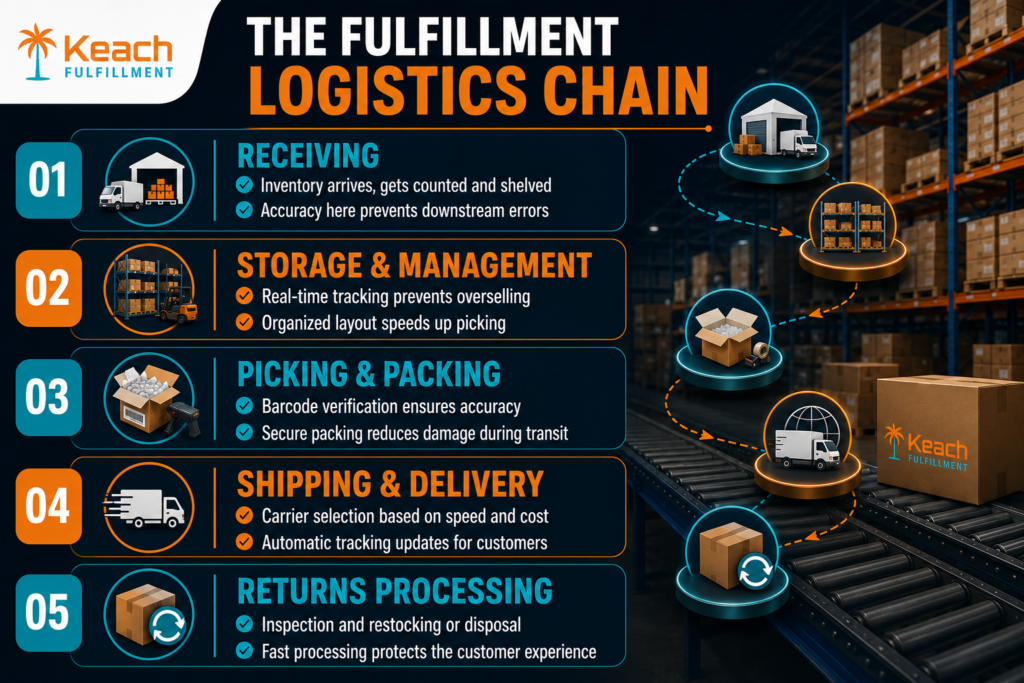
The fulfillment logistics chain overview
Third-Party Logistics Order Fulfillment and What It Actually Means
Third-party logistics order fulfillment might sound like a complex term, but it actually makes perfect sense. Instead of storing your inventory in the garage and sending out orders yourself, you give this responsibility to another company, which will do everything for you – store, hold, and distribute your orders.
The biggest advantage is scale. A 3PL negotiates shipping rates based on the combined volume of all its clients. A small brand shipping fifty orders a week gets access to rates normally reserved for companies shipping thousands. Good order fulfillment partners pass those savings along and handle the logistics so the founder can focus on product and marketing.
Order Processing and Why Speed Alone Is Not Enough
The key to great order processing is not just moving fast. It is moving accurately. A package that ships in two hours but contains the wrong item creates more problems than one that ships the next day with everything correct. Returns, replacements, and customer service hours all eat into margins.
Professional fulfillment centers use barcode scanners and automated systems to verify every item before it goes into a box. The speed comes from efficient processes rather than rushing. Good order fulfillment balances velocity with accuracy so customers get what they ordered without the headaches of correcting mistakes.
Order Logistics That Scale With the Business
The best order logistics systems grow alongside the brand. They handle holiday spikes without the founder needing to hire temporary staff and manage schedules. They scale back during quiet months without anyone losing their job.
This kind of flexibility is nearly impossible to achieve with an in-house team. Professional order fulfillment providers have the infrastructure to absorb volume swings without breaking stride. The brand stays lean while the fulfillment operation flexes with demand.
For a look at how growing brands handle the transition, this guide on whether your fulfillment is keeping up covers the signs that it is time to make a change.
Keach Fulfillment partners with ecommerce brands to manage the entire logistics chain. Receiving, storage, picking, packing, shipping, and returns are all handled under one roof. The orders go out on time, and the customers stay happy, and the founder gets back to building something bigger.
Get a fulfillment partner that scales with your business.
Schedule a consultation now!