
You have built a great product. Your marketing is dialed in. Orders are coming in steadily. Then the reviews start arriving. “Arrived damaged.” “The box was crushed.” “Product was loose inside the package.”
These reviews hurt. They hurt your seller rating. They hurt future sales. And they hurt because you know the product itself is good. The problem was not what you made. It was how it was packaged.
Packaging standards exist for a reason. They protect your products from the rough journey between your warehouse and your customer’s doorstep. They ensure customers receive items in the condition you intended. And they prevent the costly cycle of returns, refunds, and negative reviews.
Let’s walk through what ecommerce packaging solutions look like, why it matters, and how to get it right for your online retail products.
Keep reading to learn packaging standards that protect your products and your reputation.
Book Your Exclusive CallWhy Packaging Standards Matter for Online Retail
When a customer buys from a physical store, they inspect the product before purchasing. They see the box. They feel the weight. They can spot damage before money changes hands.
Online retail is different. Customers buy based on photos and descriptions. They trust that what arrives will match what they saw. When packaging fails, that trust breaks. The customer does not blame the shipping carrier. They blame you.
Ecommerce packaging standards exist to bridge this gap. They provide guidelines for protecting products during transit, ensuring that what leaves your warehouse arrives in the same condition.
Proper packaging serves several purposes. It prevents physical damage from drops and impacts. It protects against moisture and dust. It keeps product components from separating. And it creates a professional presentation that builds brand trust.
Skipping proper packaging might save a few cents per order. But the cost of returns, refunds, and lost customers far outweighs any small savings.
Understanding Ecommerce Packaging Standards
Different products need different packaging approaches. But certain ecommerce packaging standards apply across most categories.
Box integrity. The outer shipping box must be strong enough to protect its contents. Single-wall corrugated cardboard works for lightweight items under ten pounds. A double wall is better for heavier or fragile products. The box should not flex or bend when moderate pressure is applied.
Interior cushioning. Products should not move inside the box. If you shake a sealed package, you should hear nothing moving. Cushioning materials like bubble wrap, air pillows, foam inserts, or crumpled paper fill empty spaces and absorb shock.
Sealing strength. Box flaps should be sealed with heavy-duty packing tape, not masking tape or household tape. The H taping method, where tape runs along all seams, provides the strongest closure.
Weight distribution. Heavy items should be placed at the bottom of the box with lighter items on top. For single items, the product should be centered to distribute impact evenly.
Label placement. Shipping labels should be placed on a flat surface, not over box seams or edges. Barcodes must be scannable and free from wrinkles or damage.
These standards apply whether you are shipping one order a day or ten thousand.
The Role of Protective Packaging Ecommerce
Protective packaging ecommerce refers to materials specifically designed to shield products during shipping. The right protective packaging depends on what you are shipping.
- Bubble wrap is a versatile choice for many products. The air-filled bubbles create a cushion that absorbs shock. Wrap fragile items completely, with at least two layers of bubble wrap for delicate products like glass or ceramics.
- Air pillows are lightweight plastic cushions filled with air. They are excellent for filling space in boxes, preventing products from shifting during transit. Air pillows add very little weight, keeping shipping costs down.
- Foam inserts provide custom protection for oddly shaped or extremely fragile items. Foam can be cut to fit specific product shapes, holding items securely in place.
- Paper fill is a biodegradable option for lighter items. Crumpled kraft paper fills voids and provides moderate protection. It is less protective than bubble wrap or foam but works well for non-fragile products.
- Corrugated dividers create separate compartments within a single box. These are useful for shipping multiple items together, preventing them from touching or knocking against each other.
Choosing the right protective packaging reduces damage rates significantly. A small investment in better materials pays off in fewer returns and happier customers.
Common Packaging Failures and How to Avoid Them
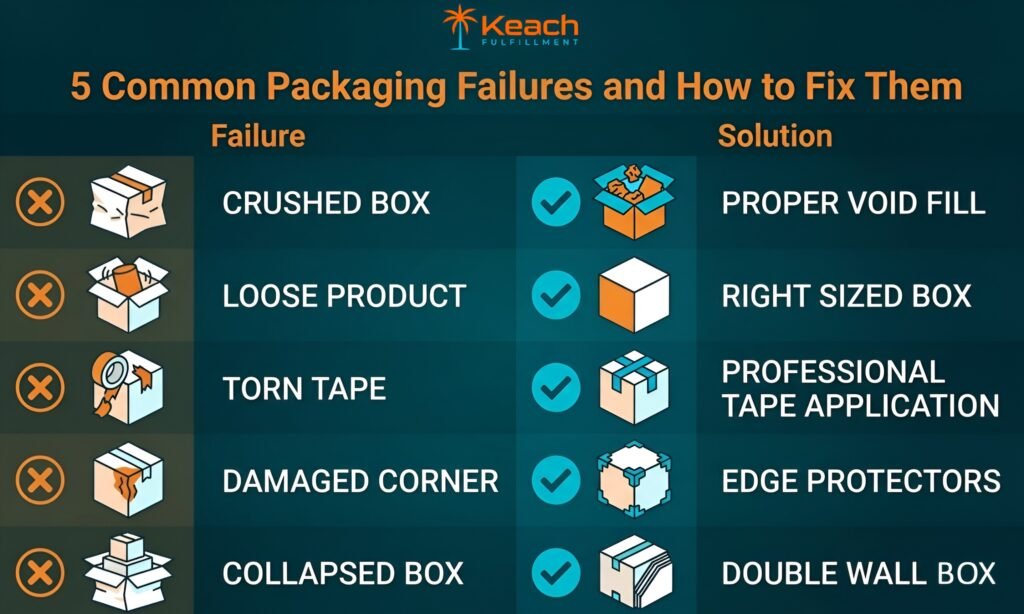
Even experienced sellers make packaging mistakes. Here are the most common failures and their solutions.
Underpacking: The product moves inside the box because there is too much empty space. The solution is simple. Fill all voids. If you can hear movement when you shake the box, add more cushioning.
Overpacking: The box is too large for the product, requiring excessive fill material. The solution is right-sizing. Choose a box that fits your product snugly with room for one to two inches of cushioning on all sides.
Weak tape: Standard office tape does not hold up during shipping. The solution is professional-grade packing tape, at least two inches wide, applied to all seams.
No edge protection: Corners and edges are vulnerable to impact. The solution is edge protectors or additional cushioning around corners, especially for heavy or fragile items.
Ignoring weight limits: Boxes collapse under the weight they were not designed to handle. The solution is checking box weight ratings and using double-wall boxes for heavier products.
Product Packaging Services: When to Outsource
Many sellers start by packaging orders themselves. That works when volume is low. But as you grow, packaging becomes a significant time commitment.
- Product packaging services take this work off your plate. Professional packagers handle everything from selecting materials to sealing boxes. They have experience with different product types and know which packaging approaches work best.
- Outsourcing makes sense in several situations. High volume is the most obvious reason. A professional packaging team works faster and more consistently than an in-house team that splits time between multiple tasks.
- Complex products are another reason. If your items have unusual shapes, multiple components, or special handling requirements, experienced packagers bring expertise you may not have.
- Cost efficiency matters too. Professional packaging services buy materials in bulk, getting better pricing than most individual sellers can access. Their labor costs are often lower than hiring employees when you factor in benefits, training, and equipment.
Seasonal spikes are easier to handle with outsourcing. Instead of scrambling to hire temporary staff during the holidays, your packaging partner simply scales up.
Let us review your packaging approach and recommend improvements that reduce damage.
Contact Keach Fulfillment Today!How Packaging for Online Stores Affects Customer Experience
Packaging for online stores is not just about protection. It is also about presentation. The moment a customer opens their package is an opportunity to delight them or disappoint them.
Good protective packaging shows that you care. When a customer sees bubble wrap carefully applied, a box that fits perfectly, and no loose items rattling around, they feel confident in your brand. They trust that you pay attention to details.
Poor packaging sends the opposite message. A crushed box, loose items, or inadequate cushioning suggests carelessness. Even if the product survives, the customer starts with a negative impression.
Some brands take packaging further, using it as a marketing tool. Branded boxes, tissue paper, thank you notes, and small free samples create unboxing experiences that customers share on social media. But even without these extras, clean, professional protective packaging makes a difference.
The key is balance. You need enough protection to ensure safe delivery, but not so much that packaging costs eat into your margins or frustrate customers with excessive waste.
Industry Specific Packaging Considerations
Different product categories have unique packaging needs. Here are a few examples.
Apparel: Clothing needs protection from moisture and dust, but not heavy cushioning. Poly bags are often sufficient. Fold garments carefully to prevent creases.
Electronics: Static-sensitive components require anti-static bags. Fragile screens need rigid protection. Heavy components need secure positioning to prevent shifting.
Beauty products: Liquids need leak-proof seals and absorbent materials in case of spills. Glass bottles need rigid outer protection.
Food items: Edible products need food-safe packaging, temperature considerations, and expiration date visibility.
Furniture: Large, heavy items need corner protection, stretch wrap, and palletizing for shipment.
Understanding your product category’s specific requirements helps you choose the right ecommerce packaging solutions.
In our previous guide, Product Inspection Protecting Ecommerce Sellers from Costly Returns, we discussed how inspection catches problems before they reach customers. Packaging is the next line of defense. Even perfectly inspected products will arrive damaged if the packaging fails. The two work together.
Sustainable Packaging Options
Sustainability is increasingly important to both customers and marketplaces. Many sellers are exploring eco-friendly packaging alternatives.
- Recycled cardboard is widely available and performs as well as virgin material. Most shipping boxes contain some percentage of recycled content.
- Biodegradable bubble wrap replaces plastic with materials that break down naturally. These options cost more but appeal to environmentally conscious customers.
- Paper-based void fill replaces air pillows and plastic bubble wrap. Crumpled kraft paper and honeycomb paper protect without plastic.
- Compostable poly bags are available for products that need bagging. These bags break down in commercial composting facilities.
The trade-off is usually cost and protection. Sustainable materials often cost more and may provide less protection than traditional options. Many sellers use a hybrid approach, protecting fragile items with traditional materials while using sustainable options where possible.
Building a Packaging Process That Scales
Whether you package in-house or outsource, having a documented process matters. Here is a simple framework.
- Standardize your materials. Use the same box sizes, tape types, and cushioning materials across similar products. Standardization reduces confusion and speeds up packing.
- Train everyone the same way. Every packer should follow the same steps. Document your process with photos or videos. New hires should practice before packing real orders.
- Audit randomly. Periodically open packed boxes before they ship. Check for proper cushioning, correct tape application, and accurate labeling. Catch problems internally before customers catch them.
- Track damage rates. Monitor how many orders arrive damaged. If rates increase, investigate why. A sudden spike often indicates a process breakdown or material quality issue.
- Review and improve. Packaging needs change as your products and volume change. Review your approach quarterly and adjust as needed.
Wrap Up
Packaging might not be the most exciting part of running an online retail business. But it is one of the most important. Proper packaging protects your products, reduces returns, and creates positive customer experiences.
The standards are not complicated. Use boxes strong enough for your products. Fill empty spaces so nothing moves. Seal seams with professional tape. Choose cushioning materials appropriate for what you are shipping. And test your packaging before sending it out the door.
When you get packaging right, customers receive products in perfect condition. They trust your brand. They ordered again. When you get it wrong, the opposite happens. Damaged products lead to returns, refunds, and lost customers.
At Keach Fulfillment, we take packaging seriously. From selecting the right materials to applying proper cushioning, our team follows ecommerce packaging standards designed to protect your products throughout their shipping journey. Whether you need help with poly bagging, bubble wrapping, or complete packaging solutions, we have the experience and scale to handle it.
Let us build a packaging solution that protects your products and your brand.
Contact Keach Fulfillment today