
There is a distinct form of fear that arises when you ship goods that are perishable or have temperature sensitivities. You carefully pack your box of premium chocolates, pricey skin care products, or specialized supplements. You then keep track of the number very carefully. If this box ends up being on a warm delivery truck for three extra hours, the goods melt, spoil, become ineffective, and you are left with having to deal with the cost of giving refunds or even waste.
Cold chain logistics is an entirely different approach to normal shipments used in the e-commerce industry. This process is not just about moving packages from one place to another. An advanced fulfillment center, which will deal with such products, is not supposed to run as a normal facility but rather as an exact science.
What Cold Chain Fulfillment Involves
Standard fulfillment is based on two criteria: efficiency and accuracy. In cold chain fulfillment, there is a third requirement, but one that is much more costly: temperature control. From the minute the temperature-controlled inventory enters through the doors, it should be transferred right away into the temperature-controlled area.
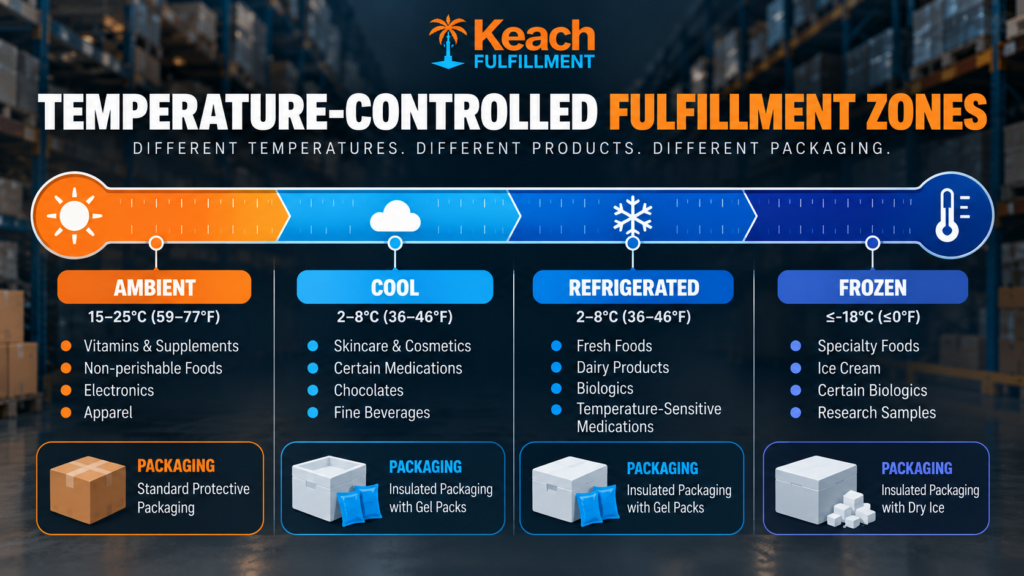
Different from normal fulfillment centers, cold chain fulfillment centers don’t consist of only one large freezer unit; there are multiple temperature zones which can include ambient, cool, refrigerated, and frozen zones. As soon as the order comes in, it is important for the packers to act as fast as they can in the temperature-sensitive packing center by using special insulated liners, bubble wrap, dry ice, or gel packs.
Keach Fulfillment handles sensitive products with strict temperature controls.
From receiving to delivery, your inventory stays stable.Why Perishables Need More Than Just a Freezer
Just throwing a box full of temperature-sensitive cosmetics into a typical walk-in cooler will not do the trick. The whole process of logistics involves a thorough knowledge of how much time the product can last once it is out of its optimal environment. That is why food, plant, or sensitive medical brands turn to reliable refrigerated fulfillment services from online brands specializing in this process.
If you have perishable food items, the requirements will be even stricter due to food regulations. Getting the right cold storage and fulfillment services for your perishables means getting facilities that adhere to sanitation standards and keep traceability data.
If the shipment of dairy products or raw seafood gets damaged during the transportation process, it will lead not only to customer dissatisfaction but also to potential legal issues. Right logistics partners consider such aspects mandatory and include them in all the processes.
4 Temperature Zones for Product Fulfillment
The Logistics of Direct-to-Consumer Cold Chain
Delivery of temperature-sensitive products to customers directly is quite challenging since this process entails that the product is being delivered directly to the consumer without passing through the regular supply chains like the supermarkets.
In case the delivery time is around five days, then the gel packs may not work, meaning that the brand must either increase the shipping speeds or purchase high-quality insulated packaging.
This is where having a dedicated fulfillment center for temperature-sensitive products pays off, as the center understands the transit time for all carriers and therefore chooses the best mode of shipping depending on the destination and the time of year.
For instance, delivering chocolate in July to Arizona will be done differently from delivering the same product in December to Maine. In addition, the center tracks the weather conditions and sometimes adds additional coolant to the packages when a heatwave is predicted.
When Things Go Wrong: Safety and Recalls
Even with the best systems, mistakes happen. A freezer compressor fails overnight, or a batch of product arrives from the manufacturer already compromised. When temperature controls break, the consequences can be severe, which is why it helps to understand how fulfillment centers handle product recalls.
A facility must be able to isolate compromised inventory immediately, document the temperature logs, and manage the retrieval or destruction of the affected units without mixing them back into the safe stock.
Managing Complexity and Special Events
It becomes even trickier if one needs to deal with pop-ups, farmers’ markets or industry shows. When a brand hosts an event in the summer, it is important to get their goods to the place on time and well-refrigerated.
This is quite a specific issue, and being familiar with how fulfillment centers handle orders for pop-up shops and industry shows will help a brand to avoid potential PR disaster. Fulfillment center will need to coordinate special freight, make sure that the venue has appropriate refrigeration systems and organize delivery in such a way that cold chain will not be broken.
Then there is the physical aspect of this matter. Not all temperature sensitive products are small. There are brands selling special medical equipment, or commercial refrigerators. Handling oversized products requires specific expertise, and the knowledge of what oversized product fulfillment is and how it works is very important for such brands.
Parcel carriers cannot deliver six feet tall freezer; therefore, fulfillment partner will need to organize freight deliveries and coordinate appointments to ensure the safe delivery and quick connection of the item.
The Technology That Keeps Everything Stable
For the high-performing fulfillment center, technology is one of the key components of cold chain logistics. The IoT sensors are usually put inside the freezers and coolers to monitor the temperature around the clock. When there is a slight deviation in the temperature range, an alarm goes off and enables the team to solve the problem before any damage happens to the inventory.
The warehouse management system also plays a key role in this process. The software helps prioritize orders of perishable products, making sure that the oldest items are sent out first to ensure that they do not spoil and calculating the thermal requirements for each package according to the destination zip code.
Conclusion: Trust the Process and the Partner
There’s no room for luck when it comes to transporting temperature-sensitive products. This is a very controlled and specialized activity which demands appropriate infrastructure, proper packaging materials, and people who understand the science of cold storage. If you think that you can do all this from a garage or even an ordinary warehouse, then you are likely to run into losses due to damage to your inventory.
At Keach Fulfillment, we specialize in taking care of the most difficult inventory needs, offering brands peace of mind knowing that your products are exactly the same way as they came out of the facility. Whether you are shipping cosmetics or frozen specialty foods, our fulfillment center infrastructure is built to take care of the challenge.
We keep your temperature-sensitive goods safe.
Talk to Keach About Cold Storage.