
You started small. Packing orders in your spare bedroom. Making trips to the post office. It was manageable. Then you grew. Now you have hundreds of orders each week. Your garage is full of boxes. Your dining table is buried in packing materials. And you have not had a weekend off in months. This is the moment many business owners face. You have proven your product works.
You have customers who love you. But fulfillment is consuming your life. Supply chain outsourcing is the solution. Instead of handling everything yourself, you partner with experts who manage the logistics. You focus on what you do best. They handle the rest. Let us walk through what outsourcing looks like, why it makes sense for growing brands, and how to know when it is time to leap.
Outsourcing gives you back your schedule while improving customer experience.
Contact Us Right AwayWhat Is Ecommerce Logistics and Why Does It Matter?
Professional logistics is the entire process of getting products from your supplier to your customer’s doorstep. It includes warehousing, inventory management, order processing, picking and packing, shipping, and returns handling.
When you are small, you touch every part of this process. You receive boxes, check inventory, pack orders, print labels, and drop packages at the post office. You know exactly what is happening because you are doing it yourself. But as you grow, this becomes impossible.
You cannot personally pack five hundred orders a week. You cannot track inventory across thousands of units. You need help. Professional ecommerce logistics providers exist exactly for this reason. They have the space, the staff, and the systems to handle volume that would overwhelm a small business. They turn logistics from a bottleneck into a competitive advantage.
What Is Supply Chain Outsourcing Exactly?
Supply chain outsourcing means hiring an external partner to handle some or all of your logistics operations. This can range from outsourcing just your warehousing to outsourcing your entire fulfillment process. The most common form is working with a third party logistics provider, or 3PL.
You send your inventory to their warehouse. They store your products, pick and pack orders, and handle shipping. You retain ownership of the inventory and control over your customer experience. They handle the physical work. Outsourcing does not mean losing control. It means delegating operational tasks to specialists.
You still decide how orders should be packed, which carriers to use, and what your shipping policies are. The 3PL simply executes your decisions. For many growing brands, outsourcing is the difference between staying small and scaling successfully. It frees up capital, space, and mental energy for the work that actually grows the business.
What Are The Third Party Logistics Benefits?
Scalability. When you handle logistics yourself, your capacity is limited by your time and space. A 3PL scales with your sales. Seasonal spike? No problem. New product launch? They handle it. You never have to turn down orders because you cannot pack fast enough.
Cost savings. This surprises many business owners. Outsourcing often costs less than doing it yourself. Why? Volume discounts. A 3PL ships thousands of packages daily. They get carrier rates you cannot access. They buy packing materials in bulk. Their per-unit costs are simply lower.
Expertise. Logistics is complicated. Carrier negotiations, compliance requirements, and international shipping. A good 3PL has dedicated experts for each area. You get their knowledge without hiring a full logistics team.
Focus. This is the biggest third party logistics benefits for most owners. Every hour you spend packing orders is an hour not spent on marketing, product development, or customer relationships. Outsourcing gives you back that time.
| Business Challenge | DIY Approach | With Supply Chain Outsourcing |
|---|---|---|
| Seasonal order spikes | Over time, burnout, delays | 3PL absorbs volume seamlessly |
| Rising shipping costs | Pay retail or small business rates | Access negotiated carrier discounts |
| Limited storage space | Rent more space, move inventory | Use the existing 3PL warehouse |
| Fulfillment errors | Fix mistakes, apologize to customers | Professional processes, higher accuracy |
| No time for growth | Stuck packing boxes | Focus on marketing and product |
How Do Outsourced Logistics Services Actually Work?
First, you connect your sales channels to the 3PL’s system. This is usually done through an integration or API. Your Shopify store, Amazon account, or other platforms send order data directly to the 3PL. Second, you ship your inventory to the 3PL’s warehouse. Their team receives your products, inspects them for damage, and stores them in organized locations. Your inventory becomes visible in their system.
Third, when a customer places an order, that order is sent to the 3PL instantly. Their team picks the products from storage, packs them according to your specifications, and prints a shipping label. Fourth, the package is handed to a carrier. Tracking information is sent back to your sales channel automatically. Your customer receives a shipping notification.
Fifth, your inventory counts update in real time. If you sell on multiple channels, those update too. You never oversell because your system always knows exactly what is available. The entire process happens without you lifting a finger. You wake up to orders that have already been picked, packed, and shipped while you slept.
That is what outsourced logistics looks like.
Let us show you.When Should a Brand Consider Logistics Outsourcing Services?
Logistics outsourcing services make sense at different points for different businesses. Here are clear signs it is time. You are spending more than ten hours a week on fulfillment. That time has value. What could you do with ten extra hours each week? Marketing? Product development? Time with family? You have run out of space. Your garage is full. Your spare bedroom is a warehouse.
You are tripping over boxes. Outsourcing moves inventory offsite. You are making mistakes. Wrong items shipped. Orders delayed. Labels messed up. Errors increase when you are rushed. A professional 3PL makes fewer mistakes. You want to grow. If you have plans to increase sales, your fulfillment needs to scale with you. Self-fulfillment does not scale.
Outsourcing does. You are launching new products. More products mean more complexity. A fulfillment partner handles that complexity so you do not have to. You are tired. Burnout is real. If fulfillment is draining your energy and enthusiasm, outsource it. Your business and your family will thank you.
What Is the Difference Between DIY Logistics and Outsourcing?
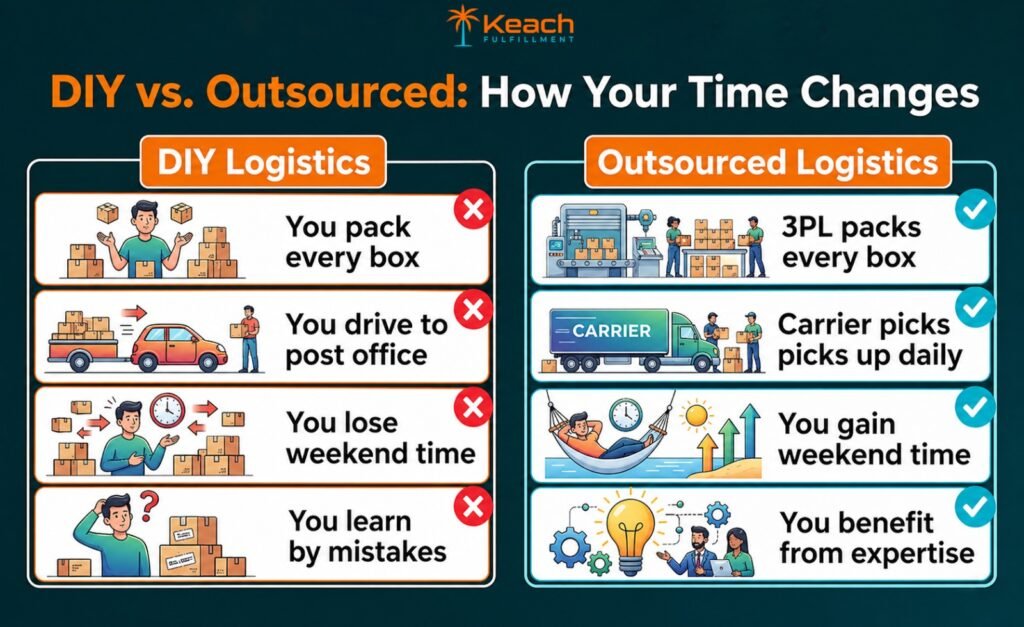
The difference comes down to where you spend your time and money. With DIY logistics, you pay with your time. Hours spent packing boxes. Hours spent at the post office. Hours spent hunting for misplaced inventory. The cash cost is low, but the time cost is enormous.
With outsourcing, you pay with money. Per order fees for picking and packing. Storage fees for inventory. Shipping fees at negotiated rates. The cash cost is higher, but your time is completely freed. For a small business with ten orders a week, DIY makes sense. The time cost is manageable. For a growing business with hundreds of orders a week, the math flips. Your time is simply too valuable to spend on packing boxes.
The other difference is expertise. DIY logistics means you learn by making mistakes. Outsourcing means you benefit from years of experience. A good 3PL has already made the mistakes and figured out the solutions.
In our previous guide, What Is Supply Chain Coordination in Ecommerce, we discussed how coordination keeps your supply chain running smoothly. Outsourcing is often the best way to achieve that coordination, because professional logistics providers have already built the systems and relationships you need.
How Do I Choose a Supply Chain Outsourcing Partner?
Choosing the right partner is critical. Here is what to look for. Experience with your product type. Some 3PLs specialize in apparel. Others focus on electronics or beauty products. Find one that understands your specific needs. Integration with your sales channels. The partner should offer direct integration with your platforms. Shopify, Amazon, WooCommerce. No custom development required.
Transparent pricing. You should know exactly what you are paying for. Receiving fees, storage fees, pick and pack fees, and shipping fees. No surprises. Scalable capacity. Ask about their peak season capabilities. Can they handle double your normal volume? Triple?
Communication. How will they notify you of problems? How often will you receive reports? Good communication prevents small issues from becoming big problems. References. Talk to current clients. Ask about error rates, shipping speeds, and problem resolution. A good partner will be happy to provide references.
Wrap Up
Supply chain outsourcing is not a luxury for big brands only. It is a practical solution for any growing business that has outgrown DIY logistics. The benefits are clear. More time. Lower costs. Fewer errors. Happier customers. The decision comes down to this. Do you want to spend your days packing boxes, or do you want to spend them growing your business?
At Keach Fulfillment, we help growing brands leap into professional ecommerce logistics. Our team handles your warehousing, picking, packing, and shipping. You keep control of your customer experience while we handle the physical work. Our integrations work with the platforms you already use. Our pricing is transparent. Our service is reliable.
Let us handle your logistics so you can focus on what matters.
Contact Keach Fulfillment today.