
Your supply chain moves products from supplier to customer. But without accurate inventory data, that movement becomes blind.
You order stock you already have. You miss sales because you thought you were out. You rush ship items that were sitting on a shelf all along. Inventory management solves these problems. It gives you visibility into what you own and where it sits. This visibility transforms how your entire supply chain logistics operates.
Learn how visibility transforms your operations from chaotic to controlled.
Contact Keach FulfillmentWhat Makes Inventory Management Essential for Supply Chain Logistics?
Inventory management tracks every product from the moment it arrives until it ships to a customer. Without this tracking, your supply chain logistics operates on guesswork.
Consider what happens without proper inventory management. You receive a shipment but forget to log it. The system shows low stock, so you order more. Now you have double the inventory you need. Cash sits on shelves instead of working for your business. Alternatively, you sell a product but fail to update your counts. The system shows available stock that no longer exists. A customer orders. You cannot fulfill. You lose a sale and damage customer trust.
Inventory management systems prevent both scenarios. They track every movement automatically. Your counts stay accurate. Your supply chain runs on data, not guesses. Businesses that understand what inventory management means for ecommerce brands often avoid these costly fulfillment mistakes early.
How Do Inventory Management Systems Create Visibility?
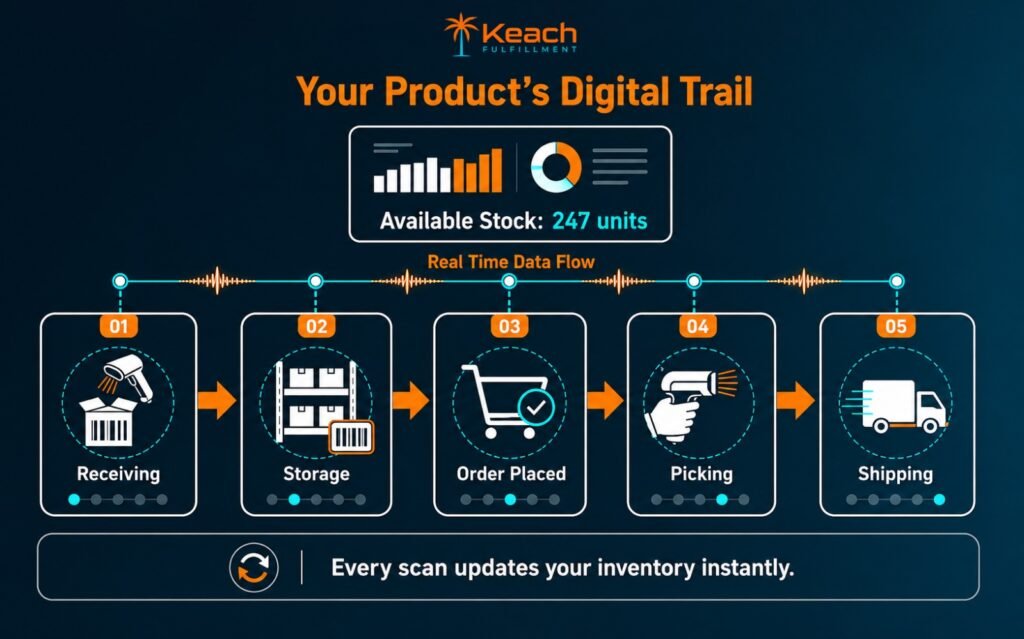
Inventory management systems provide real time visibility across your entire operation. Every scan updates your counts instantly. When a product arrives at your warehouse, staff scan it immediately. The system adds it to your available stock. Your sales channels reflect the new inventory within seconds.
When a customer places an order, the system reserves that product. Other channels see the reduced count right away. You never oversell because your systems communicate instantly. When a picker grabs the product, they scan it again. The system confirms they have the correct item. It also updates your counts one final time. The product moves from available to sold.
This continuous tracking creates a complete history. You can see exactly when each product arrived, where it was stored, when someone picked it, and when it shipped. Inventory management systems solutions provide this visibility automatically. This becomes even more important when managing inventory across multiple sales channels where stock counts must stay synchronized in real time.
Inventory management systems show you exactly what you have and where it sits.
Contact Keach Fulfillment Today!Why Does Inventory Accuracy Matter for Supply Chain Logistics?
Supply chain logistics depends on accurate inventory data. Every decision flows from knowing what you have available. Your purchasing decisions rely on inventory data. If your system shows fifty units, you wait to reorder. If you actually have twenty, you run out before the next shipment arrives.
Warehouse Operations & Inventory Data
Your warehouse operations rely on inventory data. Pickers need to know where products sit. Without accurate location data, they waste time searching.
Customer Promises & Inventory Data
Your customer promises rely on inventory data. Your website shows availability based on your system. Inaccurate data leads to overselling and disappointed customers.
Inventory Management & Accuracy
Inventory management delivers the accuracy your supply chain needs. Professional systems achieve 99.5 percent accuracy or higher. You trust your data, so you make better decisions. Accurate forecasting also becomes easier when brands understand how inventory forecasting prevents stockouts before demand spikes happen.
How Do Inventory Systems Integrate with Warehousing?
Strong inventory management systems integrate directly with your warehouse operations. The software and the physical space work as one.
Barcode scanning connects the two worlds. Each product receives a unique barcode. Each storage location also has a barcode. Scanning both confirms exactly where every item sits.
When a picker needs a product, the system directs them to the correct location. They scan the location barcode, then the product barcode. The system verifies the match before they move on.
This integration eliminates searching. Pickers never wander through aisles hunting for products. They walk directly to the right spot. Order processing speeds up dramatically.
For more insights on connecting systems and operations, explore our guide on supply chain logistics coordination in ecommerce.
What Features Should You Look for in Inventory Systems?
Choosing the right inventory management systems requires knowing which features matter most.
Real time syncing tops the list.
Your system should update counts across all channels instantly. No delays. No manual exports.
Barcode Scanning
Barcode scanning eliminates data entry errors. Look for systems that support handheld scanners or mobile device cameras.
Multi Location Support
Multi location support matters if you use multiple warehouses. Your system should track inventory across all facilities from one dashboard.
Prevent stockouts
Reorder Point alerts prevent stockouts. The system notifies you when inventory falls below your specified threshold.
Integration
Integration capabilities connect your inventory system to your sales channels, accounting software, and fulfillment partners.
Conclusion
Inventory management transforms chaotic supply chains into efficient operations. Real time visibility eliminates guesswork. Accurate data drives better decisions. Integrated systems speed up order processing.
At Keach Fulfillment, we pair professional warehousing with robust inventory management systems. Our technology tracks every product from receiving to shipping. You see real time counts through your dashboard. Your customers receive accurate availability information.
Let’s get inventory management operations done.
Contact Keach Fulfillment today