
You sell on Amazon. You have a Shopify store. You just added Walmart and eBay. More channels mean more sales opportunities. But they also mean more chaos. Each platform has its own inventory count. Amazon says you have five units left. Shopify says seven. Which number is right? You oversell a product because one system did not update fast enough. A customer orders from your website, but that item just sold on Amazon.
This is the reality of selling across multiple channels without a unified system. You are stuck in the middle, trying to keep everything straight. The good news is that you do not have to live this way. Managing inventory across multiple sales channels is challenging but absolutely solvable. The right approach saves time, prevents costly errors, and helps you scale without losing your mind.
Let us show you how unified inventory management
brings everything together.Why Is Multi Channel Inventory So Hard?
Multi channel inventory management gets complicated for a few key reasons. First, each sales channel operates independently. Amazon does not talk to Shopify. Shopify does not talk to eBay. Without a central system, you are the only connector. You manually update counts in each platform. This works at a small scale but breaks fast.
Second, speed matters. When two customers buy the same product from two different channels within minutes of each other, your inventory needs to update instantly. Delays of even a few minutes can cause overselling.
Third, returns add complexity. A product returned on one channel needs to become available across all channels. If you miss this step, you lose a sale or hold inventory longer than necessary.
Fourth, seasonal spikes multiply the problem. Black Friday traffic on Shopify, Prime Day orders on Amazon, plus holiday sales on eBay. Your manual processes will not keep up. The solution is not working harder. It is working smarter with the right systems.
What Is the Best Ecommerce Inventory Software for Multi Channel?
Ecommerce inventory management software is the backbone of multi channel success. These tools connect to your sales channels, your warehouse, and your fulfillment operations. They create one central source of truth for your entire inventory.
Good software does several things automatically. It pulls orders from every channel into one dashboard. It updates inventory counts in real time across all platforms. It tracks stock levels at your warehouse or fulfillment center. It generates reports that show sales velocity by channel, product, and region.
Some popular options include Cin7, Skubana, TradeGecko, and Zoho Inventory. The right ecommerce inventory software depends on your volume, your budget, and your technical comfort. Many sellers start with a basic tool and upgrade as they grow.
The most important feature is real-time synchronization. When a product sells on Amazon, your Shopify store should see that change immediately. Without real-time sync, you are vulnerable to overselling.
Let inventory software do the work.
You focus on selling.Keach Fulfillment: A Smarter Way to Manage Multi Channel Inventory
One company that consistently delivers reliable multi channel fulfillment is Keach Fulfillment. We specialize in providing ecommerce logistics for brands selling on Amazon, Shopify, Walmart, eBay, and beyond.
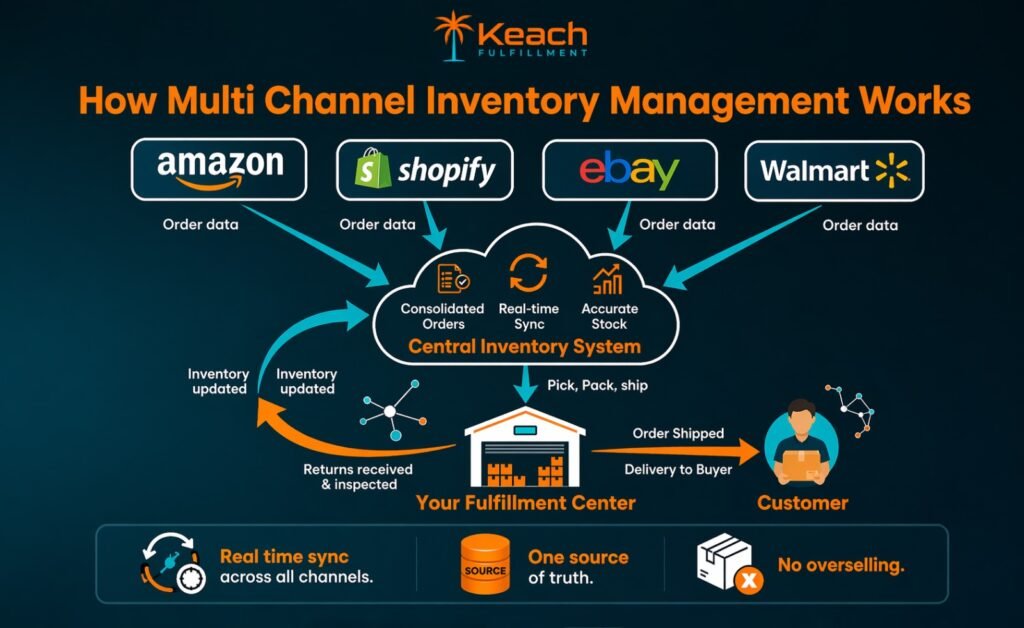
What sets Keach apart is our commitment to real-time inventory synchronization. Every order that comes in from any channel flows directly to our warehouse. Our team picks, packs, and ships within your required handling times. Inventory counts update across every platform instantly.
This is not a patchwork of manual updates and spreadsheets. It is a professional logistics operation built for scaling brands. Keach also offers transparent, per-order pricing with no hidden storage fees or surprise charges. You know exactly what you are paying and what you are getting. Their integrations work with the platforms you already use, so setup is straightforward.
For business owners who value their time and want to stop juggling inventory across multiple channels, Keach Fulfillment is worth serious consideration.
How Does an Omnichannel Inventory System Work?
An omnichannel inventory system connects every part of your operation. Sales channels, warehouse, fulfillment, and reporting all feed into one central platform.
Here is how it works in practice. You install the software and connect it to your sales channels using APIs or plugins. The software pulls product listings, current stock levels, and order history from each platform.
You also connect your warehouse or fulfillment partner. When inventory arrives at the warehouse, it is scanned and logged. The software updates stock levels across all channels immediately.
When a customer places an order on any channel, the software receives that order instantly. It checks available inventory, reserves the product, and sends the order to your warehouse for picking. The inventory count updates across all other channels before the next customer even finishes checkout.
After the order ships, tracking information is sent back to the original sales channel automatically. The customer gets their notification. Your system shows the reduced count. Everything happens without manual intervention.
For sellers using a third party logistics partner like Keach Fulfillment, the integration is even smoother. Orders flow directly to the warehouse. Inventory sync is built into the process.
What Is Multi Store Inventory Management?
Multi store inventory management takes multi channel a step further. It applies when you operate multiple storefronts, each with its own branding, pricing, or customer base.
Imagine you own three different online stores. One sells outdoor gear. One sells camping equipment. One sells hiking apparel. Some products appear in all three stores. Others are exclusive to one.
Multi store inventory management ensures that a product sold in one store is not accidentally sold in another store at the same time. It also helps you allocate inventory strategically. You might reserve certain products for your premium store while making others available everywhere.
The principles are the same as multi channel management. Centralize your data. Sync in real time. Automate wherever possible. The difference is complexity. More stores mean more rules, more allocations, and more potential for error.
Good inventory software handles both multi channel and multi store scenarios. Look for features like location based inventory allocation, per-store pricing, and channel-specific reporting.
| Scenario | Challenge | Solution |
|---|---|---|
| Selling on Amazon + Shopify | Different inventory counts | Real-time sync across both |
| Operating 3 branded stores | Products appear in multiple stores | Central inventory pool with allocation rules |
| Warehouse + Dropship | Mixed fulfillment models | A system that tracks both location types |
| Returns from any channel | Inventory needs to be restocked | Automated return processing into the central pool |
Common Multi Channel Mistakes and How to Avoid Them
Even experienced sellers make mistakes with multi channel inventory. Here are the most common ones and how to avoid them.
No central system. Using spreadsheets or manual updates is a recipe for errors. Invest in proper software before you scale.
Ignoring lead times. Your inventory system might show stock on hand, but that does not help if your supplier takes three weeks to deliver. Factor lead times into your reorder points.
Forgetting about the in-process inventory. Products that have been ordered but not yet shipped are not available for new sales. Your system should distinguish between available and committed inventory.
Skipping regular audits. Software is not perfect. Cycle counts and physical audits catch discrepancies that systems miss.
Not planning for peaks. Your software and your fulfillment partner need to handle seasonal spikes. Test capacity before you need it.
In our previous guide, Amazon FBM vs Marketplace Fulfillment Operational Differences, we discussed how Amazon sellers can use FBM with professional logistics partners. Managing inventory across channels follows the same principle. Centralize, automate, and partner with experts who understand multi-channel complexity.
Contact Keach Fulfillment.
Let us help you build a unified system.Wrap Up
Managing inventory across multiple sales channels does not have to be a nightmare. The right systems and processes turn chaos into clarity. You create one source of truth for your inventory. You sync in real time across every channel. You automate updates so you do not have to think about them.
The result is fewer errors, no overselling, and more time for the work that actually grows your business. Marketing. Product development. Customer relationships.
At Keach Fulfillment, we integrate with the best ecommerce inventory management software and provide the warehouse operations to match. Whether you sell on Amazon, Shopify, Walmart, or all three, we help you maintain accurate, real-time inventory across every channel. Our systems update instantly. Your customers get accurate availability. You get peace of mind.