
You found a great product. You built a nice website. Orders are coming in. Then something goes wrong. Your shipment arrives late. The warehouse loses a box. The carrier misroutes a delivery. Your customer waits. And waits. None of these problems started with you. But they all end with you. The customer does not blame the carrier or the warehouse. They blame your brand.
This is why supply chain coordination matters. It is the invisible work of keeping every link in your logistics chain connected and communicating. When coordination works, problems get solved before customers ever know they existed. When it fails, you spend your days putting out fires.
Let us show you how better coordination stops them before they start.
Contact us todayWhat Is Supply Chain Logistics Coordination in Simple Terms?
Supply chain coordination is the practice of aligning every partner in your logistics network so they work as one system. Your supplier, your freight forwarder, your warehouse, your fulfillment center, your carriers. All moving in sync. Think of it like a race. Each runner needs to know when the next runner is ready. The baton needs to pass smoothly. If any runner is out of position, the whole team stumbles.
In ecommerce, the baton is information. When will the supplier ship? When will the freight arrive? How much inventory is in the warehouse? Which orders need to go out today? Coordination ensures this information flows to the right people at the right time.
Without coordination, you get gaps. Products arrive, but no one told the warehouse to expect them. Orders are ready, but carriers were not scheduled. Customers are delayed without explanation.
Why Is Supply Chain the Backbone of Ecommerce?
Supply chain logistics is the physical movement of products from point A to point B. But in ecommerce, it is much more than moving boxes. It is the backbone of your entire customer experience. When logistics works well, customers receive their orders quickly and accurately. They track their packages easily. They have no reason to contact customer support.
When logistics fail, everything falls apart. Orders arrive late or not at all. Customers get frustrated. Returns spike. Your seller rating drops. You spend hours apologizing instead of growing your business. For ecommerce brands, logistics is not a back-office function. It is a core competency. The brands that master logistics outlast the ones that treat it as an afterthought.
Consider two identical brands selling the same product at the same price. One ship reliably within two days. The other takes five days and has frequent errors. Which brand gets the repeat customer? Which brand gets the five-star review? Logistics is the difference.
What Does Ecommerce Supply Chain Management Include?
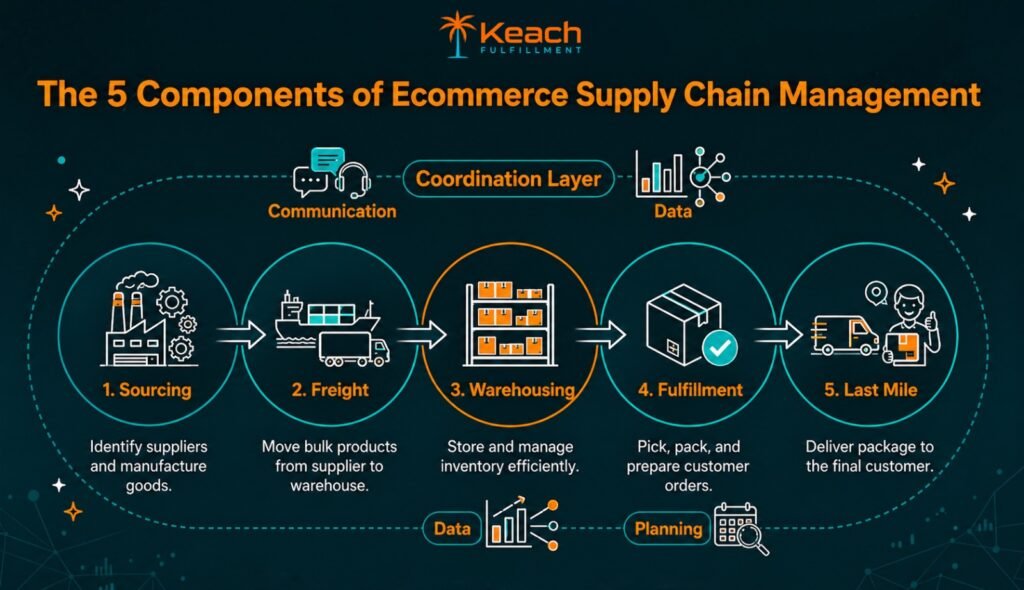
Ecommerce supply chain management covers the entire journey of a product from supplier to customer. It includes sourcing, freight, warehousing, fulfillment, and last-mile delivery. Sourcing is finding and managing suppliers. This includes negotiating prices, managing quality, and ensuring reliable production schedules.
Freight is moving products from suppliers to warehouses. This includes ocean freight, air freight, and trucking. It also includes customs clearance for international shipments. Warehousing is storing products between shipments. This includes receiving, putting away, inventory management, and cycle counting.
Fulfillment is picking, packing, and shipping customer orders. This includes order processing, label printing, and carrier handoff. Last-mile delivery is the final step from carrier to customer. This includes tracking updates, delivery exceptions, and returns processing. Each of these pieces needs to work together. When they do, customers receive products quickly and reliably. When they do not, you have problems.
| Supply Chain Component | What It Includes | Coordination Challenge |
|---|---|---|
| Sourcing | Supplier selection, quality control, production scheduling | Supplier delays, quality issues |
| Freight | Ocean, air, or truck transport, customs clearance | Transit delays, documentation errors |
| Warehousing | Receiving, storage, and inventory management | Misplaced inventory, receiving backlogs |
| Fulfillment | Pick, pack, ship, order processing | Picking errors, carrier handoff delays |
| Last Mile | Final delivery, tracking, returns | Missed deliveries, return processing |
How Can Supply Chain Support Services Help My Business?
Supply chain logistics support services provide expertise that most ecommerce brands cannot afford to build in-house. They handle the complex, time-consuming work of coordination so you do not have to. For example, a support service might manage your freight relationships. They negotiate rates with carriers, track shipments, and handle customs documentation. When a shipment is delayed, they adjust plans and communicate with your warehouse. Another support service might manage your warehouse operations.
They handle receiving, put away, and inventory accuracy. They coordinate with your fulfillment partner to ensure products are available when orders come in. The value of these services is not just time savings. It is expertise. A good support service has handled hundreds of shipments across dozens of industries. They have seen the problems before and know how to solve them. For a growing brand, outsourcing supply chain support is often cheaper than hiring a full-time logistics manager. You get experienced help without the overhead of a permanent hire.
Let experienced support services handle it for a fraction of the cost.
Reach Out TodayWhat Is a Supply Chain Strategy for Ecommerce?
A supply chain strategy ecommerce is a plan for how your logistics operation will support your business goals. It answers questions like: How fast do we need to ship? How much inventory should we hold? Which partners should we work with?
A good strategy starts with your customer promise. If you promise two-day shipping, your strategy needs to support that. If you sell heavy or bulky items, your strategy needs to account for freight costs. Your strategy also needs to consider your growth plans. A strategy that works at five hundred orders a month will not work at five thousand. Build scalability into your plan from the beginning.
Common strategic choices include whether to use a single fulfillment center or multiple locations, whether to hold inventory in-house or outsource to a 3PL, and whether to use regional carriers or national services. The best strategy is the one that aligns with your specific products, customers, and goals. There is no one-size-fits-all answer.
How Do You Improve Supply Chain Coordination?
Improving coordination does not require a complete overhaul. Start with these practical steps. Centralize your information. Use a single platform for tracking orders, inventory, and shipments. Spreadsheets and email chains create confusion.
Set clear expectations with every partner. Write down responsibilities, deadlines, and communication protocols. Review them regularly. Build in buffer time. Expect delays. Plan for them. A buffer of a few days between each step gives you room to adjust when things go wrong.
Measure performance. Track on-time delivery, inventory accuracy, and order processing times. What gets measured gets improved. Communicate proactively. When a problem arises, tell your partners before they have to ask. Good communication prevents small issues from becoming big ones.
In our previous guide, Supply Chain Coordination for Ecommerce and Retail Businesses, we dove deeper into specific improvement strategies and partner selection. That guide is a great resource if you are ready to build out your coordination approach.
What Happens When Supply Chain Coordination Fails?
When coordination breaks down, the costs add up quickly. You lose sales. Products that are stuck in transit or lost in a warehouse cannot be sold. Every day of delay is a day of lost revenue.
You lose customers. A single delayed order might be forgiven. Repeated delays drive customers to competitors. You lose time. Every supply chain problem requires hours of phone calls, emails, and investigation. Time that could be spent on marketing or product development.
You lose money. Rush shipping, replacement orders, and refunds all eat into your margins. The worst part is that these costs are often invisible. You do not see a line item for “poor coordination.” You just see lower margins, slower growth, and more customer complaints.
Wrap Up
Supply chain logistics coordination is not glamorous. No customer ever wrote a five-star review because your freight arrived on time. But when coordination fails, customers notice immediately. The goal is to make logistics invisible. Orders ship on time. Customers receive their products. No one thinks about the complex chain of events that made it happen.
At Keach Fulfillment, we build coordination into everything we do. Our systems track inventory from receiving to shipping. Our team communicates proactively when issues arise. We integrate with your suppliers, your carriers, and your sales channels so information flows automatically. Whether you need help with warehousing, fulfillment, or full supply chain management, we have the experience and systems to keep your operation running smoothly.
Let us coordinate the details so you can focus on growth.
Contact Keach Fulfillment today