
Every merchant reaches a point where he or she finds himself staring at the bill for the shipment of his two-pound parcel and asking himself that same question: why does it cost this much to ship the two-pound box from coast to coast?
The reason isn’t one line item on an invoice, but rather a collection of many little price negotiations involving negotiated rates, zone costs, dimensional weight, and surcharges that even small merchants are not aware of. The fulfillment partner operates within this stack every single day, and hence the difference between his or her costs and yours is often larger than anyone expects. It’s in shipping where fulfillment will make or lose money for your business.
Why Carrier Rates Look So Different Inside a 3PL
Carriers price by volume, which means a warehouse shipping thousands of packages a week gets rates that a brand shipping hundreds simply cannot access no matter how politely they ask their rep, and that gap shows up in several places at once.
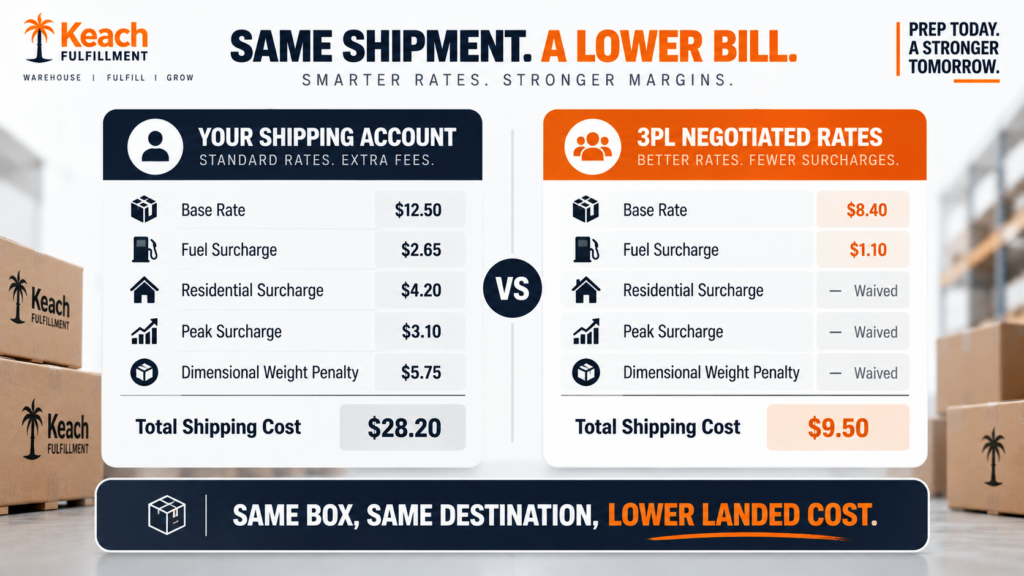
Base rates are lower, surcharges get negotiated down or waived entirely, and accessorial fees for things like address corrections or Saturday delivery get trimmed, so over the course of a year those small differences add up to real money that most sellers never fully account for.
The comparison sellers ask about most is 3PL carrier rates vs. my own shipping account, and on paper your UPS or FedEx discount looks decent until you compare it against what a fulfillment partner actually pays. In practice, their negotiated pricing usually beats yours by a wide margin because the carrier is pricing for volume rather than for a single account, and volume is the one thing a growing brand can’t manufacture on its own.
Your Shipping Rates vs. 3PL Rates
How Does 3PL Shipping Reduce Delivery Time
Speed comes from location more than anything else, and that’s a detail most sellers don’t appreciate until they see the numbers. A single warehouse can only reach so far in two days, but move inventory into two or three strategically placed facilities, and suddenly most of the country sits inside a two-day radius, which is the core mechanism behind 3PL shipping zones and transit times.
Shorter zones mean faster delivery and lower cost at the same time, which is a rare combination in logistics because most improvements force you to trade one for the other.
Most providers also run multiple carrier relationships rather than committing to one, so a package heading to a rural address might go with USPS while the same package heading to a major metro might ship with UPS Ground, and routing decisions happen at the warehouse level based on what actually performs best for that lane.
Sellers who’ve spent years defaulting to a single carrier often find this part surprising, mostly because they never had the volume to make routing worthwhile, but at scale even small differences in carrier performance start affecting delivery times across thousands of orders.
If you’ve ever wondered Can a 3PL do 2-day shipping for my orders, the answer is usually yes, provided your inventory is positioned correctly, because two-day delivery isn’t a carrier trick but a placement decision that depends entirely on where your stock sits relative to your customers.
Where the Savings Actually Come From
Cheaper rates don’t come from one big negotiation, since they come from several small advantages stacking up over time and compounding in ways that aren’t obvious on a single invoice.
- Negotiated base rates across multiple carriers.
- Reduced or waived surcharges on fuel, residential, and peak.
- Smarter box selection to avoid dimensional weight penalties.
- Zone skipping, where packages move in bulk before entering the carrier network.
- Routing decisions that match each package to the cheapest viable carrier.
That last point matters more than people realize, because most sellers default to one carrier out of habit and never see what they’re leaving on the table. A fulfillment partner compares options on every order, which is part of how a 3PL gets cheaper shipping rates without cutting corners on delivery speed, and it’s also why the savings tend to grow quietly over time rather than arriving as one dramatic improvement that shows up in the first month.
Keach Fulfillment uses negotiated carrier rates and smarter zones.
See How!What Changes in the First Weeks
Better shipping mechanics don’t kick in on day one because they build gradually as your inventory settles and the warehouse learns the shape of your orders. Carrier accounts get linked, shipping rules get configured, and product data gets cleaned up during those first weeks, and zones only start mattering once inventory is physically positioned, which typically takes a couple of weeks from the moment your first pallet arrives.
This is the stretch where sellers learn how long 3PL onboarding takes and what the first 30 days involve, and the honest answer is that setup speed depends less on the warehouse and more on how clean your product data was before you shipped anything.
Brands that arrive with tidy SKUs and accurate counts move fast, while brands that arrive with years of accumulated data clutter spend the first month sorting through it instead of shipping orders.
Setting Expectations Before the Handoff
Knowing what to expect when partnering with a 3PL provider for the first time keeps the transition calm, because your business doesn’t dramatically change once the handoff happens. Orders flow, tracking updates sync back to your store, and invoices arrive with clearer line items than you’ve probably seen before; the first month is mostly observation as you watch zone performance, check delivery times, and review which carriers perform best for your customers.
Once the data settles, the improvements become obvious in ways that weren’t visible during the first week, which is why it helps to resist judging the partnership until you’ve seen a full month of shipping activity.
Why This Matters More Than It Used To
Customer expectations have hardened over the past few years, and two-day delivery used to be a premium option but now functions as the baseline that shoppers assume without thinking. Sellers who can’t meet it lose orders to those who can, and the math is unforgiving because faster delivery lifts conversion while lower shipping costs lift margin, which means a fulfillment partner improves both at once in a way that’s rare in any business decision. The tradeoff is control, and for most brands that trade is worth making once the numbers are clear.
Conclusion: Ship Smarter, Not Harder
The benefits of 3PL shipping come down to leverage, since you get access to rates and routing that only make sense at scale without building the scale yourself. Keach Fulfillment exists to give growing brands that advantage without the overhead, and from negotiated carrier pricing to smarter zone placement, the goal is straightforward. Packages that arrive faster, invoices that make more sense, and a shipping line item that stops being a problem.
Faster delivery, lower costs, fewer surprises on the invoice.
Talk to Keach About Shipping.