
The signing with the fulfillment provider seems to be the end of the journey when it is just the beginning. The period between signing and processing the first order is usually underestimated by merchants due to the fact that the task itself is simple.
The honest answer is that most brands go live somewhere in the second or third week, then spend the rest of the month settling into a rhythm. Thirty days is a reasonable window for a functioning operation. It is not a reasonable window for perfection. Here’s what those weeks actually look like.
What Onboarding Actually Means at a Fulfillment Center
Onboarding isn’t a single event. It’s a sequence of handoffs, and each one depends on the last one being finished.
Your inventory has to arrive and be counted. Your sales channels have to connect to the warehouse system. Your SKUs have to be mapped so the right product gets picked. Packaging rules, carrier accounts, return procedures, and label formats all need to exist before anything ships. Miss one and the first live order becomes a manual rescue operation.
A well-run 3PL onboarding process is mostly front-loaded. The heavy lifting happens before any customer is waiting on a package, which is exactly why it feels slow at the time and invisible afterward.
30-Day Fulfillment Onboarding Timeline
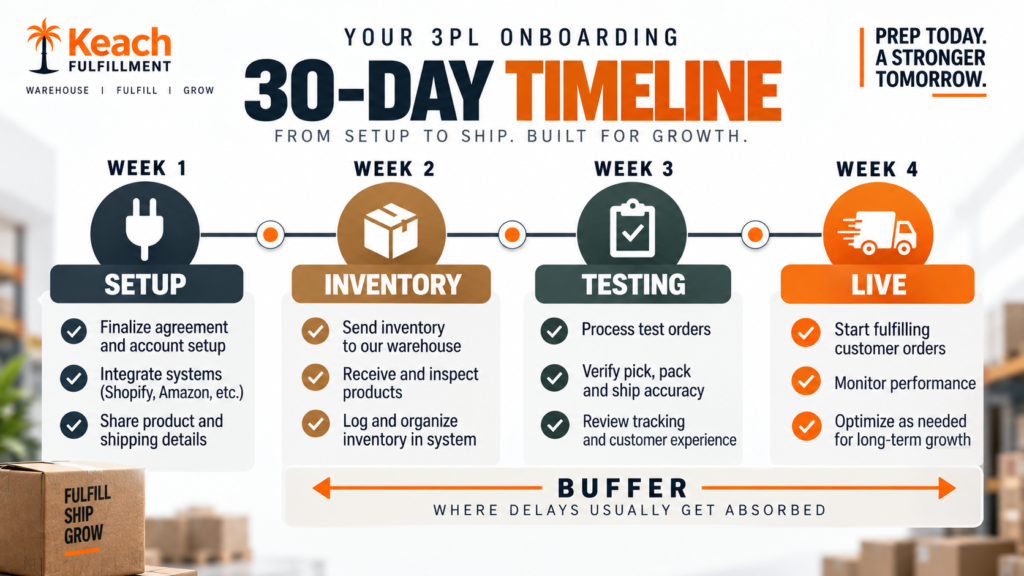
Week One: The Unseen Work That Decides Everything
Nothing ships in week one, and that’s normal.
This is when your software gets connected, whether that’s Shopify, Amazon, WooCommerce, or something less common. SKU data gets cleaned up and matched. Shipping rules get configured, including which carrier handles which zone and how rates get calculated.
The 3PL setup process and software integration timeline is the piece sellers ask about most, and it’s also the piece most likely to drag. If your product data is messy or your SKUs have drifted over the years, expect cleanup time. Experienced 3PL solutions providers flag these issues early rather than discovering them during your first busy week.
Keach Fulfillment walks you through setup step by step.
See How Keach Fulfillment Onboards New Brands.Week Two: Inventory Arrives and Gets Checked In
This week is physical. Pallets show up, get unloaded, counted, and entered into the system.
The brands that breeze through this are prepared properly. Learning how to prepare inventory for 3PL onboarding mostly comes down to labeling, packaging, and accuracy. Every carton needs a clear SKU reference. Units should be packed so they can be counted without a full unpack. Anything fragile needs protection that survives a freight truck, not just a courier van.
Discrepancies get resolved here too. If your records say 480 units and the warehouse counts 472, that conversation is far easier before the inventory is shelved than after.
Week Three: Test Orders Before Live Traffic
This is where the operation proves itself.
Most warehouses run test orders through each sales channel, checking that the right item gets picked, the label prints correctly, and tracking information flows back to your store. Some also push a return through the system so the reverse flow is tested before it’s needed for real.
If you want to know what to expect during 3PL warehouse onboarding, this is the week that answers it. You’ll see how they communicate, how quickly they respond, and whether their team catches small errors on its own.
Week Four: Live Orders and Real Numbers
By week four, orders are moving, and you’re watching actual performance data. Pick accuracy, ship time, and exception rates start telling you whether the partnership works.
The average 3PL onboarding timeline for e-commerce brands lands somewhere between two and four weeks for a standard catalog. Larger catalogs, hazmat items, or subscription models push past that. Smaller brands with clean data sometimes finish earlier.
It helps to keep a 3PL onboarding checklist for online store owners nearby during this stretch, covering software connection, SKU mapping, inventory prep, test orders, and a review of the first week’s live performance. Small oversights have a way of surfacing once real volume arrives.
Where Timelines Slip
Delays come from predictable places. Incomplete product data. Inventory arriving late or mislabeled. Slow responses during the software connection phase. Peak season crowding the warehouse calendar.
None of these are disasters. They’re the difference between a smooth month and a frustrating one. The fix is usually preparation on your side and clear communication on theirs, which is why the better 3PL solutions teams ask uncomfortable questions before onboarding starts rather than after.
Conclusion: A Month of Setup for Years of Breathing Room
The first thirty days are the least glamorous part of the relationship and the most important. Get them right and the months that follow run quietly in the background, which is the entire point. Keach Fulfillment built its onboarding around one assumption: sellers would rather hear bad news early than discover it during a launch week. From SKU cleanup to test orders, the goal is a launch you barely notice.
Keach handles the setup, the counts, and the first shipments.
Start Your Onboarding now!