
You have a solid product. Your marketing is working. Orders are flowing in. But something is wrong. Customers are receiving the wrong items. Orders are missing pieces. Packages are taking too long to ship. Your team is frustrated, and your customers are even more frustrated.
The root cause might surprise you. It is not your warehouse staff. It is not your shipping carriers. It is what happens before products ever reach your shelves.
Product preparation, the work done to get inventory ready for storage and fulfillment, has a direct impact on how accurately orders are picked and packed. When preparation is done right, fulfillment services run smoothly. When it is skipped or rushed, errors multiply.
Let’s explore how proper preparation sets the foundation for accuracy, speed, and customer satisfaction.
Struggling with fulfillment errors that frustrate your customers and your team?
Keep reading to learn how to better prepare products. Leads to fewer mistakes and faster shipping.
Book Your Exclusive CallWhat Is Product Preparation in Ecommerce?
Before we dive into accuracy, let us define what we are talking about. Product preparation is everything that happens to inventory between the moment it arrives at a warehouse and the moment it becomes ready to pick for customer orders.
This includes inspecting products for damage, applying barcode labels, poly bagging individual units, kitting multiple items together, and organizing products in a way that makes them easy to find.
Ecommerce prep services handle all of these tasks. Instead of your team spending hours on preparation, a specialized provider does the work. The result is inventory that is consistent, scannable, and ready to move.
Without proper preparation, products sit in receiving areas longer than they should. Labels are missing or incorrect. Items are stored in random locations because no one had time to organize them properly. Every one of these problems leads to fulfillment errors down the line.
How Preparation Affects Picking Accuracy
Picking is the process of pulling products from storage to fulfill customer orders. It sounds simple. But in a busy warehouse, pickers make hundreds or thousands of decisions every day. Each decision is an opportunity for error.
Proper preparation reduces those errors in several ways.
Clear labeling: When every product has a scannable barcode in a consistent location, pickers can verify they have the right item quickly. A quick scan confirms the pick. Without proper labeling, pickers must rely on visual identification, which is slower and more error-prone.
Consistent packaging: Products that are prepared uniformly are easier to pick. When every unit of the same SKU looks identical, pickers grab with confidence. When packaging varies, confusion follows.
Logical storage: Prepared products are stored in organized locations. Similar items are grouped. Fast-moving products are placed in easily accessible areas. This organization reduces travel time and picking mistakes.
Damage prevention: Products that are properly bagged or wrapped are less likely to be damaged during picking. A picker grabbing a poly bagged shirt is less likely to snag or dirty it than one grabbing a loose shirt.
Professional product prep workflow designs these elements into every step, creating a system where accuracy is the default outcome.
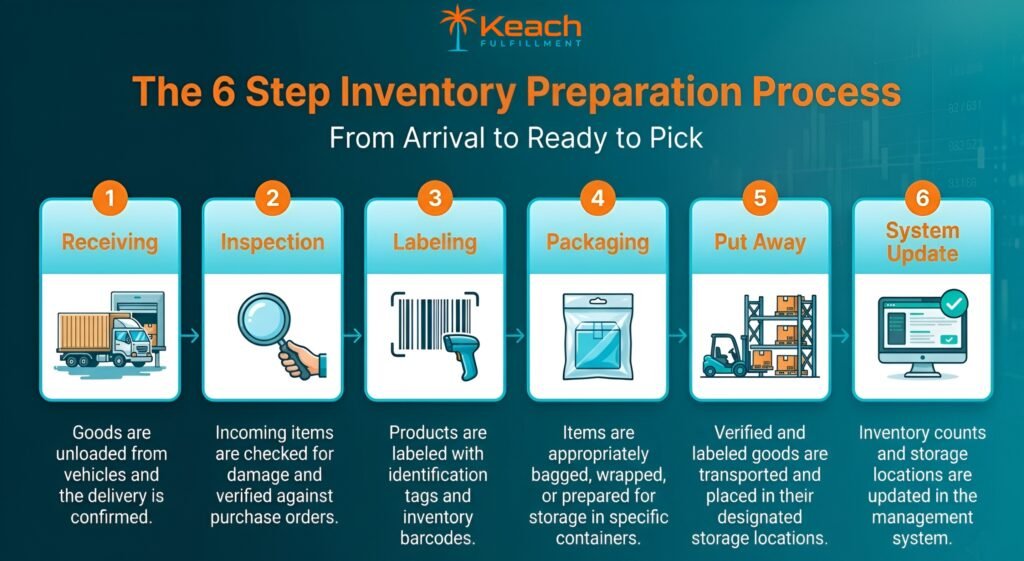
The Inventory Preparation Process Step by Step
A well-designed inventory preparation process follows a logical sequence. Each step builds on the previous one.
Step 1: Receiving: Products arrive and are logged into the system. Quantities are verified against packing lists. This creates a baseline record of what entered the facility.
Step 2: Inspection: Every unit is checked for damage, defects, or quality issues. Damaged products are separated and reported. Only acceptable inventory moves forward.
Step 3: Labeling: Barcodes, SKU labels, and compliance markings are applied. Labels are placed in consistent locations and verified for scanability.
Step 4: Packaging: Products are poly bagged, bubble wrapped, or otherwise protected. Kitted items are assembled into bundles.
Step 5: Put away: Prepared products are moved to storage locations. The system records exactly where each item is located.
Step 6: System update: Inventory counts are updated in real time. Your dashboard shows accurate, current stock levels.
When this process is followed consistently, every product in the warehouse is ready to pick. No surprises. No missing labels. No damaged units hiding in storage.
How Ecommerce Product Preparation Reduces Common Errors
Let us look at specific errors that proper ecommerce product preparation prevents.
Wrong item picked: This happens when similar-looking products are confused. Proper labeling with scannable barcodes eliminates this error. Pickers scan before picking, and the system confirms they have the correct item.
Missing components: This happens with kitted products where pieces have separated. Proper preparation includes verifying that all components are present before the kit is bagged or boxed. Once sealed, the kit stays intact.
Damaged products: This happens when damaged units are not caught before storage. Proper inspection during preparation identifies damage early. Damaged products never reach picking.
Inventory discrepancies: This happens when products are stored without being properly logged. Proper put-away procedures ensure every item is scanned into its location.
Slow fulfillment: This happens when pickers waste time searching for products. Proper organization during put-away means pickers always know where to find what they need.
In our previous guide, Packaging Standards for Online Retail Products, we discussed how proper packaging protects items during shipping. Preparation extends that protection backward into the warehouse, ensuring products are in good condition before they ever get picked.
| Preparation Step | Without It | With It |
|---|---|---|
| Inspection | Damaged products reach customers | Damage caught before storage |
| Labeling | Pickers guess at product identity | Scannable barcodes confirm picks |
| Poly Bagging | Products get dirty or damaged in storage | Products stay clean and protected |
| Kitting | Bundle components separately | Kits remain intact |
| Organized Put Away | Pickers search for products | Pickers go directly to locations |
The Connection Between Preparation and Speed
Accuracy is not the only benefit of proper preparation. Speed improves as well. When products are prepared consistently, pickers move faster. They do not stop to verify product identities by sight. They do not hunt for missing labels. They do not inspect each unit for damage because that already happened.
The time savings add up quickly. A picker who saves five seconds per pick across one thousand picks saves nearly an hour and a half. Across a full warehouse team, the productivity gain is substantial. Faster picking means faster order processing. Faster processing means shorter delivery times. Shorter delivery times mean happier customers.
Professional packaging and labeling services contribute to this speed. When labels are applied consistently and packaging is uniform, the entire fulfillment operation runs more efficiently.
Real World Examples of Preparation Improving Accuracy
Let us look at a few scenarios where preparation makes a measurable difference.
Apparel seller: A clothing brand sends shirts to a prep center. Each shirt is folded, placed in a poly bag, and labeled with a scannable barcode. In the warehouse, pickers scan each bag before placing it in order. The result is 99.9 percent picking accuracy. Before using prep services, the brand had a 2 percent error rate, mostly from grabbing the wrong size or color.
Beauty products: A skincare company sells sets with multiple items. The prep center receives individual products, inspects each one, and assembles them into sealed kits. Each kit has its own barcode. Pickers grab one kit per order instead of hunting for three separate items. Order processing time drops by 40 percent.
Electronics accessories: A cable seller has dozens of similar-looking products. Without proper labeling, pickers frequently grabbed the wrong cable type. After implementing professional labeling services, error rates dropped to near zero. The company saved thousands in return shipping and refund costs.
These examples show that preparation is not an extra expense. It is an investment in accuracy that pays for itself.
Ready to see your fulfillment errors drop and your processing speed increase?
Professional preparation transforms chaotic warehouses Into accurate, efficient operations.
Book Your Exclusive CallSigns Your Current Preparation Process Needs Improvement
How do you know if your preparation process is causing fulfillment problems? Look for these warning signs.
High error rates: If customers regularly receive wrong items or missing components, your preparation may be the culprit. Inconsistent labeling and poor organization lead to picking mistakes.
Slow order processing: If your team struggles to keep up with order volume, preparation bottlenecks may be slowing them down. Products that are hard to find or require extra handling take more time.
Frequent inventory discrepancies: If your system counts rarely match physical counts, products may not be logged properly during put-away. This often traces back to rushed or inconsistent preparation.
Damaged products reaching customers: If customers report receiving damaged items, inspection during preparation may be insufficient. Damaged products should never make it to picking.
Staff frustration: If your warehouse team complains about missing labels, disorganized storage, or confusing product identification, listen to them. They see the problems firsthand.
When to Outsource Product Preparation
Many sellers start by handling preparation themselves. That works at small volumes. But as you grow, the case for outsourcing strengthens.
Volume. When you are preparing hundreds or thousands of units weekly, the time commitment becomes significant. Outsourcing frees your team for higher-value work.
Complexity. Products with special handling needs, multiple components, or strict marketplace requirements benefit from professional expertise.
Space. Preparation requires a workspace. As you grow, finding room for receiving, inspection, labeling, and packaging becomes challenging. Outsourcing moves these activities off-site.
Seasonal spikes. Handling holiday volume with in-house preparation often requires temporary staff and overtime. A prep partner scales without the hiring hassle.
Accuracy requirements. If your business cannot tolerate fulfillment errors, professional preparation provides the consistency you need.
Professional ecommerce prep services offer a simple value proposition. You send inventory to the prep center. They handle everything. You receive ready-to-sell products that pick accurately and ship quickly.
Wrap Up
Fulfillment accuracy does not happen by accident. It is the result of careful preparation at every stage of the inventory journey. Products that are inspected, labeled, packaged, and organized properly are picked accurately and shipped quickly. Products that are rushed through preparation cause errors, delays, and customer frustration. The connection is clear. Good preparation leads to good fulfillment. Skipped or sloppy preparation leads to problems.
If your business struggles with fulfillment errors, look upstream. The root cause is often not in the picking or packing process itself. It is what happened before products ever reached the picker.
At Keach Fulfillment, we build accuracy into every step of our product preparation workflow. From inspection and labeling to poly bagging and kitting, we prepare your inventory so it picks correctly every time. Our packaging and labeling services are designed to eliminate the errors that plague so many ecommerce operations.
Ready to stop chasing fulfillment errors and start shipping accurately?
Let us show you how professional product preparation transforms your operations.
Contact Keach Fulfillment today!