
You have a Shopify store. You also sell on Amazon. And you just listed a few products on eBay. More channels mean more customers, which sounds great in theory. But then the headaches start.
Your Shopify inventory says you have ten units left. Amazon says twelve. Which number is right? You oversell a product because one system did not update fast enough. A customer orders from your website, but the item is sitting in an Amazon warehouse. You cannot get to it.
This is the reality of selling across multiple platforms without a unified strategy. Each channel operates in its own silo. You are the one stuck in the middle, trying to keep everything straight.
Multi-channel fulfillment solves this problem. It connects your sales channels to a single fulfillment operation. Orders flow in from everywhere. Inventory updates automatically. Products ship from one place. Let us break down what this means for your business.
What Is Multi-Channel Fulfillment?
Let us start with a simple definition. Multi channel fulfillment is the process of managing orders and inventory across multiple sales channels from a single fulfillment operation.
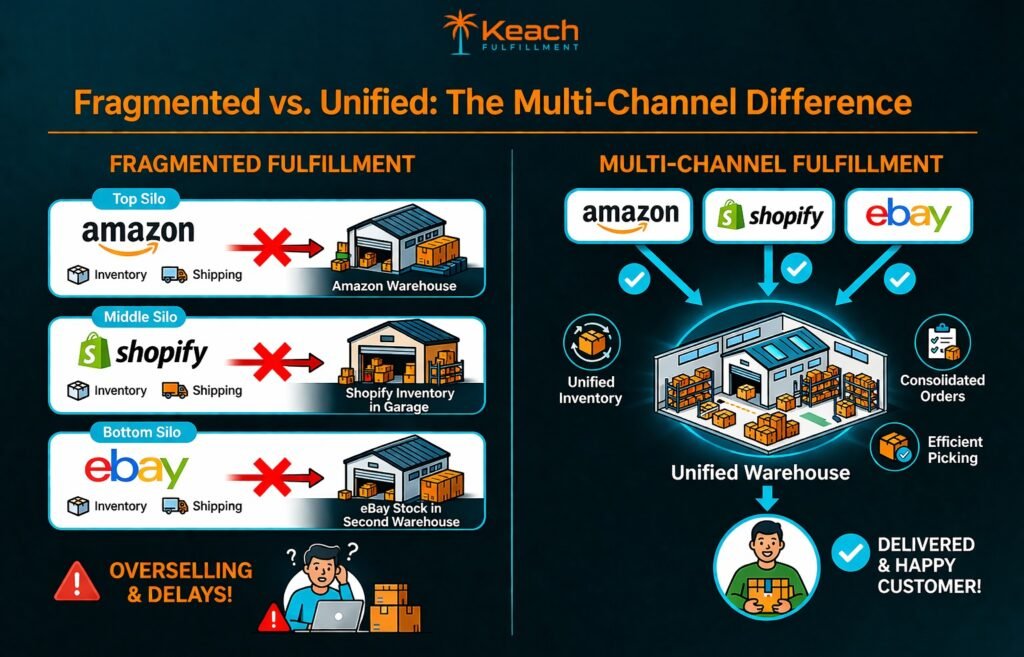
Instead of running separate systems for Amazon, Shopify, eBay, and your own website, you connect every channel to one warehouse or fulfillment partner. When a customer buys from any channel, that order flows into your central system. The product is picked from your unified inventory, packed, and shipped. Inventory counts update across every channel automatically.
The alternative is fragmented fulfillment. You store some inventory at Amazon for FBA orders. You keep separate inventory for your Shopify orders in your garage or a small warehouse. You manage a third batch for Walmart. Each channel operates independently.
Fragmentation creates real problems. You cannot easily move inventory between channels. You might be out of stock on Amazon while sitting on excess units for Shopify. You spend hours reconciling numbers across different systems. Multi-channel fulfillment eliminates these problems by creating one source of truth for your entire operation.
Why Multi-Channel Order Fulfillment Matters
Multi-channel order fulfillment is not just a nice to have. For growing ecommerce brands, it is essential.
Inventory efficiency. When all your channels share a single inventory pool, you need less total stock to hit your sales targets. Safety stock can be shared rather than duplicated. This frees up cash that would otherwise sit on shelves.
Preventing oversells. Overselling happens when two channels sell the same product at nearly the same time, and your systems do not sync fast enough. With unified fulfillment, inventory updates in real time. The moment a unit sells on Amazon, your Shopify store sees the reduced count.
At Keach Fulfillment, we build multi-channel solutions that just work. Our platform integrates with Amazon, Shopify, WooCommerce, eBay, Walmart, and more. We handle the complexity so you can focus on growth. From receiving and storage to pick, pack, and ship, we provide the unified fulfillment that multi-channel sellers need.
Consistent branding. Orders from different channels should feel the same. Same packaging. Same shipping speed. Same tracking experience. Multi-channel fulfillment delivers this consistency because every order flows through the same process.
Less administrative work. One dashboard instead of five. One set of processes instead of multiple. One team managing everything instead of separate teams for each channel. Less complexity means fewer errors and more time for growing your business.
How Multi-Channel Ecommerce Logistics Works
Multi-channel ecommerce logistics follows a straightforward flow when set up correctly.
First, you connect your sales channels to a central fulfillment system. This could be a warehouse management system, a third-party logistics provider’s platform, or integration software that links everything together. The key is real-time communication between channels and your fulfillment hub.
Second, your inventory is stored in a single location or a network of locations that operate as one. When products arrive, they are logged into the system and become available across all channels immediately.
Third, when an order comes in from any channel, the system receives it automatically. Inventory is reserved so other channels cannot sell that same unit. Your fulfillment team picks, packs, and ships the order, often within hours.
Fourth, tracking information is sent back to the original sales channel. The customer receives shipping notifications from the platform where they purchased, but the fulfillment happens from your central hub.
This flow works whether you sell on two channels or twelve. The key is integration. Your systems need to talk to each other in real time, not once a day or once an hour.
The Role of Multi-Channel Inventory Management
Multi-channel inventory management is the engine that makes everything work. Without accurate, real-time inventory data, multi-channel fulfillment falls apart.
Here is what proper multi-channel inventory management looks like. When a shipment arrives at your warehouse, every unit is scanned and logged. That inventory becomes available across all your sales channels instantly. When a customer buys from any channel, that unit is deducted from your total available stock. Every channel sees the updated count in real time.
This real-time sync prevents the most common multi-channel problem. Selling the same unit twice because your systems were out of sync.
Good inventory management also helps with forecasting. You can see which products are moving quickly across all channels, not just on Amazon or just on Shopify. This visibility helps you make better purchasing decisions. You buy stock based on total demand, not channel by channel.
Many sellers find that proper multi-channel inventory management reduces their total inventory needs by 15 to 25 percent. That is cash that can be used for marketing, product development, or anything else that grows your business.
Oversold a product one too many times?
Real-time inventory sync across every platform.
One source of truth.Common Multi-Channel Scenarios
Let us look at a few real world examples of how multi-channel fulfillment works in practice.
The Amazon plus Shopify seller. A brand sells skincare products on Amazon and its own Shopify store. With multi-channel fulfillment, all inventory is stored in one warehouse. When a customer buys from Shopify, the order ships from that warehouse. When a customer buys from Shopify, the same warehouse fulfills the order, either through Seller Fulfilled Prime or by sending inventory to Amazon as needed. The brand never worries about splitting inventory or manually updating counts.
The eBay plus Walmart seller. An electronics accessories seller lists products on eBay and Walmart. Both platforms have their own requirements. A good fulfillment partner handles the compliance differences while pulling from the same inventory pool. The seller sees one dashboard with orders from both channels.
The multi-brand operator. A company owns several different ecommerce brands, each with its own website. Rather than operating separate warehouses for each brand, they use multi-channel fulfillment to store all inventory together. Orders from any brand flow into the same system, but reporting keeps the brands separate. This approach saves space, reduces labor costs, and simplifies operations.
In our previous guide, Multi-Channel Ecommerce Fulfillment Complete Operational Guide, we dove deeper into platform-specific strategies and partner selection. That guide is a great resource if you are ready to build out your multi-channel operation.
Challenges of Multi-Channel Operations
E-commerce multi-channel operations come with challenges. Knowing what they are helps you prepare.
Channel-specific requirements. Amazon requires certain labeling and packaging. Walmart has different standards. Your fulfillment partner must handle these variations without creating separate workflows for every channel. The solution is working with a partner experienced across multiple platforms.
Returns processing. Returns from different channels need consistent handling but different crediting. An Amazon return goes through Amazon’s return process. A Shopify return might be handled directly. Your fulfillment partner should support both approaches seamlessly.
Seasonal planning. Different channels have different peak seasons. Amazon has Prime Day and Q4 holidays. Shopify sellers see spikes around Black Friday Cyber Monday. Your inventory and staffing need to account for overlapping peaks.
Cost visibility. When you share inventory across channels, you need to know which channel is driving which costs. Good reporting helps you allocate fulfillment expenses accurately for margin analysis.
These challenges are manageable with the right systems and partners. The benefits of multi-channel fulfillment far outweigh the complexities.
When to Move to Multi-Channel Fulfillment
Not every business needs multi-channel fulfillment from day one. Here is how to know when it is time.
You are selling on three or more channels. The more channels you add, the more painful fragmentation becomes. Once you pass two channels, the case for unification gets strong.
You are spending more than a few hours each week reconciling inventory. If you regularly find yourself comparing spreadsheets or logging into multiple dashboards, you need a better system.
You have had an oversell. Even one oversell is a sign that your systems are not keeping up. Customers hate being told an item is out of stock after they have already paid.
You want to scale. Handling multi-channel fulfillment manually might work at fifty orders a day. It will not work at five hundred. Build the right systems before you need them, not after. For a professional support, contact Keach Fulfillment to make sure you’re always acing handling multi-channel fulfillment by skilled team
Wrap Up
Multi-channel fulfillment is not about adding complexity. It is about reducing it. When your sales channels are connected to a single fulfillment operation, you stop juggling. You stop wondering which inventory count is correct. You stop explaining to customers why their order from your website is shipping from three different places.
The goal is simple. One inventory pool. One fulfillment process. One source of truth. Orders flow in from every channel. Inventory updates automatically. Customers receive consistent, reliable service no matter where they buy.
At Keach Fulfillment, we build multi-channel solutions that just work. Our platform integrates with Amazon, Shopify, WooCommerce, eBay, Walmart, and more. We handle the complexity so you can focus on growth. From receiving and storage to pick, pack, and ship, we provide the unified fulfillment that multi-channel sellers need.