
You have decided to sell on Amazon. Great choice. Now comes the first big decision. How will you get products to your customers? Amazon gives you two main paths. FBA, where Amazon stores and ships your products. Or FBM, where you handle fulfillment services yourself. But here is what many sellers miss. FBM does not have to mean you do all the work alone.
You can use FBM while partnering with a third party logistics provider. Your orders still show as merchants fulfilled on Amazon. But behind the scenes, a professional fulfillment center is doing the picking, packing, and shipping. Understanding the operational differences between handling fulfillment yourself and using professional services will help you make the right choice for your business.
Keep reading to learn which approach fits your business best.
Contact us todayWhat Is Amazon FBM Fulfillment?
Amazon FBM fulfillment stands for Fulfilled by Merchant. Under this model, you are responsible for storing your inventory and shipping orders to customers. When a customer buys your product, you receive the order and must pick, pack, and ship it within Amazon’s required handling time.
FBM gives you control. You decide where the inventory is stored. You choose which carriers to use. You handle customer service for shipping issues. You also keep more of your margin since you are not paying Amazon’s FBA fees.
The challenge is operational. As order volume grows, so does the work. Packing boxes, printing labels, and coordinating carrier pickups consume time and energy. This is where many sellers start looking for help.
The Amazon Order Fulfillment Process for FBM
When a customer places an order, Amazon sends you a notification. You have a set handling time, typically one to two business days, to confirm shipment. Within that window, you must pick the product from your inventory, pack it securely, print the shipping label, and hand the package to a carrier.
Once the carrier scans the package, you update Amazon with tracking information. Amazon then notifies the customer that their order is on the way. You are responsible for any delivery issues, lost packages, or damage claims.
This process works well for sellers with low order volumes. But each step requires manual effort. As volume increases, the process becomes harder to manage without help.
Amazon Seller Fulfillment Options
Self fulfillment. You store inventory at home or in a small space. You handle all picking, packing, and shipping yourself. Best for very low volumes under fifty orders per week.
In-house team. You hire employees to handle fulfillment services. You rent or buy warehouse space. You manage the entire operation. Best for medium volumes where outsourcing is not yet cost-effective.
Third-party logistics. You partner with a fulfillment company. They store your inventory in their warehouse. Orders flow to them automatically. They pick, pack, and ship. Best for growing sellers who want to scale without managing a warehouse. The third-party option gives you the benefits of FBM control with the efficiency of professional operations.
How the Merchant Fulfilled Network Works with a 3PL
The merchant fulfilled network is Amazon’s term for sellers who fulfill their own orders. But Amazon does not require that you personally pack every box. You can use a fulfillment partner as long as you meet Amazon’s performance metrics.
Here is how it works. You connect your 3PL to your Amazon seller account using an integration tool or API. When an order comes in, it is sent automatically to the 3PL. Their team picks the product from your dedicated inventory, packs it according to your specifications, and ships it using a carrier that meets Amazon’s delivery requirements.
The 3PL then uploads tracking information to Amazon. The customer sees the order as shipped from you. Amazon’s performance metrics are satisfactory because handling times and shipping speeds are met. You retain the FBM advantage of lower fees while offloading the physical work. It is the best of both worlds.
Amazon FBM Logistics Considerations
Handling time. Amazon requires you to set a handling time for each product, typically one or two business days. Your fulfillment partner must be able to pick, pack, and ship within that window consistently.
Shipping speeds. Customers expect fast delivery. Your fulfillment partner should have carrier relationships that provide competitive shipping speeds without exorbitant costs.
Inventory placement. With FBM, you decide where your inventory is stored. Storing closer to your customer base reduces shipping times and costs. A 3PL with multiple warehouse locations can help.
Returns. Under FBM, you handle returns directly. Your fulfillment partner should have a clear process for receiving, inspecting, and processing returned items.
Performance metrics. Amazon tracks your late shipment rate, pre fulfillment cancel rate, and valid tracking rate. Your fulfillment partner’s performance directly impacts these metrics.
| Fulfillment Approach | Control Level | Best For |
|---|---|---|
| Self Fulfillment | Complete control | Under 50 weekly orders |
| In-House Team | Full control with help | 50 to 500 weekly orders |
| 3PL for FBM | Strategic control | 500+ weekly orders or scaling fast |
Operational Differences Between Self Fulfillment and 3PL for FBM
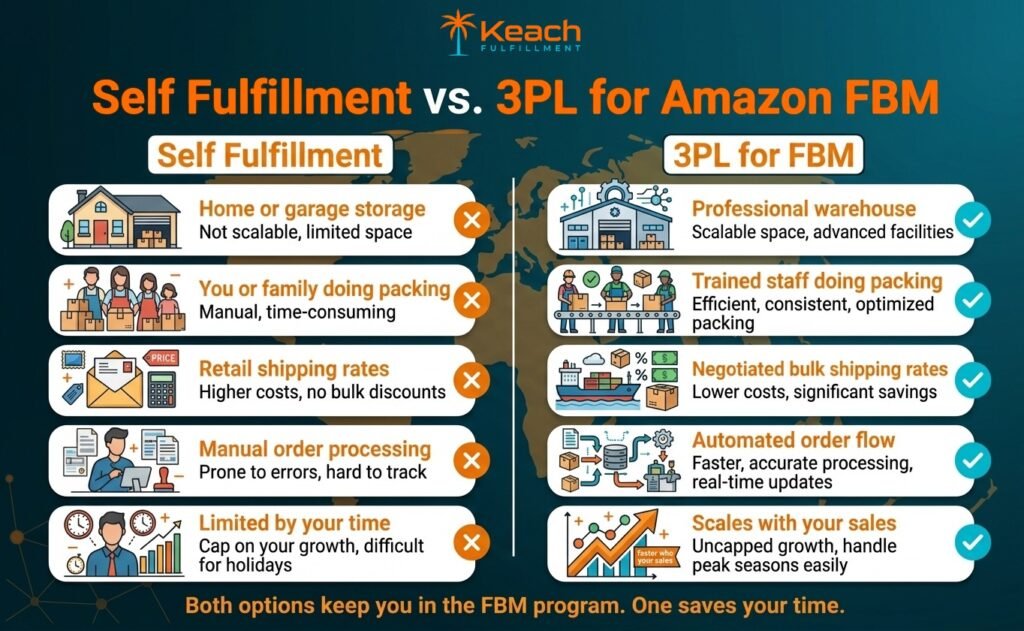
Space. Self fulfillment requires you to dedicate space in your home, garage, or a small rental. A 3PL moves inventory offsite, freeing your space for other uses.
Staff. Self fulfillment means you or a small team does the work. A 3PL provides trained staff who do fulfillment as their primary job.
Equipment. Self fulfillment requires you to buy printers, scales, tape dispensers, and packing materials. A 3PL already has industrial equipment and bulk material pricing.
Carrier relationships. Self fulfillment means paying retail or small business shipping rates. A 3PL has negotiated carrier rates that are often much lower.
Scalability. Self fulfillment hits a ceiling. You can only pack so many boxes. A 3PL scales with your business seamlessly.
Errors. Self fulfillment error rates tend to increase when you are rushed. Professional 3PLs maintain high accuracy because they have systems and quality checks.
In our previous guide, WooCommerce Fulfillment Explained, we discussed fulfillment services for WooCommerce stores. The same principles apply to Amazon FBM. Professional logistics partners handle the physical work while you focus on sourcing, marketing, and growth.
Which Approach Is Right for You?
Choosing between self fulfillment and a 3PL for FBM depends on your situation. Self fulfillment works when your order volume is low, your products are simple to pack, and you have more time than money. It also works when you are just starting and want to learn the business before committing to a partner.
A 3PL for FBM makes sense when order volume is consuming your time, you have run out of storage space, you are making fulfillment errors, or you want to scale without building your own warehouse. Many sellers start with self fulfillment and switch to a 3PL when they hit fifty to one hundred orders per week. That is the point where fulfillment stops being a task and starts being a job.
Wrap Up
Amazon FBM gives you control over your fulfillment services. But control does not have to mean doing everything yourself. You can keep the benefits of FBM, lower fees, and direct customer relationships, while outsourcing the physical work to a professional partner.
The operational differences are clear. Self fulfillment works on a small scale. A 3PL for FBM works at every scale beyond that. You get professional picking, packing, and shipping without managing a warehouse or hiring staff.
At Keach Fulfillment, we help Amazon sellers master FBM. Our team integrates with your Amazon seller account. Orders flow to us automatically. We pick, pack, and ship within Amazon’s handling time requirements. You get the control of FBM with the efficiency of professional logistics.
Contact Keach Fulfillment today.
Let us handle your FBM fulfillment.