
Running an online store means more than just listing products and processing payments. The moment a customer clicks “buy,” a complex series of operations kicks into motion, and that’s where many new ecommerce sellers hit their first major operational wall. Understanding what is ecommerce fulfillment and how it actually works makes the difference between scaling smoothly and drowning in logistics chaos.
The truth is, fulfillment isn’t glamorous. Nobody starts an online business dreaming about packing boxes or negotiating with shipping carriers. But getting this part right determines whether your customers receive orders on time, whether you have bandwidth to grow, and ultimately, whether your business can scale beyond what you personally can handle in your garage.
Breaking Down the Ecommerce Fulfillment Meaning
At its core, ecommerce fulfillment means everything that happens after a customer places an order until that package arrives at their doorstep. It’s the physical execution of online commerce, the bridge between digital transactions and tangible products.
Think of it this way: your website is the storefront, but fulfillment is the back office, warehouse, shipping department, and logistics coordination all rolled into one. When fulfillment works well, customers barely notice it. They order, products arrive quickly and correctly, and everyone’s happy. When it breaks down, though, the consequences ripple through your entire business.
Most founders handle fulfillment themselves initially. You store inventory at home, pack orders as they come in, make daily post office runs, and track shipments manually. This works at small volumes. It’s when you’re processing dozens or hundreds of orders weekly that the cracks start showing: missed shipments, packing errors from rushing, inventory scattered across multiple locations, and zero time left for actually growing the business.
The Complete Ecommerce Order Fulfillment Process
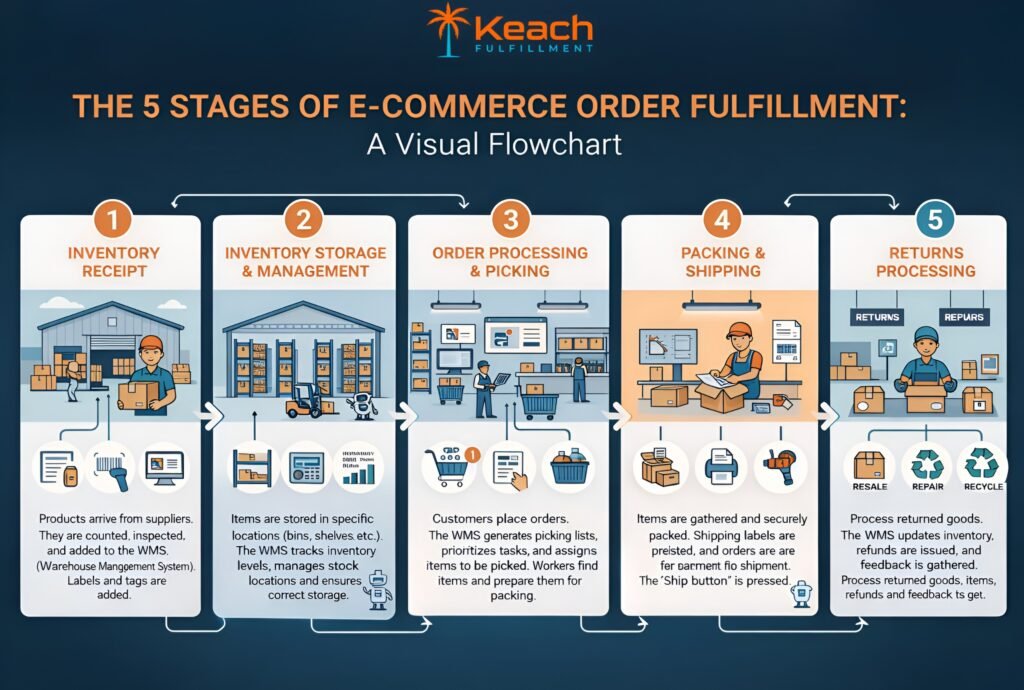
Understanding the ecommerce order fulfillment process reveals why it’s more complex than it first appears. Each stage requires attention, systems, and often specialized knowledge.
Inventory Storage and Management
Everything starts with having products available when customers order them. Inventory needs to be received from suppliers, counted for accuracy, inspected for damage, and organized in accessible storage locations. You need systems tracking exactly what you have, where it’s located, and when you’re running low.
For self-managed operations, this might be shelves in your basement with a spreadsheet. Professional operations use warehouse management systems that track every unit with barcode scanning and real-time updates. The complexity scales with your product range. Managing 5 SKUs is straightforward; managing 500 becomes a full-time job without proper systems.
Order Processing and Picking
When an order comes in, someone needs to locate the products (picking), verify they’re correct, and move them to packing areas. In your home operation, this means walking to your storage area and grabbing items. In professional warehouses, pickers use handheld scanners that direct them to exact shelf locations, then scan barcodes to verify they grabbed the right products.
This verification step prevents the most common fulfillment error: shipping the wrong item. Visual-only picking leads to mistakes when you stock similar products. Barcode scanning forces accuracy.
Packing and Quality Control
Products need to be packed securely enough to survive shipping while minimizing dimensional weight charges that increase costs. This means selecting appropriately sized boxes, adding protective materials like bubble wrap or air pillows, and ensuring nothing shifts during transit.
Professional ecommerce fulfillment services have standardized packing procedures for different product types. Fragile items get specific treatment. Apparel ships differently than electronics. These standards create consistency that home operations struggle to maintain when you’re rushing through orders.
Quality checks at packing verify that the right products in correct quantities are going to the right customer. Catching errors here is cheap. Fixing them after shipment involves return shipping costs, replacement shipping, customer service time, and damaged reputation.
Shipping and Tracking
Once packed, orders need shipping labels with accurate addresses, appropriate service levels (ground, 2-day, overnight), and proper weight for billing. Labels print, packages move to carrier pickup areas, and tracking information flows back to your store and customers.
Shipping carrier selection affects both cost and delivery speed. Professional operations use software that automatically shops rates across carriers and selects optimal options based on destination, weight, and urgency. Self-managed sellers typically stick with one carrier and pay retail rates rather than negotiated discounts.
Returns Processing
Returns are inevitable in ecommerce. Products come back for various reasons, such as the wrong size, changed minds, defects, or shipping damage. The fulfillment process includes receiving returns, inspecting the condition, determining if items can be restocked, and processing refunds or exchanges.
Returns handling often gets overlooked when evaluating what ecommerce fulfillment is, but it’s a critical component. Smooth returns processing maintains customer satisfaction even when initial orders don’t work out.
When Self-Fulfillment Stops Making Sense
There’s no universal order volume threshold where everyone should outsource. The transition point depends on your business model, product characteristics, and personal situation. That said, several clear indicators suggest you’ve outgrown DIY fulfillment.
If you’re working nights and weekends just to keep up with packing orders, you’re trading growth time for operational tasks. Every hour spent on fulfillment is an hour not spent on marketing, product development, or strategic partnerships that actually scale revenue.
Space constraints hit differently depending on your living situation, but when inventory spreads across multiple rooms, or you’re renting off-site storage just for products, you’re essentially paying for amateur warehouse space at premium prices.
Packing errors start increasing when you’re rushed. Quality suffers under volume pressure. If customer complaints about wrong items or damaged shipments are rising, that’s a direct signal that your current system can’t handle the load.
Perhaps most telling: you’ve avoided running promotions or expanding to new sales channels specifically because you can’t handle the fulfillment volume. That’s turning down revenue directly because of operational limitations.
How Professional Ecommerce Fulfillment Services Work
An ecommerce fulfillment company operates as your outsourced logistics department. Here’s how the relationship typically works.
You send inventory to their warehouse instead of storing it yourself. Their receiving team counts products, verifies conditions, and logs everything into their warehouse management system. Products get stored in organized locations, tracked by SKU and barcode.
When customers order from your Shopify store, Amazon shop, or wherever you sell, those orders flow automatically to the fulfillment provider through platform integrations. No manual forwarding or file uploads, orders arrive in their system within minutes of customers placing them.
Their warehouse staff receives pick lists showing exactly where products are located. They collect items using barcode scanners for verification, pack them according to your specifications (including any custom packaging or inserts you’ve requested), generate shipping labels automatically, and move packages to carrier pickup areas.
Tracking information flows back to your store automatically. Customers receive shipping notifications. Inventory counts update in real-time across all your sales channels, preventing overselling.
You maintain dashboard access showing current inventory levels, order status, and fulfillment performance metrics. The entire operation runs without you touching products, freeing you to focus on business growth instead of box packing.
| Fulfillment Model | Best For | Typical Costs |
|---|---|---|
| Self-Fulfillment | <100 orders/month | Time + supplies |
| Hybrid (peak seasons only) | Seasonal businesses | Variable based on volume |
| Full Outsourcing | >200 orders/month | $2-5 per order + storage |
| Amazon FBA | Amazon-focused sellers | Platform-specific fees |
Choosing the Right Fulfillment Approach
Not every business needs to outsource fulfillment, and not every fulfillment provider suits every business. Making the right choice requires honest assessment of your current situation and growth trajectory.
Consider your order volume and growth rate. If you’re processing 50 orders monthly with slow growth, self-fulfillment probably still makes sense. At 300 orders monthly with 20% monthly growth, you’re approaching the point where professional fulfillment becomes economical and necessary.
Product characteristics matter significantly. Small, lightweight products are easier to self-fulfill than large, fragile items requiring specialized packaging. Products with expiration dates need rotation systems that home operations struggle to maintain. Hazardous materials have storage and shipping requirements that require professional handling.
Your sales channel mix influences fulfillment complexity. Selling only on your own website is simpler than managing inventory across Shopify, Amazon FBM, eBay, and Etsy simultaneously. Multi-channel selling benefits enormously from unified fulfillment that synchronizes inventory across platforms.
Geographic customer distribution affects shipping strategy. If customers cluster in specific regions, the warehouse location becomes important for delivery speed and cost optimization.
Technology That Powers Modern Fulfillment
Behind effective ecommerce fulfillment services sits a sophisticated technology infrastructure that most sellers don’t see but directly benefits from.
Warehouse management systems coordinate all operations from receiving through shipping. They track product locations, generate pick lists, manage packing workflows, and integrate with carriers for label generation and rate shopping.
Barcode scanning creates verification checkpoints throughout the process. Products get scanned at receiving to confirm arrival, during picking to verify correct items, and at packing for final accuracy checks. This systematic verification maintains accuracy rates above 99% in professional operations.
Integration middleware connects warehouse systems to ecommerce platforms. APIs enable automatic order flow, real-time inventory synchronization, and tracking updates without manual intervention. This integration is what makes outsourced fulfillment seamless rather than requiring constant coordination.
Reporting and analytics dashboards provide visibility into fulfillment performance. You see metrics like order accuracy rates, average ship times, inventory turnover, and cost per order. Data-driven insights enable continuous optimization.
The Real Costs and ROI of Professional Fulfillment
Price comparison between self-fulfillment and outsourced services isn’t straightforward because many self-fulfillment costs are hidden or untracked.
Calculate your true self-fulfillment expenses: warehouse or storage space rental, packing supplies, shipping materials, equipment like scales and label printers, any part-time labor, and critically, your own time at a realistic hourly value. If you spend 20 hours weekly on fulfillment and your time is worth $50/hour to your business, that’s $1,000 weekly in opportunity cost alone.
Professional fulfillment typically costs $2.50-$5.00 per order for pick and pack, plus storage fees and actual shipping costs. For many businesses, this totals 60-70% of true self-fulfillment costs when all factors are included, and it frees substantial time for revenue-generating activities.
The ROI calculation isn’t just a cost comparison, though. Professional fulfillment usually ships faster and more accurately than overwhelmed solo operations. Better customer experience drives repeat purchases and positive reviews. That value is harder to quantify but very real.
Common Fulfillment Mistakes to Avoid
Many ecommerce sellers make predictable mistakes when setting up or outsourcing fulfillment operations.
Choosing solely on price often backfires. The cheapest fulfillment provider typically means the least experienced staff, the oldest technology, and the most errors. Those errors cost more than the fees saved through picking the budget option.
Failing to verify integration capabilities before committing creates ongoing headaches. If your fulfillment provider can’t connect directly to your ecommerce platforms, you’re stuck with manual order forwarding and delayed inventory updates that cause overselling problems.
Not testing with small batches first is risky. Send a trial shipment, place test orders, verify that accuracy and speed meet promises before moving all inventory. Discovering problems after full commitment is exponentially more painful.
Overlooking returns processing in contracts confuses. How are returns handled? What are the inspection procedures for returned items? What fees apply? Clear answers prevent disputes later.
Ignoring scalability constraints means outgrowing your fulfillment provider and facing another disruptive transition. Verify they can handle 5x or 10x your current volume before things get complicated.
Making the Transition Smoothly
Successfully moving from self-fulfillment to outsourced operations requires preparation and realistic expectations.
Start by organizing your product data. Every SKU needs accurate descriptions, dimensions, weights, and any special handling requirements documented clearly. The better information you provide upfront, the smoother operations run.
Build inventory buffers before transitioning. Keep some stock available for self-fulfillment while ramping up with your new provider. This prevents stockouts during the learning curve period.
Expect an adjustment phase. The ecommerce fulfillment company needs to learn your products, and you need to learn their systems and communication rhythms. Most transitions take 2-4 weeks to reach full efficiency.
Communicate proactively with customers during the transition. Brief shipping delays or location changes in tracking aren’t concerning when you’ve set expectations. Surprises damage trust.
What Success Looks Like
When fulfillment works correctly, it becomes invisible infrastructure that just handles itself. Orders ship accurately and quickly without your involvement. Customers receive products as expected and leave positive reviews.
Your time redirects to strategic activities: sourcing new products, improving marketing, optimizing conversion rates, and expanding to new channels. Revenue grows without operational constraints.
Inventory management improves through real-time visibility and professional systems. You make smarter purchasing decisions based on actual turnover data rather than guesswork.
The ultimate measure: you’ve successfully run major promotions or seasonal campaigns without fulfillment becoming a bottleneck. You’ve scaled significantly without the operational chaos that plagued earlier growth attempts.
Understanding what ecommerce fulfillment is and how the ecommerce order fulfillment process actually works is foundational knowledge for any online seller. Whether you’re handling operations yourself or working with an ecommerce fulfillment company like Keach Fulfillment, getting this right determines your ability to deliver consistently excellent customer experiences while maintaining the bandwidth to grow your business strategically rather than just operationally.