
Once, there was a case of a store owner who had spent months running an e-commerce store with two separate systems. Orders came into Shopify, then they were manually transferred into the warehouse management software. Inventory was updated in one place and then in another, which caused some inconsistency between the two systems. In addition to spending his evenings reconciling spreadsheets, the store owner had to fix the errors, which should never have been there in the first place.
It seems that using a 3PL warehouse management system is the very solution for all of the above-mentioned issues. The order is transferred automatically, as the inventory syncs in real-time and the customer receives their tracking information without any effort on the part of the owner. Knowledge of how to integrate Shopify and a 3PL warehouse management system is the first step to creating a self-running business.
What Does a Shopify 3PL Integration Actually Do?
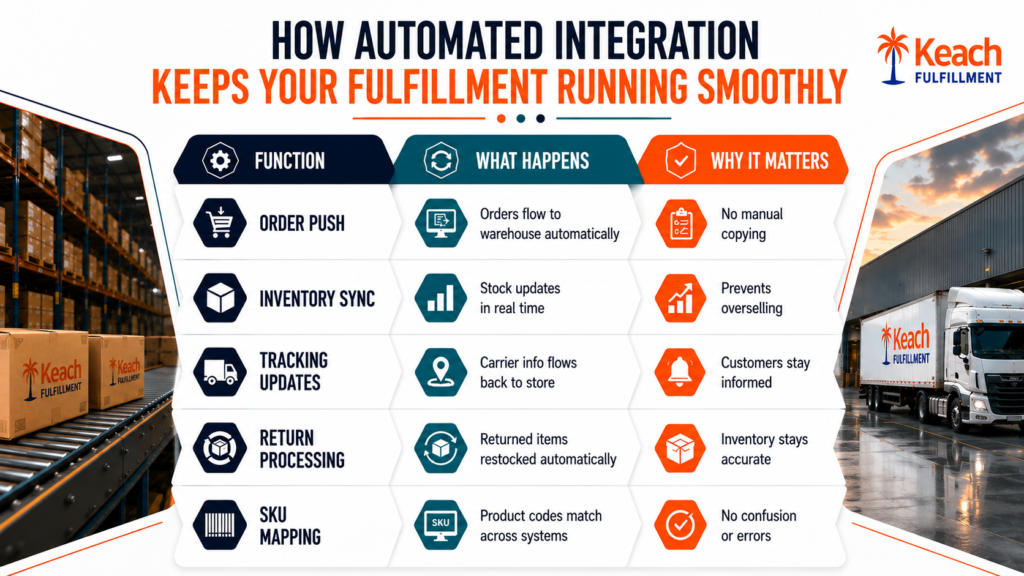
A Shopify WMS integration connects the store to the warehouse through an API. When a customer places an order, the details flow into the warehouse system instantly. The pick list gets generated, the product gets pulled, and the shipping label gets printed. The automated order routing from Shopify to a 3PL fulfillment center means the order never waits for manual processing.
The real-time inventory sync between Shopify and 3PL WMS works the same way. When an item ships, the stock level drops in both systems simultaneously. When a restock arrives at the warehouse, the store sees the updated quantity immediately. The two systems stay aligned without anyone doing data entry.
For a deeper look at how the provider relationship works, this guide on what a 3PL actually does sets the foundation.
What the Shopify and WMS Integration Handles
3PL API Integration Shopify and How the Connection Gets Built
The 3pl api integration Shopify process starts with the provider connecting their system to the store through the Shopify API. The integration maps the product SKUs, inventory fields, and order statuses so both systems speak the same language. Once the mapping is done, the automation takes over. A 3PL warehouse management system that is designed for Shopify handles the mapping cleanly. The store owner does not need to understand the technical details. The provider sets up the connection and tests it, and the orders start flowing
Keach Fulfillment handles the integration and the inventory sync.
Reach out and see what a connected store looks like.Why the Right Integration Changes Everything for a Shopify Store
The difference between a store with a proper Shopify 3PL inventory sync and one without it shows up in the daily reality. The connected store processes orders while the owner sleeps, the inventory stays accurate without spreadsheets, and the customers get tracking updates without being asked. The disconnected store burns hours on manual work and still gets it wrong.
A 3PL warehouse management system that integrates well becomes invisible. The owner stops thinking about the backend and starts focusing on growth. The technology does what it was built to do, and the business benefits from the consistency.
If an order ever does go wrong, this blog on handling fulfillment mistakes covers the recovery process.
Or
If the sync ever breaks, our piece on fixing inventory sync issues covers the troubleshooting steps.
A Store That Runs Without the Owner Touching Every Order
The goal of the integration is not just to save time. It is to build a business that can scale without the founder becoming the bottleneck. The orders flow, the inventory syncs, and the customers stay happy. The store grows because the systems are doing the heavy lifting.
Our system offers an advanced 3PL warehouse management system that integrates with Shopify and ensures synchronization of all processes. The integration has been tested, and the synchronization is done in real-time.
Let Keach Fulfillment handle the integration, so your store runs itself.
Make an appointment to learn how a connected business operates.