
Your product sells well online. Customers love it. Now retailers want to stock it on their shelves. Exciting opportunity, right? Yes, but B2B fulfillment works very differently than shipping individual orders to homes. Retailers expect pallets, not poly bags. They demand specific labeling and packing slips. They have strict delivery windows. Making the leap from direct to consumer to wholesale requires new systems and processes. Let us walk through what changes and how to prepare.
What Makes B2B Fulfillment Different from DTC?
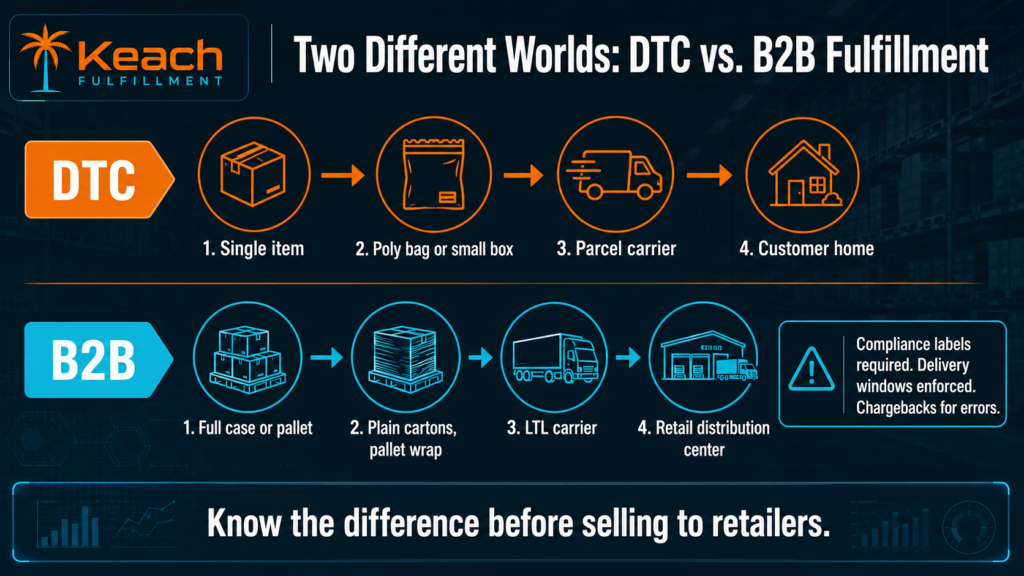
B2B fulfillment serves other businesses rather than individual consumers. This seemingly small difference changes everything about your logistics. Order sizes grow dramatically. Instead of shipping one widget, you ship cases or pallets of widgets. Your packaging shifts from branded boxes to plain brown cartons stacked on pallets.
Retailers demand specific order management processes. Each carton needs a label with purchase order numbers. Pallets need stretch wrapping. Delivery appointments must be scheduled in advance. Timing also changes. Consumers expect delivery in days. Retailers plan weeks or months. However, late shipments still damage relationships. Missing a retailer’s delivery window can result in chargebacks or lost shelf space.
How Do Retail Distribution Services Work?
Retail distribution services move products from your warehouse to store shelves. This process involves multiple steps.
- First, you receive a purchase order from the retailer. It specifies exact quantities, delivery dates, and routing instructions. Ignoring any detail creates problems.
- Next, your team picks and packs the order. Unlike DTC, where you pick individual items, B2B often involves picking full cases or pallets. Accuracy matters enormously. Retailers do not accept partial shipments.
- Then, you schedule delivery through the retailer’s portal. Most large retailers use vendor compliance programs. They assign specific carriers and delivery appointment windows.
- Finally, products arrive at the retailer’s distribution center. Their team verifies quantities against your packing list. Any discrepancy triggers a chargeback. Wholesale fulfillment requires precision at every step.
Professional wholesale logistics prevents costly chargebacks.
Check out Fulfillment now!What Is Wholesale Logistics?
Wholesale logistics encompasses everything involved in moving bulk products from manufacturers to retailers. It differs significantly from direct to consumer shipping.
Warehousing requirements change. B2B inventory often sits on pallets rather than individual bins. Your warehouse needs adequate vertical space and pallet racking. Forklifts or pallet jacks become essential equipment.
Carrier selection shifts too. Parcel carriers like UPS and FedEx work well for small packages. B2B shipments often travel via LTL (less-than-truckload) carriers. These carriers handle pallets but charge based on weight, dimensions, and freight class.
Documentation becomes more complex. Bills of lading, packing lists, and compliance labels accompany every shipment. Missing documents delay delivery.
Many brands partner with wholesale fulfillment specialists who understand these nuances. They maintain proper warehouse equipment. They know carrier requirements. They handle compliance documentation.
How Do You Prepare for B2B Fulfillment?
Transitioning from DTC to B2B requires planning. Here are essential steps. Audit your warehouse equipment. Do you have pallet racking? Can you receive and store large shipments? Do you own pallet jacks or forklifts?
Review retailer compliance guides. Target, Walmart, and other retailers publish detailed requirements. Study them carefully. Follow every specification. Update your systems. Your order management software must handle purchase orders, not just web orders. It should generate compliant labels and packing lists.
Train your team. B2B picking and packing differ from DTC. Staff needs training on pallet building, stretch wrapping, and documentation. Start with one retailer. Master their requirements before adding others. Each retailer adds complexity.
In our previous guide, Top Order Fulfillment Services: Why Outsourcing Fulfillment to a 3PL Company Center Works, we explored how professional fulfillment partners handle complex operations. B2B fulfillment represents exactly the kind of complexity where expert partners excel.
Should You Outsource B2B Fulfillment?
Many brands choose to outsource wholesale logistics rather than build their own B2B operation. The investment required often surprises DTC brands. Pallet racking, forklifts, and warehouse management systems cost tens of thousands of dollars. Staff training takes months. Compliance mistakes result in costly chargebacks.
Professional fulfillment centers already have the equipment, systems, and expertise. They ship to retailers daily. They know compliance requirements. They absorb the investment cost across many clients. For most growing brands, outsourcing B2B fulfillment makes better financial sense than building internal capabilities.
Wrap Up
Moving from direct to consumer to B2B fulfillment opens significant growth opportunities. Retail shelves reach customers who never shop online. However, the logistics differ dramatically. Larger orders, palletized shipping, strict compliance requirements, and retailer chargebacks create new challenges.
At Keach Fulfillment, we handle both DTC and B2B fulfillment for growing brands. Our retail distribution services include warehouse equipment, carrier relationships, and compliance expertise. You focus on selling to retailers. We handle getting products to their shelves.
Let our B2B expertise handle the logistics.
Contact Keach Fulfillment