
You wake up to a notification on your phone. Another order. Then another. By lunchtime, you have ten orders to pack. By evening, it is thirty. Your spare bedroom is overflowing with boxes. Your kitchen table is buried under packing materials. And you are spending your nights printing labels instead of spending time with your family.
This is the dream and the nightmare of a growing Shopify store. More sales are great. But more sales also mean more packing, more shipping, and more of your time consumed by logistics.
Shopify makes it easy to start selling. But fulfillment is where many store owners get stuck. The platform handles your website, your payments, and your customer data. It does not handle your inventory or your shipping.
That part is up to you. Or up to a partner you choose.
Let us walk through how Shopify fulfillment works, the options available to store owners, and how to choose the right approach for your business.
What Is Shopify Fulfillment?
Shopify fulfillment is simply the process of getting products from your inventory into your customers’ hands after they place an order on your Shopify store. It includes picking the right items, packing them securely, printing shipping labels, and handing packages to a carrier.
Sounds straightforward. But the complexity grows fast.
When you start, fulfillment might mean you walking to your garage, grabbing a product off a shelf, dropping it in a box, and taping it shut. That works for ten orders a week. It does not work for ten orders a day.
As volume increases, you need systems. You need organization. You need help. This is where professional Shopify fulfillment services enter the picture.
Your Shopify Fulfillment Options
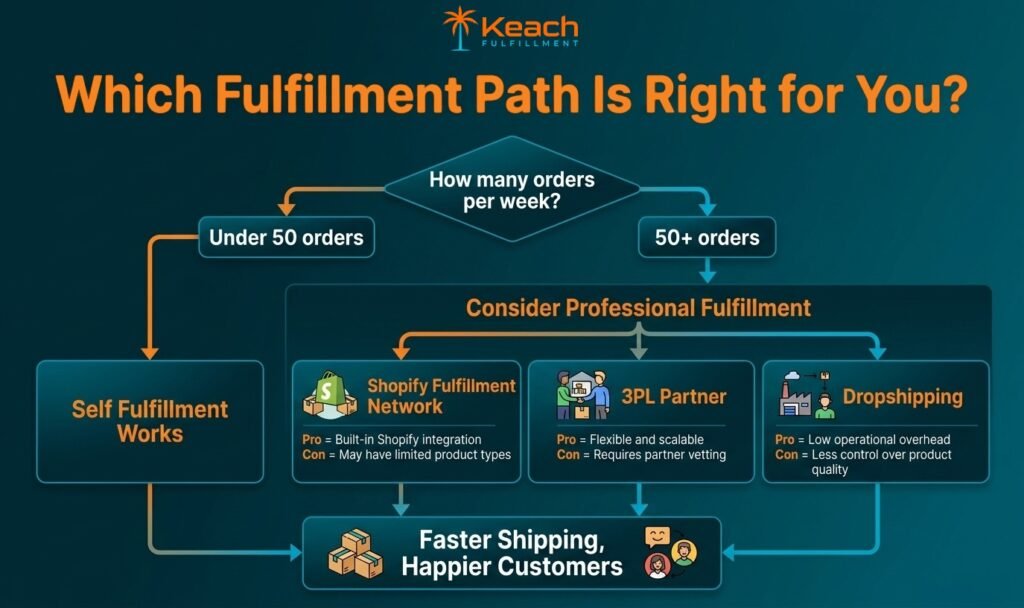
Shopify store owners have several paths to choose from. Each has trade-offs.
Self fulfillment. You handle everything. Products are stored at home or in a small space. You pack and ship each order yourself. This option costs the least in cash but the most in time. It works for very small volumes but does not scale.
Shopify Fulfillment Network. Shopify offers its own fulfillment service. You send inventory to Shopify’s warehouses. They pick, pack, and ship orders for you. The integration is seamless because it is native to Shopify. But the network is still growing, and coverage can be limited.
Third party logistics (3PL). Independent fulfillment companies integrate with Shopify through apps or APIs. You send inventory to their warehouses. They handle everything from storage to shipping. This option offers flexibility and often better pricing at scale.
Dropshipping. You never touch the product. When a customer orders, your supplier ships directly to them. This option requires no inventory or fulfillment work from you. But margins are typically thinner, and you have less control over quality and shipping speed.
Most growing Shopify stores eventually land on a 3PL. It offers the best balance of control, cost, and scalability.
How Shopify Order Fulfillment Works with a 3PL
When you partner with a professional shopify order fulfillment provider, the process is straightforward.
First, you install an integration app or connect your Shopify store to the 3PL via API. This connection allows orders to flow automatically from your store to the fulfillment center.
Second, you ship your inventory to the 3PL’s warehouse. They receive your products, inspect them, and store them in organized locations. Your inventory becomes visible in their system and syncs with your Shopify store.
Third, when a customer places an order on your Shopify store, that order is sent to the 3PL instantly. Their team picks the products from storage, packs them according to your specifications, and prints a shipping label.
Fourth, the package is handed to a carrier. Tracking information is sent back to Shopify automatically. Your customer receives a shipping notification with tracking details.
Fifth, your Shopify inventory counts update in real time. If you have multiple sales channels, those update too.
The beauty of this setup is automation. Once configured, orders flow without any manual work from you. You focus on marketing, product development, and customer service. The 3PL focuses on picking, packing, and shipping.
Outsource the packing. Focus on growth.
Let a 3PL handle fulfillment.What to Look for in a Shopify Fulfillment Company
Not all shopify fulfillment company options are created equal. Here is what to evaluate.
Native integration. The best fulfillment partners offer a direct Shopify integration through an app or API. You should be able to connect your store with a few clicks. No custom development required.
Real-time inventory sync. When an order is placed, your inventory should update across all channels instantly. This prevents overselling and keeps your store accurate.
Transparent pricing. Look for clear pricing on receiving, storage, pick and pack, and shipping. Hidden fees are a red flag. A good partner will provide a simple rate card.
Scalable operations. Your fulfillment partner should handle your volume today and your volume next year. Ask about their capacity for seasonal spikes.
Quality control. Ask about error rates. Professional 3PLs operate at 99.5 percent accuracy or higher. They should have processes for catching mistakes before orders ship.
Returns processing. Customers return products. Your fulfillment partner should have a clear process for receiving, inspecting, and restocking returns.
Shopify Warehouse Services and Logistics
Shopify warehouse services go beyond simple pick and pack. A full service 3PL offers a range of capabilities.
Receiving and inspection. When your inventory arrives, it is checked against your packing list. Damaged or incorrect items are flagged. Only sellable products enter your inventory.
Storage. Products are stored in organized locations. Barcode systems track exactly where every item is located. Climate-controlled storage is available for sensitive products.
Pick and pack. When orders come in, items are picked from storage, packed securely, and prepared for shipping. Custom packaging, gift wrapping, and inserts are handled according to your specifications.
Shipping. The 3PL selects the best carrier for each order based on speed and cost. Tracking numbers are uploaded to Shopify automatically.
Returns management. Returned items are received, inspected, and either restocked or disposed of according to your instructions.
Kitting and assembly. If you sell products as bundles or kits, the 3PL can assemble them before storage or on demand.
These shopify logistics solutions free you from the physical work of running an online store. You focus on the digital side. They handle the physical side.
Self Fulfillment vs. Outsourcing: An Honest Look
Many store owners hesitate to outsource because they want control. They worry about cost. They think they can handle it themselves.
Let us be honest about what self-fulfillment really costs.
Your time. If you spend ten hours a week packing orders, that is ten hours you are not spending on marketing, product development, or customer acquisition. What is your time worth?
Your space. Your spare bedroom, garage, or basement has value. When it is filled with boxes and bubble wrap, you lose that space for other uses.
Your sanity. Fulfillment is repetitive, physical work. It is not why you started your business. Doing it yourself day after day leads to burnout.
Your growth. Self-fulfillment caps your volume. You can only pack so many boxes in a day. When you hit that limit, you stop growing, or you start outsourcing.
Outsourcing shifts these costs from you to a partner. Yes, you pay per order. But you gain time, space, and the ability to scale without limits.
In our previous guide, What Is Multi Channel Fulfillment in Ecommerce, we discussed how fulfillment connects across multiple platforms. Shopify fulfillment is often the center of that multi channel operation. Your Shopify store becomes one of several channels feeding into a unified fulfillment system.
| Fulfillment Option | Best For | Trade Off |
|---|---|---|
| Self Fulfillment | Under 50 orders per week | High time cost, does not scale |
| Shopify Fulfillment Network | Moderate volume, native integration | Limited warehouse locations |
| 3PL | 50+ orders per week, scaling business | Requires partner vetting |
| Dropshipping | Testing products, no inventory | Lower margins, less control |
Common Shopify Fulfillment Mistakes
Avoid these common pitfalls.
Choosing based only on price. The cheapest fulfillment partner is rarely the best. Low prices often mean slow shipping, high error rates, or hidden fees. Look for value, not just cost.
Ignoring integration quality. A clunky integration leads to missed orders, incorrect inventory counts, and frustrated customers. Test the integration before committing.
Forgetting about returns. Every store has returns. Make sure your fulfillment partner has a clear, efficient returns process. Nothing frustrates customers like a difficult return.
Not planning for peaks. Your fulfillment partner should handle Black Friday and holiday volume. Ask about their peak season capacity before you need it.
Skipping test orders. Before you send all your inventory to a new fulfillment partner, run test orders. Verify that the integration works, shipping speeds meet expectations, and packaging looks right.
When to Switch to Professional Fulfillment
How do you know it is time to stop self-fulfilling and hire a partner? Look for these signs.
You are spending more than ten hours a week on fulfillment. That time has value. When fulfillment consumes your evenings and weekends, it is time for help.
You have run out of space. Your garage is full. Your spare bedroom is a warehouse. You are tripping over boxes. Professional fulfillment moves inventory offsite.
You are making mistakes. Wrong items shipped. Orders delayed. Labels messed up. Errors increase when you are rushed. A professional partner makes fewer mistakes.
You want to grow. If you have plans to increase sales, your fulfillment needs to scale with you. Self fulfillment does not scale. Outsourcing does.
You are launching new products. More products mean more complexity. A fulfillment partner handles that complexity so you do not have to.
Wrap Up
Shopify makes selling online easy. But fulfillment is where many store owners struggle. The platform gives you the digital tools. You still need the physical infrastructure to get products to customers.
The right approach depends on your volume, your goals, and your tolerance for packing boxes. Self fulfillment works at the very beginning. But as you grow, outsourcing becomes not just convenient but necessary.
Professional Shopify fulfillment services handle the physical work so you can focus on the digital work. Marketing, product development, customer relationships. The activities that actually grow your business.
At Keach Fulfillment, we integrate seamlessly with Shopify. Orders flow from your store to our warehouse automatically. Our team picks, packs, and ships with speed and accuracy. You get real time inventory visibility and automated tracking updates. And you get your time back.
Let us handle your Shopify fulfillment.
Contact Keach Fulfillment today.