
You sell on Amazon. You also have a Shopify store. And you just launched on Walmart. More channels mean more sales opportunities. But they also mean more complexity.
Each platform has its own rules, its own inventory requirements, and its own expectations for shipping. Managing all of them separately is exhausting. You update inventory counts in three different systems. You track orders from multiple dashboards. You worry about overselling products because one channel does not know what sells on another.
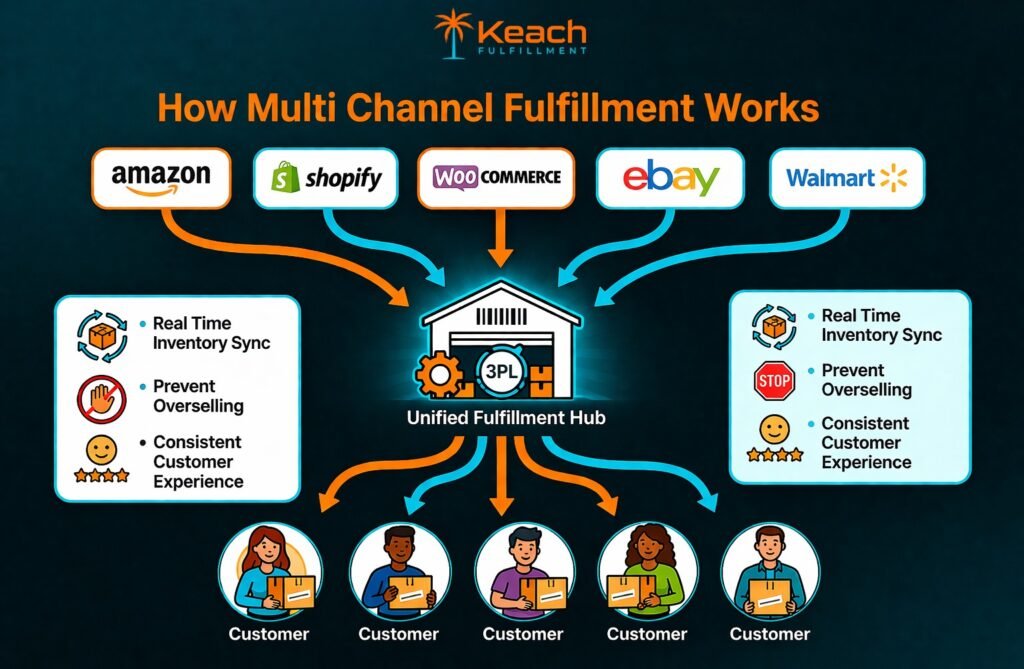
This is where multi channel fulfillment comes in. Instead of treating each sales channel as its own operation, you connect them through a single fulfillment strategy. Orders flow in from everywhere. Inventory updates automatically. Products ship from one central location.
Deciding when to outsource is a critical part of this selection process. Let us walk through how multi channel fulfillment works, why it matters, and how to set up a system that scales with your business.
What Is Multi Channel Fulfillment?
Multi channel fulfillment is the practice of managing orders and inventory across multiple sales channels from a single operational hub. Instead of running separate fulfillment operations for Amazon, your Shopify store, and your eBay listings, you connect everything to one warehouse or fulfillment partner.
When a customer buys from any channel, the order flows into your central system. Inventory counts update across all channels automatically. Products are picked, packed, and shipped from one location using consistent processes.
The alternative is fragmented fulfillment. You store some inventory at Amazon’s warehouses for FBA orders. You keep a separate inventory for your Shopify orders in your own space. You manage a third batch for Walmart. Each channel operates in its own silo.
Fragmentation creates problems. You cannot easily shift inventory between channels. You might be out of stock on Amazon while sitting on excess units for Shopify. You spend hours reconciling inventory across systems. Multi channel fulfillment solves these problems by creating a single source of truth for your entire operation.
Why Multi Channel Ecommerce Logistics Matters
Multi-channel ecommerce logistics is not just about convenience. It directly impacts your bottom line.
Inventory efficiency. When all channels share a single inventory pool, you need less total stock to achieve the same sales volume. Safety stock can be shared rather than duplicated across channels. This frees up cash that would otherwise sit on warehouse shelves.
Reduced overselling. Overselling happens when two channels sell the same product at nearly the same time, and your systems do not sync fast enough. With unified fulfillment, inventory updates in real time. The second unit sells on Amazon, your Shopify store sees the reduced count immediately.
Consistent customer experience. Orders from different channels should feel consistent. Same packaging quality. Same shipping speed. Same tracking information. Multi channel fulfillment delivers this consistency because every order flows through the same process.
A hidden advantage of outsourcing fulfillment is how it supports this consistency during rapid growth.
Operational simplicity. One dashboard instead of several. One set of processes instead of multiple. One team managing everything instead of separate teams for each channel. Simplicity reduces errors and frees up time.
How Multi Channel Fulfillment Works
A typical multi-channel setup follows a straightforward flow.
First, you connect your sales channels to a central fulfillment system. This could be a warehouse management system, a third-party logistics provider’s platform, or an integration tool that links everything together.
Second, your inventory is stored in a single location or a network of locations that operate as one. When products arrive, they are logged into the system and become available across all channels.
Third, when an order comes in from any channel, the system receives it automatically. Inventory is reserved so other channels cannot sell that same unit. The fulfillment team picks, packs, and ships the order.
Fourth, tracking information is sent back to the original sales channel. The customer receives shipping notifications from the platform where they purchased, but the fulfillment happens from your central hub.
This flow works whether you sell on two channels or twelve. The key is integration. Your systems need to talk to each other in real time.
Amazon Multi Channel Fulfillment Options
Amazon multi channel fulfillment deserves special attention because Amazon offers its own fulfillment program that can be used for non-Amazon orders.
Amazon’s Multi Channel Fulfillment (MCF) program allows you to store inventory in Amazon’s warehouses and use that inventory to fulfill orders from your Shopify store, your website, or other platforms. When a customer buys from your non-Amazon channel, Amazon picks, packs, and ships the order using the inventory you already have stored with them.
The advantage is convenience. If you already use FBA for your Amazon sales, MCF lets you leverage that same inventory for other channels. You do not need a separate warehouse or fulfillment partner.
The trade-offs are worth considering. MCF fees are typically higher than using a dedicated 3PL for non-Amazon orders. Shipping speeds may be less predictable. And you are relying on Amazon’s systems for orders that Amazon did not generate.
Many sellers use a hybrid approach. They keep some inventory with Amazon for FBA orders and some with an independent 3PL for other channels. Others centralize everything with a 3PL and use that same inventory to fulfill Amazon orders through Seller Fulfilled Prime or direct shipping.
The right choice depends on your volume, your margins, and your tolerance for complexity.
Shopify Fulfillment Services and WooCommerce Options
For sellers using Shopify or WooCommerce, shopify fulfillment services and woocommerce fulfillment services integrate directly with multi-channel operations.
Shopify has its own fulfillment network, but many sellers prefer working with independent 3PLs that integrate seamlessly with Shopify. The integration works like this. You install a plugin or connect via API. Orders from your Shopify store flow automatically to your fulfillment partner. Inventory counts sync in real time. Tracking numbers are sent back to Shopify and shared with your customer.
WooCommerce works similarly. Most 3PLs offer plugins or API connections for WooCommerce stores. The order flow is the same. The customer buys on your WooCommerce site. Order goes to fulfillment. Inventory updates. Tracking returns.
The beauty of these integrations is that they work alongside your other channels. The same fulfillment partner that handles your Shopify orders can also handle your Amazon orders, your eBay orders, and your Walmart orders. Everything flows into one system.
Choosing a Multi Channel Fulfillment Partner
Not all 3PLs are equipped for true multi channel fulfillment. Here is what to look for.
Native integrations. Your fulfillment partner should have pre-built integrations with the platforms you use. Amazon, Shopify, WooCommerce, eBay, Walmart. The more integrations they offer, the less custom work you will need.
Real-time inventory syncing. When an order comes in from any channel, your inventory counts should update across all channels instantly. Delays of even a few minutes can lead to overselling.
Unified reporting. You should be able to see orders, inventory, and shipments from all channels in one dashboard. Jumping between different systems defeats the purpose of multi channel fulfillment.
Scalable operations. Your fulfillment partner should be able to handle volume spikes from any channel. If you run a flash sale on Shopify or get a surge of Amazon orders, they should not miss a beat.
Transparent pricing. Multi channel fulfillment adds complexity. Make sure you understand how your partner charges for receiving, storage, pick and pack, and integration support.
For a deeper dive into financial and structural comparisons, consider 3PL costs, software, and the 3PL vs 4PL debate before making your final decision.
Common Multi Channel Challenges and Solutions
Even with a good setup, multi channel fulfillment comes with challenges. Here is how to address them.
Channel-specific requirements. Amazon requires certain labeling and packaging. Walmart has different standards. Your fulfillment partner must handle these variations without creating separate workflows for every channel. The solution is a partner with experience across multiple platforms.
Returns processing. Returns from different channels need to be handled consistently but credited appropriately. An Amazon return should go through Amazon’s return process. A Shopify return might be handled directly by your team. Your fulfillment partner should support both.
Seasonal planning. Different channels have different peak seasons. Amazon’s Prime Day and Q4 holidays. Shopify’s Black Friday Cyber Monday. Your inventory and staffing plans need to account for overlapping peaks.
Cost allocation. When you share inventory across channels, you need to understand which channel is driving which costs. Good reporting helps you allocate fulfillment expenses accurately.
In a well-run multi-channel operation, these challenges become manageable rather than overwhelming.
Wrap Up
Multi channel selling is the norm for growing ecommerce brands. But selling on multiple platforms without a unified fulfillment strategy is a recipe for chaos. Separate inventory pools, disconnected systems, and inconsistent customer experiences all hurt your business.
The solution is multi channel fulfillment. One inventory pool. One fulfillment process. One source of truth. Orders flow in from every channel. Inventory updates automatically. Customers receive consistent, reliable service no matter where they buy.
Whether you use Amazon’s Multi Channel Fulfillment, a dedicated 3PL, or a hybrid approach, the goal is the same. Break down the silos between your sales channels. Let your fulfillment operate as a single system supporting every part of your business.
At Keach Fulfillment, we specialize in multi channel operations. Our platform integrates with Amazon, Shopify, WooCommerce, and other major channels. We handle the complexity so you can focus on growth. From receiving and storage to pick, pack, and ship, we provide the unified fulfillment that multi channel sellers need.