
You trust your inventory system. It tells you exactly how many units you have of each product. You make purchasing decisions based on those numbers. You promise customers availability based on what the system shows. But what if the system is wrong?
This happens more often than most business owners realize. A shipment is received but is never scanned. A few units get damaged and thrown away without being logged. A picker grabs the wrong item, and the system adjusts for something that never actually left.
Over time, these small discrepancies add up. Your system says one thing. Your shelves say another. The gap between them grows until suddenly you cannot trust anything your software tells you.
This is why the regular inventory audit process matters. Audits are how you verify that your records match reality. They catch errors before they become disasters. And they give you confidence that the numbers you rely on are actually true.
Let’s talk about how regular verification keeps your data reliable and your business running smoothly.
Give us a call right nowWhat Is an Inventory Audit?
An inventory audit is simply a process of comparing your recorded stock counts against what you actually have on hand. It sounds straightforward, but the execution matters enormously.
When done well, an audit does more than just count boxes. It identifies where discrepancies are happening, why they are happening, and what processes need to change to prevent them in the future. It is both a verification tool and a diagnostic tool.
For ecommerce businesses, accuracy in this area is non-negotiable. Every order you ship depends on your inventory records being correct. Every restocking decision relies on those numbers. If your records are off, everything downstream gets thrown into chaos.
Key Inventory Accuracy Methods
Different situations call for different inventory accuracy methods. Here is a look at the most common approaches and when to use them.
Physical inventory counts. This is the traditional approach, where you count everything in your warehouse at once. It is thorough but disruptive. Operations usually need to pause while the count happens. Most businesses do this annually, often at year’s end for financial reporting.
Cycle counting. Instead of counting everything at once, cycle counting breaks your inventory into sections and counts a portion each day or week. Over time, every item gets counted without ever shutting down operations. This approach is more manageable and provides ongoing accuracy rather than a single annual snapshot.
Spot checking. Sometimes you suspect a problem with a specific product or location. Spot checking lets you verify just those items quickly. It is not a comprehensive solution, but it is useful for investigating issues.
ABC analysis counting. This method prioritizes your most valuable or fast-moving items. A items (high value, high velocity) get counted more frequently. B items get moderate attention. C items (slow-moving, low value) get counted less often. This approach focuses effort where it matters most.
| Audit Method | How It Works | Best For |
|---|---|---|
| Physical Inventory | Count everything at once, operations pause | Annual financial reporting |
| Cycle Counting | Count sections continuously over time | Ongoing accuracy without disruption |
| Spot Checking | Verify specific items when issues arise | Investigating known problems |
| ABC Analysis | Count high-value items more frequently | Focusing effort on what matters most |
The Inventory Audit Process Step by Step
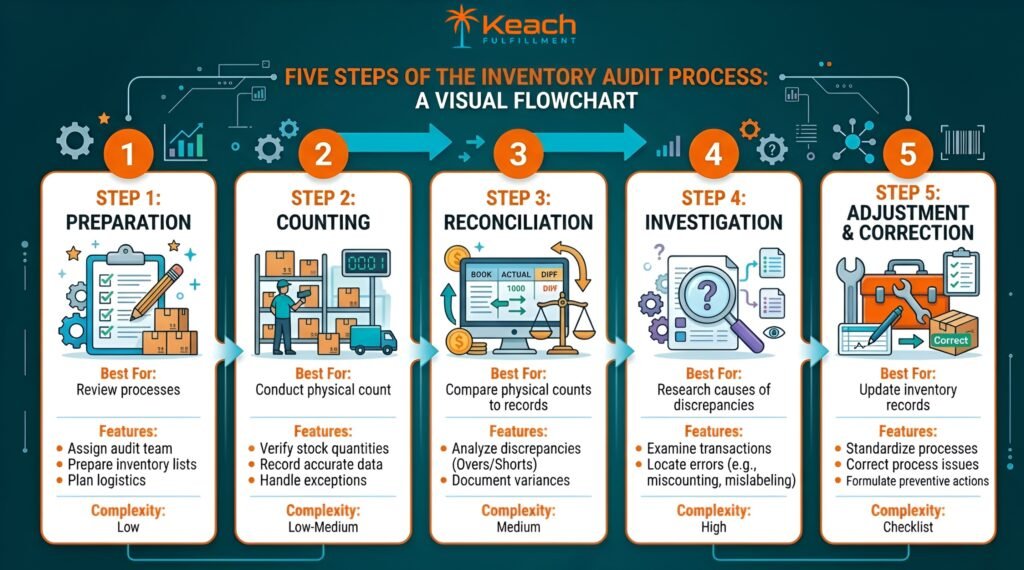
A well-designed inventory audit process follows a consistent pattern. Whether you are doing a full physical count or daily cycle counts, these steps apply.
Preparation. Before counting begins, you need to organize. Clear aisles. Stage loose items. Stop receiving and shipping if necessary. The goal is to make sure everything that should be counted is accessible, and nothing moves during the count.
Counting. Teams go through designated areas, counting each item and recording quantities. In modern warehouses, scanners speed this up and reduce data entry errors. Multiple teams may count the same sections independently to verify accuracy.
Reconciliation. After the counts are complete, the numbers are compared to system records. Discrepancies are noted. Sometimes a recount happens if the differences are significant.
Investigation. This is where you figure out why discrepancies occurred. Was a shipment never received properly? Did returns get missed? Are items being stolen or damaged without documentation? Understanding the root cause is essential for preventing future errors.
Adjustment and correction. System records get updated to match physical counts. Process changes are implemented to address the root causes identified during the investigation.
Why Stock Audit Procedures Matter More Than You Think
Consistent stock audit procedures do more than just keep your numbers accurate. They provide benefits that ripple through your entire operation.
Better customer experience. When your inventory records are accurate, you never oversell products you do not have. Customers receive what they order, when they expect it. No backorder emails. No disappointment.
Smarter purchasing. Accurate data leads to better buying decisions. You know exactly what you have and how fast it moves. You avoid ordering too much of something that is already sitting on your shelves.
Reduced shrinkage. Regular audits catch theft, damage, and administrative errors. When people know that counts are verified, mistakes and misconduct both decrease.
Healthier margins. Tying up cash in inventory you thought you had but actually lost is expensive. Accurate audits keep your working capital where it belongs, invested in products that actually exist and will actually sell.
Common Causes of Inventory Discrepancies
Understanding why discrepancies happen helps you prevent them. Here are some of the most common causes.
Receiving errors. Products arrive but never get scanned into the system. They sit in receiving, get moved to shelves, but the digital record never reflects their arrival.
Shipping errors. Items get picked and packed, but are not properly deducted from inventory. This is especially common when manual processes are involved.
Returns mishandling. Returned items arrive, get set aside, and never get inspected and restocked properly. The system shows them as sold, but they are actually sitting in a corner.
Theft. Unfortunately, theft happens. Both external and internal theft create discrepancies that audits can help identify.
Damage. Products get damaged in storage or handling. If damaged items are discarded without being logged, your system will show available units that are actually gone.
Data entry errors. Someone types the wrong number into a spreadsheet or selects the wrong SKU from a dropdown. These small errors compound over time.
How Technology Improves Warehouse Inventory Audit
Technology has transformed the warehouse inventory audit process. What once required paper printouts and manual entry now happens with handheld scanners and real-time systems.
Barcode scanning eliminates data entry errors. When you scan an item, the quantity is recorded automatically. No typing mistakes. No illegible handwriting.
RFID technology takes this further. RFID tags can be read without line of sight, allowing workers to scan entire pallets or shelves in seconds rather than minutes.
Inventory management software tracks audit history, showing you trends over time. You can see which locations consistently have discrepancies and which processes need attention.
For businesses using third party logistics, their technology becomes your technology. Professional fulfillment centers use sophisticated systems that track every movement. Their audit processes are built into daily operations, not added on as an afterthought.
When to Perform Inventory Audits
There is no single right answer for how often to audit. The frequency depends on your business, your products, and your risk tolerance.
High-velocity items with frequent movement benefit from weekly or even daily cycle counts. A fast-moving bestseller can develop discrepancies quickly.
Slow-moving items might be fine with quarterly or annual checks. If you only sell ten units a year, the odds of significant error are lower.
Most businesses find a balance. Cycle count your A items frequently. Count your B items monthly or quarterly. Reserve full physical counts for annual financial reporting.
The key is consistency. An audit program that happens regularly, even if it is not perfect, is better than a perfect audit that never actually gets done.
We create high-end digital experiences that reflect your brand’s elegance and innovation. Let’s craft something extraordinary together.
Contact us today!The Role of Audits in Ecommerce Success
In the previous guide, we talked about how inventory tracking systems give you visibility into your stock. But even the best system needs verification. Audits are how you confirm that what your system shows matches what your shelves hold.
Without audits, you are trusting your software blindly. With regular audits, you build a feedback loop. Your system improves over time because you catch and correct errors. You learn where your processes are weak and strengthen them.
For ecommerce brands, this feedback loop is essential. Your entire business depends on accurate inventory. Your website shows availability. Your marketing promises products. Your fulfillment team picks based on system data. If that data is wrong, everything breaks. Audits are the insurance policy that keeps your operations reliable.
Putting It All Together
Inventory audits might seem like a hassle. They take time. They require attention to detail. They force you to pause and look closely at your operations. But the alternative is worse. Operating with inaccurate inventory data means making decisions based on fiction. It means disappointing customers. It means wasting money on stock you do not actually need.
Regular audits give you confidence. You know your numbers are right. You know your purchasing decisions are based on reality. You know you can promise customers availability and deliver on that promise.
The approach you choose matters less than the commitment to consistency. Whether you do daily cycle counts or annual physical inventories, the important thing is that you are verifying. You are looking for gaps. You are fixing what is broken.
At Keach Fulfillment, accuracy is built into everything we do. Our receiving, storage, and fulfillment processes are designed to maintain precise inventory records. And our audit procedures catch discrepancies before they affect your business.
What does professional inventory management look like?
Reach out today and let us show you!