
There is a sinking feeling every ecommerce owner knows too well. You log into your dashboard, ready to see another day of solid sales, and there it is. A best-selling product is out of stock. Not only have you lost that sale, but you have also disappointed a customer who may not come back.
Stockouts are painful. They hurt revenue, damage trust, and create operational headaches. Yet many business owners treat them as an unavoidable fact of life. They are not.
The real solution lies in inventory forecasting. When done well, forecasting takes the guesswork out of stocking decisions. It helps you predict what customers will want, when they will want it, and how much you need to have on hand. Let’s explore how this works and why it matters for your bottom line.
Your shelves are full, and your customers are happy.
Let’s look at how smarter planning can keepWhat Is Inventory Forecasting?
At its simplest, inventory forecasting is the practice of using data to predict future product demand. Instead of guessing how much to order, you look at historical sales, seasonal trends, and market conditions to make informed decisions.
Think of it as a bridge between your past performance and your future needs. Without it, you are either ordering too much and tying up cash in slow-moving stock, or ordering too little and watching sales slip away.
The goal is balance. Enough inventory to meet demand, but not so much that storage costs eat into your margins. This balance is especially critical for ecommerce businesses where customer expectations around shipping speed and availability are higher than ever.
Why Stockouts Happen More Often Than You Think
Stockouts do not always mean you made a mistake. Sometimes demand surges unexpectedly. A social media post goes viral. A competitor runs out of stock. A seasonal trend takes off earlier than usual.
But more often, stockouts trace back to common gaps in ecommerce demand forecasting. Here are a few typical scenarios.
- Relying on gut feelings instead of data: Many small business owners order based on what feels right. This works for a while, but as you grow, intuition is not enough. You need numbers.
- Ignoring lead times: Your supplier takes three weeks to deliver. If you do not factor that into your planning, you will run out long before the next shipment arrives.
- Forgetting about seasonality: Sales spikes during holidays, back-to-school, or summer months require preparation. Without accounting for these patterns, you will be caught off guard every single time.
- Underestimating new product launches: You have no historical data for a new item, so you guess. Sometimes you guess wrong.
The good news is that each of these problems can be addressed with better inventory planning strategies.
Key Stock Forecasting Methods You Can Use
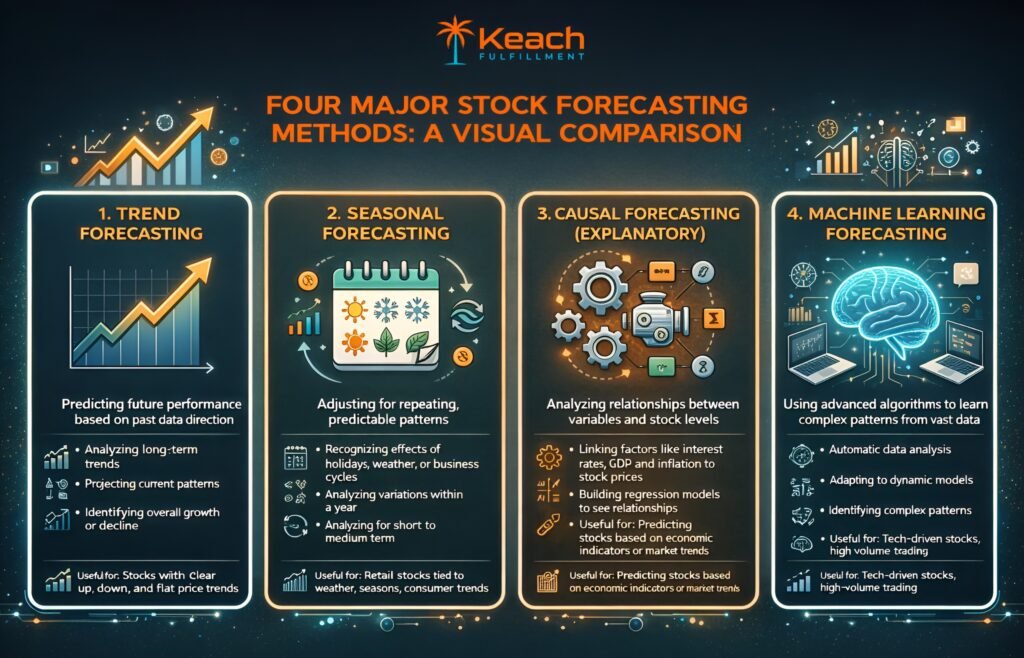
Different situations call for different stock forecasting methods. Here is a look at the most common approaches and when to use them.
- Trend forecasting: This method looks at historical sales data to identify patterns. If you sold three hundred units each month for the past six months, trend forecasting suggests you will sell about three hundred next month. Simple and reliable for stable products.
- Seasonal forecasting: Some products have predictable peaks. Sunscreen sells in summer. Cozy blankets sell in winter. Seasonal forecasting adjusts your inventory levels based on the time of year.
- Causal forecasting: This method considers external factors that influence demand. A price change, a competitor’s promotion, or a marketing campaign can all affect sales. Causal forecasting helps you anticipate these shifts.
- Machine learning forecasting: For larger businesses, algorithms can analyze vast amounts of data to predict demand with remarkable accuracy. This approach considers dozens of variables simultaneously.
Most businesses start with trend and seasonal forecasting. As you collect more data, you can layer in more sophisticated methods.
| Forecasting Method | How It Works | Best For |
|---|---|---|
| Trend Forecasting | Analyzes historical sales patterns | Stable products with consistent demand |
| Seasonal Forecasting | Adjusts for predictable peaks and valleys | Products tied to holidays or weather |
| Causal Forecasting | Considers external factors like pricing or promotions | Businesses running frequent marketing campaigns |
| Machine Learning Forecasting | Uses algorithms to analyze multiple variables | Large catalogs with complex demand patterns |
The Role of Lead Times in Inventory Planning
Lead time is the gap between placing an order and receiving the products. It is one of the most important variables in ecommerce inventory planning, yet many business owners overlook it.
Imagine you sell a product that moves one hundred units per week. Your supplier takes three weeks to deliver. If you wait until you are down to your last fifty units to reorder, you will run out before the new stock arrives.
Instead, you need to order when your stock drops to three hundred units. That is your reorder point, enough inventory to cover sales during the lead time plus a safety buffer.
This simple calculation transforms inventory management. Instead of reacting to stockouts, you prevent them by ordering at the right time.
How to Get Started with Inventory Forecasting
You do not need a data science degree to start forecasting. Begin with these practical steps.
- Gather your sales data: Pull at least twelve months of history if you have it. Look for patterns. Which months are strongest? Which products have steady demand versus unpredictable spikes?
- Calculate your lead times: how long each supplier takes from order placement to delivery. Be honest about variability. If it sometimes takes four weeks instead of three, plan for four.
- Set reorder points: For each product, determine the stock level that triggers a new order. This should cover sales during the lead time plus a safety buffer for unexpected demand.
- Review and adjust regularly: Forecasting is not a set it and forget it activity. Revisit your numbers monthly. Update them as new sales data comes in.
Let’s talk about how professional support can take the stress out of forecasting.
Your inventory needs with confidence?Common Mistakes in Ecommerce Demand Forecasting
Even well-intentioned forecasting efforts can go wrong. Here are a few pitfalls to watch for.
- Overcomplicating things early on: You do not need advanced algorithms when you are shipping fifty orders a month. Start simple and add complexity as you grow.
- Ignoring returns: Returns affect your net available inventory. If you forecast based on gross sales without accounting for returns, your numbers will be off.
- Failing to communicate with suppliers: Forecasting assumes your supplier will deliver on time. If they are unreliable, adjust your planning accordingly or find a backup source.
- Not planning for growth: If your business is growing quickly, historical data may understate future demand. Build in a growth factor to avoid stockouts during expansion.
When to Consider Professional Inventory Planning Support
There comes a point where managing forecasting in-house becomes overwhelming. Your product catalog grows. Your sales channels multiply. Your time gets stretched thin.
This is where professional inventory planning strategies from a fulfillment partner can help. A good 3PL services does not just store and ship your products. They help you understand your data, set reorder points, and maintain optimal stock levels.
Some partners even offer dashboard tools that show your inventory velocity, projected stockout dates, and recommended order quantities. This visibility transforms decision-making. You stop reacting to emergencies and start planning with confidence. That peace of mind alone is worth the investment.
Before you can forecast future demand, you need accurate receiving processes in place. Our previous guide explains how professional receiving sets the foundation for reliable inventory data.
Putting It All Together
Stockouts do not have to be part of your business story. With thoughtful inventory forecasting, you can keep your shelves stocked, your customers satisfied, and your revenue flowing.
The journey starts with good data. Know what you have sold, how fast it moves, and how long it takes to get more. From there, you build reorder points, choose forecasting methods that fit your scale, and review your numbers regularly.
It takes effort up front. But the payoff is immense no more panicked emails to suppliers. No more explaining to customers why their favorite item is unavailable. Just smooth, predictable operations that let you focus on growth.
At Keach Fulfillment, we help ecommerce brands take control of their inventory. From receiving to storage to forecasting support, we handle the details so you can focus on what you do best.
Reach out today and Let’s build a smarter inventory plan together. Let’s craft something extraordinary together.
Contact Us Now