
You have just received a shipment of new products. Maybe it is the inventory you have been waiting on for weeks, the stock that will fuel your next marketing push, or carry you through the busy season. The boxes arrive, you sign for them, and then what?
What happens in those first few hours after products enter a warehouse sets the stage for everything that follows. Accuracy here determines whether orders ship correctly, whether customers get what they ordered, and whether your inventory counts stay reliable. Get it right, and operations run smoothly. Get it wrong, and the ripple effects can last for weeks.
Understanding the inventory receiving process gives you a window into how professional fulfillment works. It also helps you see why this step deserves more attention than most business owners realize.
Let us show you how professional receiving and Storage can simplify your operations.
Contact UsWhat Happens During Inventory Receiving
At its core, receiving inventory is the moment your products move from a truck onto your shelves. But in a well-run warehouse, it is much more than unloading boxes. It is a structured process designed to catch problems before they affect your customers.
When products arrive, the first step is verification. Warehouse staff compare what actually showed up against what was supposed to arrive. They check quantities, inspect for visible damage, and note any discrepancies. This is the moment where a missing case or a dented carton gets documented, not discovered later when a customer receives a damaged item.
After verification, each product gets logged into the system. Barcodes are scanned, locations are assigned, and the inventory becomes visible in real time. From this point forward, your online store knows exactly how many units are available.
Finally, products move to their designated storage spots. Whether that is a pallet location, a shelf, or a bin, the goal is to make sure every item can be found quickly when an order comes in.
This structured approach might sound like extra work, but it prevents the chaos that happens when products are rushed onto shelves without proper checks.
Understanding the full picture of inventory management starts with knowing how products enter your system. Our previous guide covers the broader strategies that support accurate receiving and long-term operational health.
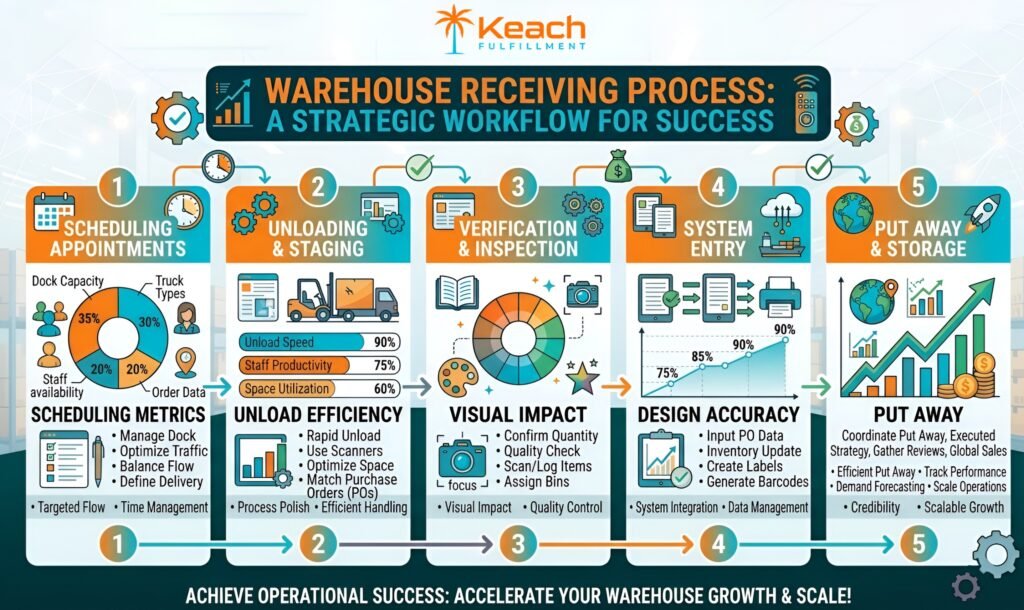
The Steps in a Warehouse Receiving Process
A reliable warehouse receiving process follows a consistent sequence. While every facility has its own variations, the core steps remain the same across professional operations.
Scheduling and preparation: Before products even arrive, the warehouse knows what is coming. Receiving staff prepare the space, gather equipment, and review any special handling instructions. This prevents bottlenecks when trucks show up unexpectedly.
Unloading and staging: When shipments arrive, they are moved to a designated receiving area. This keeps loading docks clear and gives staff room to work methodically.
Verification and inspection: This is where accuracy matters most. Staff count cartons, open random boxes to verify contents, and check for damage. If products require special conditions like temperature control, that gets confirmed here as well.
System entry: Each item is scanned into the inventory intake process. Barcodes link physical products to digital records. Lot numbers or expiration dates are recorded if applicable.
Put away: Products move to their assigned storage locations. This final step is critical because an item that is scanned but placed incorrectly becomes invisible to pickers later on.
When these steps happen consistently, accuracy rates stay high, and customer orders ship correctly.
| Receiving Step | What Happens | Why It Matters |
|---|---|---|
| Scheduling | Warehouse prepares space and equipment | Prevents bottlenecks and delays |
| Unloading & Staging | Shipments moved to the receiving area | Creates an organized workspace |
| Verification & Inspection | Counts compared to packing list, damage checked | Catches errors before inventory is logged |
| System Entry | Products scanned into the inventory system | Creates real-time visibility |
| Put Away | Items moved to designated storage | Ensures pickers can locate products quickly |
Common Problems Caught During Receiving
One of the most valuable aspects of a thorough warehouse inventory receiving process is that it catches problems before they become customer issues. Here are a few examples.
Quantity discrepancies : The packing list says fifty units, but only forty-eight arrived. Without proper receiving, you might never know until a customer orders those missing items. Catching it early lets you file claims with carriers or suppliers immediately.
Damaged goods : A box arrives looking fine, but inside, the products are crushed or leaking. When staff inspect during receiving, those items never make it to your sellable inventory. You avoid angry customers and negative reviews.
Incorrect items :Sometimes the wrong product gets shipped. Maybe it is a similar item with a different size or color. Proper verification catches this before the wrong items are stored alongside the correct ones.
Labeling issues : Products that need specific barcodes for Amazon or Walmart may arrive without them. A good inventory intake process identifies this gap so labels can be applied before storage, not discovered later when orders are being packed.
Why Receiving Accuracy Matters for Your Business
It is easy to think of receiving as just the first step, but its impact reaches everywhere in your operation. Accurate receiving means accurate inventory counts. Accurate counts mean you can trust what your system tells you about stock levels.
When receiving is sloppy, the consequences multiply. Overselling happens because your system thinks you have units that never actually arrived. Orders get delayed because pickers cannot find items that were stored in the wrong location. Returns increase because damaged products were never flagged.
There is also a financial angle. Every hour spent chasing inventory discrepancies is an hour not spent on growing your business. When receiving is handled professionally, those hours come back to you.
How Technology Supports the Inventory Receiving Process
Modern warehouses rely on technology to make receiving faster and more accurate. Handheld scanners connect directly to inventory systems, so each scan updates counts instantly. Barcode labels printed on site ensure consistency across all products.
Some facilities use camera systems to document incoming shipments. This creates a visual record in case of disputes with suppliers. Others use automated put-away systems that direct staff to the optimal storage location based on product velocity.
For ecommerce fulfillment brands, the real benefit is visibility. When receiving is done well, you can log into your dashboard and see exactly what arrived, when it arrived, and where it is stored. No waiting for email updates or guessing whether your inventory is ready to sell.
What to Look for in a Fulfillment Partner’s Receiving Process
If you are considering outsourcing fulfillment, the receiving process is worth paying attention to. A few questions can tell you a lot about how a partner operates.
- Ask how they handle discrepancies. Do they contact you immediately, or do they wait until the end of the day? A partner who communicates quickly shows they take accuracy seriously.
- Ask about their inspection standards. Do they visually check every carton, or just trust the packing list? The best warehouses assume errors can happen and verify accordingly.
- Ask how they handle special requirements. If your products need specific storage conditions, temperature monitoring, or expiration date tracking, make sure their process accommodates those needs.
A partner who treats receiving as a critical step rather than a routine task will carry that attention to detail through the rest of your fulfillment.
Putting It All Together
Inventory receiving might not be the most glamorous part of running an ecommerce business, but it is one of the most important. It is the moment where accuracy is established, problems are caught, and your inventory system becomes trustworthy.
When receiving is done right, you stop guessing about your stock levels. You stop fielding customer complaints about damaged products that should never have shipped. You stop wasting time chasing discrepancies that should have been resolved before products ever touched your shelves.
At Keach Fulfillment, we treat receiving as the foundation of everything we do. Every shipment is verified, inspected, and logged with care because we know that accuracy at this stage determines success at every stage that follows.
Let’s talk about your fulfillment needs and
How can we help you build a more reliable operation?