
Growing ecommerce businesses eventually hit a wall where manual processes can’t keep pace with order volume. The symptoms appear gradually but compound quickly. Picking errors increase. Processing times stretch. Inventory accuracy drifts. Customer complaints rise. These aren’t failures of effort or intent. They’re the natural limits of human-powered operations when scaling beyond their design capacity.
Fulfillment automation solves these scaling constraints by replacing manual, repetitive tasks with technology-driven processes that maintain quality at any volume. This isn’t about eliminating human workers. It’s about allowing people to focus on judgment, problem-solving, and customer service while machines handle the repetitive, high-volume tasks they’re better suited for.
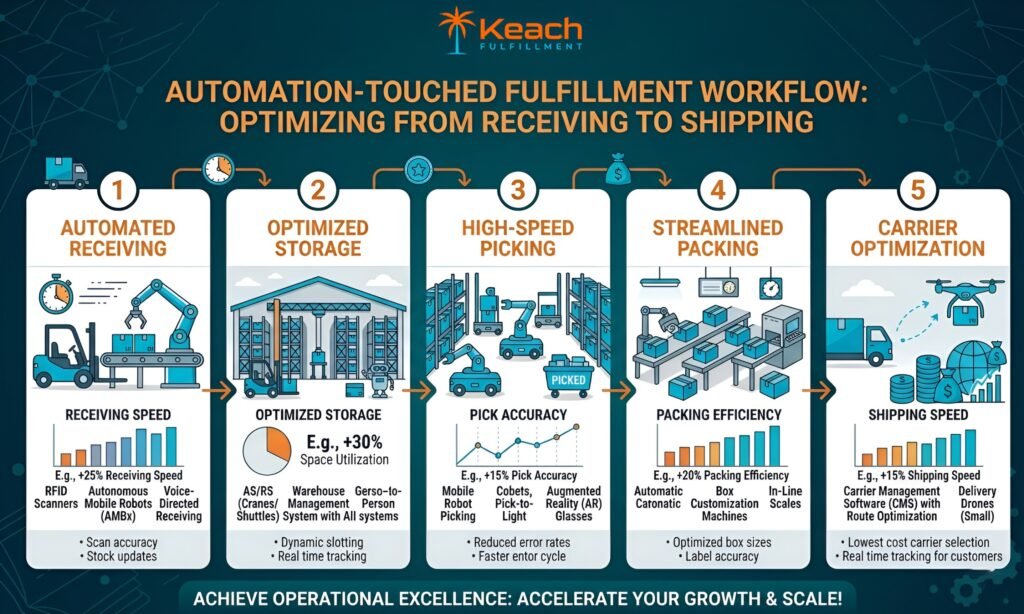
The transformation affects every aspect of warehouse operations, from inventory receiving to final shipment. Understanding how automation actually improves specific operational elements helps businesses evaluate whether the investment makes sense for their current stage and growth trajectory.
We’ll show you where technology creates the biggest impact.
Talk to our team about modernizing your fulfillment infrastructure.The Reality of Manual Fulfillment Limitations
Before diving into automation benefits, it’s worth understanding why manual operations eventually fail to scale adequately. The problems aren’t theoretical. They’re practical constraints every growing business encounters.
Human accuracy degrades under volume pressure. A picker processing 50 orders daily maintains high accuracy. That same person picking 200 orders makes more mistakes despite the best intentions. Fatigue affects judgment. Rushing creates errors. Similar products get confused when staff are moving quickly.
Speed limitations become apparent. Manual operations have maximum throughput regardless of how many staff you add. Warehouse layout, walking distances, and coordination overhead create bottlenecks. Throwing more people at the problem provides diminishing returns.
Training requirements create operational friction. Every new employee needs extensive training before reaching full productivity. Seasonal hiring becomes increasingly complex as volume grows. The time and cost of constantly training new staff compound.
Visibility gaps emerge in manual systems. Without systematic tracking, inventory accuracy problems accumulate. Products get misplaced. Counts drift from reality. Management operates with incomplete or delayed information about what’s actually happening in operations.
These limitations aren’t criticisms of manual labor. They’re acknowledgments that human capabilities have natural bounds that technology can extend or complement effectively.
What Fulfillment Automation Actually Means
The term “automation” covers a spectrum of technologies with different complexity levels and investment requirements. Understanding what’s actually involved helps separate hype from practical implementation.
Warehouse automation ecommerce typically starts with software rather than robots. Warehouse management systems coordinate operations by directing staff to exact product locations, generating optimal pick routes, managing inventory in real-time, and integrating with ecommerce platforms for automatic order flow. This foundational automation creates immediate improvements without requiring expensive robotics.
Barcode scanning represents the next automation layer. Handheld scanners or fixed scan stations force verification at critical checkpoints. Picking, packing, and quality control become automatic data capture points. Systems know exactly what’s happening in real-time rather than relying on manual tracking or end-of-day reporting.
Automated conveyance moves products through facilities without manual handling. Conveyor systems transport items between workstations. Automated guided vehicles (AGVs) move materials. Vertical lift modules deliver products to pickers rather than requiring walking. These systems reduce travel time, which consumes significant portions of manual picking productivity.
Robotics handles specific high-volume, repetitive tasks. Automated picking robots retrieve products from dense storage. Packing robots apply consistent packaging to standard products. Sorting systems route packages to the appropriate shipping lanes. These represent the most visible and expensive automation but deliver the highest throughput improvements.
The key insight is that automation builds in layers. Businesses don’t leap from manual operations to fully robotic warehouses. They progressively add automation where ROI justifies investment, creating hybrid systems combining human judgment with technology efficiency.
Before implementing automation, understanding why speed matters is crucial. Our previous article on Why Fast Fulfillment Is Critical for Ecommerce Growth explains how processing velocity affects customer satisfaction and competitive positioning, providing context for why automation investments that improve speed deliver compounding returns.
How Automated Order Fulfillment Transforms Accuracy
Accuracy improvements represent one of automation’s most measurable benefits. The difference between 95% accuracy and 99.9% accuracy seems small mathematically, but massive operationally.
Barcode verification at picking creates forced accuracy checkpoints. Without automation, pickers visually identify products and trust that they grabbed correctly. With scanning, systems confirm identity before allowing progression. Wrong items trigger immediate alerts rather than reaching customers.
Systematic verification extends through packing. Products scan again at the packing stations. Systems confirm that items in boxes match order details. This double-verification catches errors from picking or situations where multiple orders get confused.
Weight verification provides another automated check. Automated scales verify that the packed order weight matches the expected weight based on product data. Significant variances trigger inspection before shipping. This catches missing items or wrong products without visual inspection of every package.
Computer vision technologies are emerging in advanced operations. Cameras verify that the correct products are entered into bins or boxes. Image recognition confirms packing matches specifications. These systems verify without slowing human throughput.
The cumulative effect of multiple automated verification points creates accuracy rates above 99.9% in well-implemented systems. Compared to manual operations, typically achieving 93-97% accuracy, this represents an order-of-magnitude improvement in customer experience and operational cost from reduced returns and re-shipments.
Speed Improvements from Logistics Automation Systems
Beyond accuracy, automation dramatically accelerates processing without proportionally increasing labor.
Optimized pick paths reduce travel time. Manual pickers often follow inefficient routes or visit aisles multiple times. Logistics automation systems calculate optimal paths visiting each location once in logical sequence. This seemingly minor improvement can reduce pick time by 30-40%.
Batch and wave picking become feasible at scale. Systems can intelligently batch similar orders for efficient picking, then route products to appropriate packing stations for consolidation. This coordination complexity exceeds human capability, but automation handles it effortlessly.
Automated material flow eliminates walking between work zones. Products move via conveyance between receiving, storage, picking, and packing areas. Workers stay in assigned zones performing specialized tasks. Eliminating walking time between zones can reduce overall processing time by 20-30% in large facilities.
Real-time task management prevents idle time. Systems continuously assign next tasks to available staff based on priorities and locations. Nobody waits for instructions or wonders what to do next. Utilization rates improve significantly.
Parallel processing increases throughput. Multiple stations can work simultaneously on different order components that converge at packing. This parallelization isn’t feasible with manual coordination but becomes standard with automation.
The speed improvements compound with accuracy benefits. Faster processing without sacrificing accuracy creates the ideal combination supporting growth without proportional cost increases.
We can assess your current processes and identify the highest-impact improvements.
Our expertise helps prioritize technology investments for maximum ROI.Inventory Management Through Ecommerce Fulfillment Technology
Inventory visibility and accuracy improve dramatically when ecommerce fulfillment technology replaces manual tracking.
Real-time inventory updates occur automatically as products move. Receiving updates counts instantly. Picking decreases inventory immediately. Returns are added back automatically. Systems always reflect the current state rather than requiring end-of-day reconciliation.
Location tracking shows exactly where products sit. Automated systems track not just quantities but precise locations. This granular visibility enables efficient retrieval and prevents the common problem of products being “in the system” but unfindable physically.
Automated replenishment alerts notify when stock drops below thresholds. Rather than discovering stockouts when orders can’t fill, proactive notifications enable timely reordering. This prevents lost sales from invisible inventory problems.
Cycle counting integration maintains accuracy without full physical inventories. Automated systems direct regular partial counts of specific SKUs. Over time, the entire inventory gets verified without shutting down operations for complete counts.
FIFO enforcement becomes automatic for date-sensitive products. Systems direct pickers to the oldest inventory first, ensuring proper rotation. This prevents expiration issues that manual operations struggle to manage consistently.
Multi-location visibility enables distributed inventory strategies. For businesses with multiple warehouses, automated systems provide unified inventory views across locations. This enables intelligent order routing and inventory allocation, impossible with manual tracking.
| Fulfillment Stage | Manual Process | With Automation |
|---|---|---|
| Order Receipt | Manual download/entry | API integration |
| Picking | Walking with paper lists | Directed picking with scanning |
| Packing | Visual verification | Barcode and weight verification |
| Inventory Tracking | End-of-day updates | Real-time scanning |
| Shipping | Manual label creation | Automated label/carrier selection |
The Labor Impact of Automation
Automation’s effect on the workforce is more nuanced than simple replacement narratives suggest.
Task shifting occurs rather than wholesale elimination. Automation handles repetitive, high-volume tasks like scanning, data entry, and basic verification. Humans focus on exception handling, quality judgment, problem-solving, and customer service. These higher-value activities better utilize human capabilities.
Productivity per worker increases significantly. Individual workers supported by the automation process handle far more orders than their manual counterparts. This enables handling growth without proportional headcount increases. Existing teams can manage 2-3x volume with good automation.
Seasonal staffing flexibility improves. Automated operations are easier to train new staff for than complex manual systems. Seasonal workers can become productive faster when technology guides their work and prevents errors.
Working conditions often improve. Automation eliminates the most physically demanding and monotonous tasks. Workers appreciate reduced walking, less heavy lifting, and more varied responsibilities. This can improve retention and reduce workplace injuries.
The transition requires change management. Existing staff need training on the new systems. Some resistance is natural when workflows change. However, most workers appreciate automation once they experience reduced physical strain and clearer task direction.
The strategic question isn’t whether automation eliminates jobs but whether businesses can afford NOT automating, given competitive pressure to match pricing and speed of automated competitors.
Understanding Automation ROI
Investment in warehouse automation ecommerce requires capital and implementation effort. Understanding return on investment helps prioritize spending.
Software automation delivers the quickest ROI. Warehouse management systems and integration platforms cost tens of thousands rather than millions. Payback periods often run 12-24 months through improved efficiency and accuracy. This should be the first automation investment for most businesses.
Barcode scanning infrastructure provides clear returns. Scanner investments of a few thousand dollars per station reduce errors dramatically. Accuracy improvements alone often justify costs through reduced reshipping and customer service burden.
Material handling equipment delivers returns at higher volumes. Conveyor systems, vertical lift modules, or AGVs require six-figure investments. These make sense when labor costs and volume justify the capital expenditure, typically at 10,000+ orders monthly.
Robotics requires the most careful analysis. Pick-and-place robots or automated packing systems cost hundreds of thousands to millions. ROI timelines extend to 3-5 years. These investments make sense for very high-volume operations or highly specialized applications where human limitations create absolute bottlenecks.
The phased approach typically provides the best returns. Start with software and scanning. Add material handling as volume grows. Consider robotics only at scales where a clear ROI exists. This builds automation capability without overinvesting before business scale justifies advanced technology.
When Automation Makes Sense
Not every business should automate immediately. Certain conditions indicate readiness.
Volume thresholds matter. Businesses processing under 500 orders monthly can usually manage manually efficiently. Between 500 and 2,000 monthly orders, software automation and scanning make sense. Above 2,000 orders, advanced automation becomes economically viable. Above 10,000, it’s often necessary for competitive operations.
Growth trajectory influences timing. Businesses expecting rapid growth should implement automation earlier than static operations. Building automated infrastructure before growth hits prevents operational crises during scaling.
Accuracy problems indicate automation needs. If error rates exceed 2-3%, automation’s verification capabilities provide immediate value, protecting customer satisfaction and reducing return costs.
Space constraints can drive automation. Vertical storage systems and dense automated storage occupy less floor space than traditional racking. Businesses in expensive locations or with limited square footage benefit from space-efficient automation.
Labor availability and costs affect ROI. Markets with high wages or worker shortages see faster automation payback. Stable, low-cost labor markets have less immediate pressure to automate.
The decision isn’t binary between manual and fully automated. Most operations benefit from hybrid approaches combining human judgment with strategic automation, where technology provides clear advantages.
We can help you understand which technologies fit your volume and goals.
Our team has implemented automation at various scales and complexity levels.Common Automation Mistakes to Avoid
Many businesses stumble during automation implementation. Learning from common mistakes helps smooth transitions.
Overautomating too early wastes capital. Implementing complex robotics before volume justifies investment, tying up money better spent elsewhere. Start simple with software and work up as growth justifies.
Neglecting change management causes adoption problems. Technology only helps if people use it correctly. Investing in training and communication about why automation helps creates buy-in that ensures successful implementation.
Choosing incompatible systems creates integration headaches. Ensure warehouse management systems integrate with your ecommerce platforms, carriers, and other business systems. Disconnected automation loses much of its value through manual coordination requirements.
Underestimating implementation complexity leads to delays and overruns. Automation projects take longer and cost more than initial estimates. Budget conservatively and plan for learning curves.
Ignoring maintenance requirements creates long-term problems. Automated systems need ongoing maintenance, updates, and support. Factor these operational costs into ROI calculations.
Failing to measure results prevents learning. Implement tracking for accuracy rates, processing times, and costs before and after automation. Measurement enables proving ROI and identifying where further optimization helps.
The Future Evolution of Automation
Automation continues to advance with technologies that will reshape fulfillment further.
Artificial intelligence is enhancing automated decision-making. AI optimizes pick routes more intelligently, predicts inventory needs more accurately, and identifies patterns humans miss. Machine learning improves system performance over time.
Computer vision is expanding quality control capabilities. Visual inspection by AI can detect damage, verify correct products, and ensure quality standards without human inspection. This adds verification without slowing throughput.
Collaborative robots work alongside humans safely. Unlike traditional robots requiring safety cages, collaborative robots (cobots) assist humans directly with heavy lifting or repetitive tasks while people handle judgment and dexterity requirements.
Autonomous mobile robots are becoming more sophisticated and affordable. These systems navigate warehouses independently, transport products, and coordinate with other systems. Costs are dropping, making them accessible to mid-sized operations.
Voice-directed systems guide workers through tasks hands-free. Workers wear headsets, receiving voice instructions and confirming completion verbally. This improves speed and ergonomics compared to scanning.
The trajectory is clear. Automation becomes more capable and accessible continuously. The question for ecommerce businesses isn’t whether to automate but when and how to implement technologies that fit their specific needs and growth stage.
Understanding how fulfillment automation improves operations across accuracy, speed, inventory management, and scalability helps businesses evaluate investment timing and priorities. The transition from manual to automated operations happens progressively, with each layer of technology building on previous improvements. At Keach Fulfillment, we’ve implemented logistics automation systems across our Houston operations, seeing firsthand how ecommerce fulfillment technology transforms capability. The benefits extend beyond pure efficiency into reliability, scalability, and competitive positioning that manual operations simply cannot match at growth volumes. Automation isn’t about replacing people. It’s about creating operations where technology and human judgment combine to deliver the accuracy, speed, and scale modern ecommerce demands.