
Speed defines modern ecommerce. Customers now expect purchases to arrive within days, sometimes hours. This expectation isn’t just a preference anymore. It’s become the baseline standard that separates thriving online businesses from those struggling to compete.
The shift happened quietly but completely. Amazon Prime trained millions of shoppers to expect two-day delivery as normal. Then faster options appeared. Next-day shipping. Same-day in many cities. What seemed impossibly fast five years ago is now what customers simply expect from professional online retailers.
For growing ecommerce businesses, this creates both pressure and opportunity. Fast ecommerce fulfillment has evolved from a competitive advantage to a competitive necessity. Getting products to customers quickly doesn’t just make them happy. It fundamentally affects whether they buy from you in the first place, whether they come back, and whether they recommend your brand to others.
We’ll show you how faster processing unlocks revenue.
Talk to our team about same-day fulfillment capabilities.The Direct Connection Between Speed and Conversion
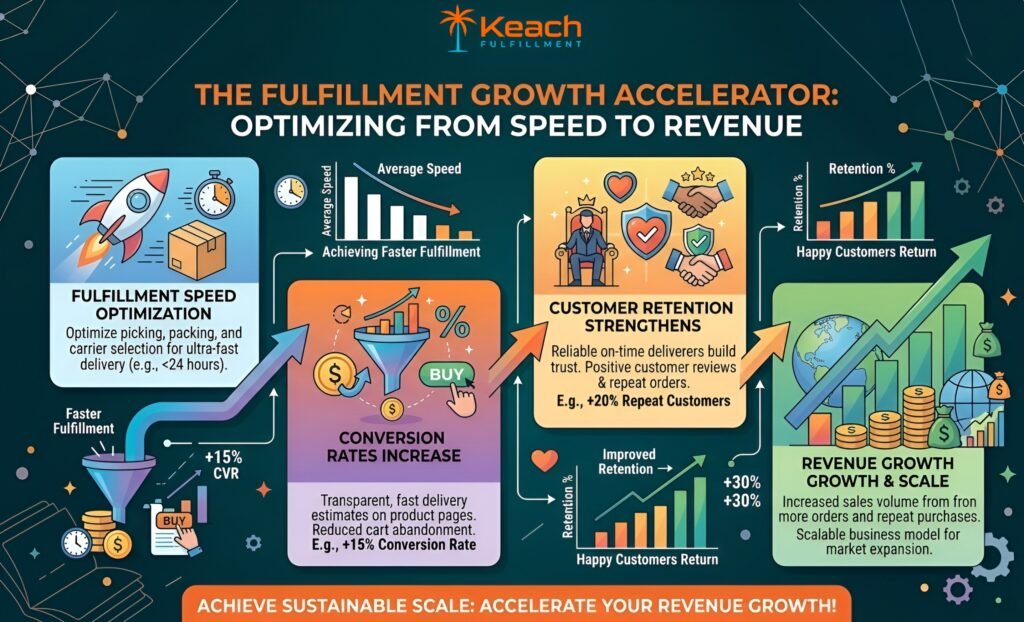
Fulfillment speed affects purchasing decisions before customers even place orders. When shopping online, the delivery timeline appears prominently during checkout. Two identical products at similar prices compete on one major factor: how quickly customers can receive them.
Research consistently shows that faster delivery options increase conversion rates. Shoppers abandon carts when delivery seems too slow. They choose competitors offering quicker arrival. The psychology is simple. People want what they want now, not eventually.
This matters most for certain product categories. Need a gift for an event this weekend? You’re buying from whoever can deliver by Friday, regardless of slightly higher prices or less-perfect product matches. Emergency purchases, time-sensitive needs, and last-minute shopping all prioritize speed over almost every other factor.
Even for non-urgent purchases, faster delivery creates psychological value. It signals professionalism and capability. Brands offering quick fulfillment seem more established, more reliable, more worth trusting with your money. Same-day fulfillment services communicate operational excellence that builds confidence during purchase decisions.
How Order Fulfillment Speed Affects Customer Retention
The experience doesn’t end at checkout. What happens between order and delivery shapes customer perception more than many sellers realize.
When packages arrive quickly, customers feel satisfied. The dopamine hit of receiving something new comes sooner. The positive association with your brand strengthens. Fast delivery creates delight, especially when it exceeds stated timelines. Promising three-day delivery and shipping next-day generates goodwill that generic on-time performance doesn’t.
Slow fulfillment creates the opposite effect. Waiting feels endless. Customers question their purchase decision. They check tracking obsessively. Frustration builds. Even if products eventually arrive fine, the prolonged waiting period has already soured the relationship.
This affects repeat purchase rates directly. Customers remember how quickly their last order arrived when deciding where to shop next. Fast order fulfillment builds loyalty because it respects customers’ time. Slow fulfillment pushes customers toward competitors who move faster.
The data support this clearly. Studies show customers who receive orders faster buy again sooner and more frequently. The velocity of the customer lifecycle accelerates when fulfillment keeps pace. Slower operations stretch the time between purchases, reducing lifetime value per customer.
Ecommerce Shipping Speed as Competitive Differentiation
In crowded markets where products are similar and prices are competitive, ecommerce shipping speed becomes the primary differentiation.
Consider two brands selling nearly identical products. Both have good reviews, reasonable prices, and similar selection. One ships orders within 24 hours. The other takes 3-5 business days to process before shipping even begins. The choice seems obvious.
Fast fulfillment creates competitive moats that are harder to overcome than pricing or features. Competitors can match your prices by cutting margins. They can copy your products. They can’t instantly replicate fulfillment infrastructure that took years to build and optimize.
This defensive advantage protects market position. Once you’ve captured customers with superior speed, competitors must overcome significant switching friction. Customers don’t easily abandon reliable, fast service for marginal improvements elsewhere.
The offensive advantage is equally valuable. Fast fulfillment enables market expansion into customer segments previously unreachable. Business customers with urgent needs become viable targets. Last-minute shoppers who previously bought from local retailers become online customers. Geographic markets previously too distant for reasonable delivery become serviceable with expedited processing.
| Fulfillment Speed | Average Processing Time | Customer Expectation |
|---|---|---|
| Standard | 3-5 business days | Baseline acceptable |
| Fast | 1-2 business days | Exceeds expectation |
| Next-Day | 24 hours | Delights customers |
| Same-Day | 4-8 hours | Creates loyalty |
The Economics of Fast Processing
Speed has costs. Same-day fulfillment services require investment in infrastructure, systems, and operations that slower competitors avoid. The question isn’t whether fast fulfillment costs more. It’s whether the return justifies the investment.
The revenue impact shows up across multiple channels. Higher conversion from faster delivery options increases top-line sales. Better retention from satisfied customers improves lifetime value. Premium pricing power from differentiated service protects margins. Reduced cart abandonment from shipping anxiety captures sales that would otherwise vanish.
Customer acquisition costs decrease when fulfillment creates a competitive advantage. Word-of-mouth from delighted customers supplements paid marketing. Repeat customers reduce reliance on expensive new customer acquisition. The cumulative effect often shows fast fulfillment paying for itself through improved economics across the entire business.
Operational benefits also offset costs. Fast processing requires systematic organization that improves overall efficiency. Inventory turns faster when orders are processed quickly, reducing carrying costs. Less warehouse congestion from rapid throughput improves space utilization. The operational excellence required for speed creates benefits beyond just the delivery timeline.
Our systems process orders consistently within 24 hours.
Let’s discuss how fast fulfillment transforms your growth trajectory.Building Infrastructure for Speed
Fast ecommerce fulfillment doesn’t happen accidentally. It requires intentional infrastructure across technology, processes, and people.
Technology enables speed through automation. Warehouse management systems that receive orders instantly and route them to picking staff eliminate processing delays. Barcode scanning during picking and packing maintains accuracy without slowing throughput. Carrier integration generates shipping labels automatically without manual work. This system’s investment creates the foundation for consistent, fast processing.
Process design determines maximum achievable speed. Warehouse layouts optimized for efficient picking reduce travel time. An inventory organization that places fast-moving products in accessible locations speeds retrieval. Packing stations pre-stocked with supplies keep staff moving without interruptions. Every wasted motion adds seconds that compound across thousands of orders.
Staffing models affect capacity during peak periods. Flexible labor that scales with order volume maintains processing speed during surges. Cross-trained teams that can shift between receiving, picking, and packing prevent bottlenecks from forming. Quality management that catches errors without slowing operations protects accuracy while maintaining pace.
Geographic positioning matters for true same-day delivery. Warehouses located near major population centers reduce last-mile transit time. Strategic facility placement can convert overnight shipping into same-day delivery for significant customer percentages without expedited carrier costs.
When Speed Becomes Too Expensive
Fast isn’t always the answer. Some businesses and products don’t justify the infrastructure investment that maximum speed requires.
Low-margin products with price-sensitive customers might not support the operational costs of premium fulfillment. Customers buying commodity items often prioritize price over delivery speed. Adding expensive fast fulfillment to win these customers could destroy unit economics.
Products with naturally long consideration cycles don’t benefit as much from rapid fulfillment. Furniture purchases, major appliances, or other investments happen on timelines where a few extra days of processing barely register. Speed still matters, but the competitive value diminishes compared to fast-moving consumer categories.
Geographic markets that carriers struggle to reach quickly face different dynamics. Rural areas with limited same-day or next-day service availability don’t reward fulfillment speed the same way urban markets do.
The calculus involves matching fulfillment investment to customer expectations and competitive requirements in your specific market. Being adequately fast for your category often matters more than being fastest overall. Exceeding customer expectations by appropriate margins drives growth more efficiently than chasing absolute speed records.
What Actually Creates Fast Order Fulfillment
Beyond infrastructure, order fulfillment speed comes from eliminating delays at every process stage.
Order receipt delays disappear through real-time integration. Manual downloading or batch processing adds hours or days. Direct connection between your store and warehouse systems starts processing within minutes.
Inventory availability problems slow fulfillment when popular products are out of stock or cannot be located quickly. Organized storage with accurate tracking means pickers go directly to the correct locations without searching.
Picking inefficiency from poor warehouse layout or inadequate direction slows throughput. Optimized routing and clear location systems keep staff moving efficiently.
Packing delays from disorganized workstations or missing supplies interrupt flow. Properly stocked packing areas with clear procedures maintain a steady pace.
Shipping coordination bottlenecks occur when carrier pickup schedules don’t align with processing completion. Strategic pickup timing and carrier relationships enable cut-off times that accommodate late-breaking orders.
Each delay source requires specific solutions. The businesses achieving genuinely fast fulfillment have identified and eliminated friction points throughout their workflows.
We can audit your process and identify speed improvements.
Our expertise helps brands cut processing time significantly.The Future Is Getting Faster
Customer expectations continue accelerating. What impresses today becomes baseline tomorrow. Ecommerce businesses must keep evolving fulfillment capabilities to maintain competitive position.
Same-day delivery expands beyond major metros. Technology improvements and delivery network density make rapid delivery economically viable in more markets. Businesses previously excused from speed competition face new pressure.
Micro-fulfillment centers bring inventory closer to customers. Smaller distributed facilities replacing or supplementing central warehouses reduce delivery distance. This geographic approach to speed may reshape fulfillment networks.
Automation enables faster processing at lower cost over time. Robotics and AI-assisted operations promise to maintain or improve speed while reducing labor requirements. Early adopters gain advantages that compound.
The competitive landscape will increasingly separate into speed tiers. Premium brands offering rapid delivery will command loyalty and pricing power. Budget alternatives might compete on price with slower service. The challenging middle ground of adequate but not exceptional speed may struggle the most.
For growing ecommerce businesses, the strategic question isn’t whether to invest in faster fulfillment. It’s how quickly to build capability before competitors make speed advantages insurmountable. The businesses winning ecommerce growth races share one characteristic: they figured out fast fulfillment before their categories demanded it, creating momentum that slower competitors struggle to match.
Understanding why fast ecommerce fulfillment drives growth is just the beginning. Implementation requires infrastructure, processes, and expertise that most brands develop over years or access through a partnership with specialists. At Keach Fulfillment, we’ve spent eight years building the systems that enable same-day fulfillment services and consistently fast order processing. The relationship between ecommerce shipping speed and business growth isn’t theoretical. We see it daily in how our clients scale when fulfillment stops being their constraint and becomes their competitive advantage.