
You have outgrown your garage. Orders pile up on your dining table. Your evenings disappear into packing boxes. Outsourcing seems tempting.
But is it the right time? 3PL fulfillment offers amazing benefits, but only for businesses ready to use them. Moving too early wastes money. Moving too late damages growth.
Learn the signs that tell you when to make the move.
Spot the Right TimeWhat Is 3PL Fulfillment Exactly?
3PL fulfillment means hiring an external company to handle your warehousing, picking, packing, and shipping. You send inventory to their warehouse. Their team fulfills orders as they arrive.
A 3PL fulfillment center operates as an extension of your business. Your sales channel connects directly to their system. Orders flow automatically. Tracking updates go to your customers. Your brand stays front and center.
The 3PL handles everything physical. You handle everything digital. This partnership works beautifully when both parties understand their roles.
What Are the Signs You Need 3PL Fulfillment Services?
3PL fulfillment services become essential when certain conditions appear. Watch for these signs.
- Time scarcity tops the list. If fulfillment consumes more than ten hours weekly, you cannot sustain that space. Those hours should go to marketing, product development, or customer relationships.
- Space constraints follow closely. Your garage overflows. Your spare bedroom resembles a warehouse. Professional storage solves this problem immediately.
- Error rates increase as you rush. Wrong items ship. Orders arrive late. Returns cost money and damage trust. Professional 3PL fulfillment centers achieve 99.5 percent accuracy.
- Growth plans require scalability. Adding new products or channels strains your current operation. A 3PL absorbs growth effortlessly.
- Seasonal spikes overwhelm DIY operations. Black Friday and holiday volume crush home-based fulfillment. Professional centers handle peaks routinely.
Professional 3PLs remove the ceiling entirely.
Explore Fulfillment BenefitsWhen Should You Keep Fulfillment In-House?
Insourcing vs outsourcing fulfillment operations: 3PL logistics decisions depend on your current situation. In-house makes sense in specific scenarios.
Very low volume justifies DIY. Under fifty orders weekly, you can manage efficiently. The time commitment stays manageable.
High customization may require in-house control. Products needing unique packaging or special handling might not fit standard 3PL processes.
Tight margins on low-value products might not support 3PL fees. Calculate your per-order costs carefully.
Testing new products before committing to volume makes sense. Once a product proves itself, move it to your 3PL.
Geographic concentration might favor self-fulfillment. If all customers live within twenty miles, local delivery works well.
What Happens During the Transition to a 3PL?
Moving from in-house to a 3PL fulfillment center takes planning. The transition typically spans four to six weeks.
- Research potential partners first. Look for experience with your product type and integration with your sales channels.
- Run a test shipment. Send a small batch of inventory to your chosen 3PL. Place test orders yourself. Evaluate their speed and accuracy.
- Integrate your systems. Connect your sales channels to their platform. Test the order flow thoroughly before going live.
- Transition gradually. Move your fastest-selling products first. Keep slow movers in-house initially. Expand as confidence grows.
- Monitor performance closely. Review accuracy reports weekly. Address any issues immediately.
In our previous guide, The Rise of 3PL: What Top 3rd Party Logistics Providers Do Differently, we explored what makes exceptional partners. Use those criteria when selecting your 3PL.
| Factor | Keep In-House | Outsource to 3PL |
|---|---|---|
| Weekly orders | Under 50 | 50+ |
| Storage space | Available at home/office | Constrained or costly |
| Error rate | Acceptable | Increasing or costly |
| Growth plans | Limited or slow | Aggressive or expanding |
| Seasonal spikes | Manageable | Overwhelming |
| Product complexity | High, custom | Standard categories |
How Do You Calculate the ROI of Outsourcing?
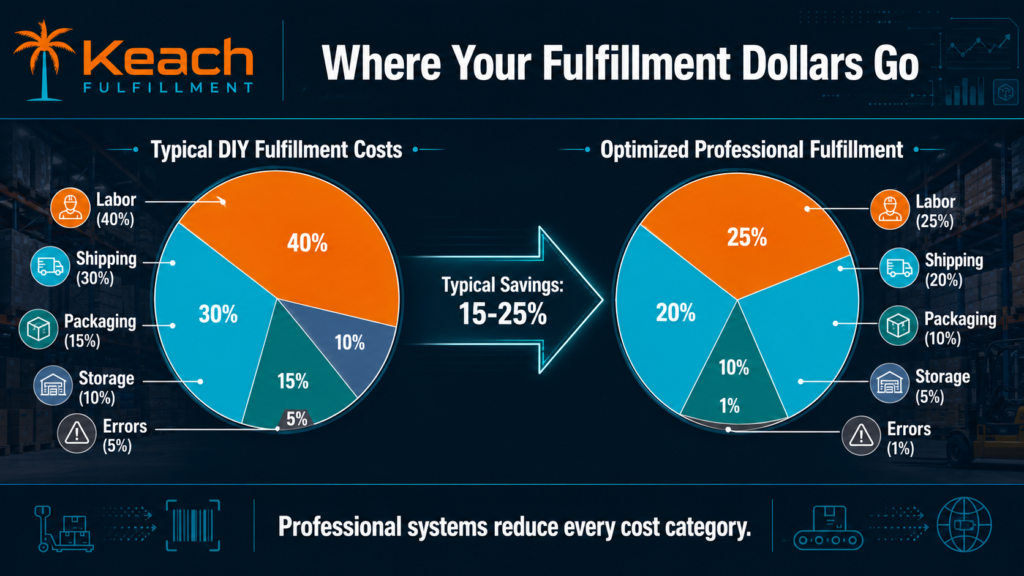
3PL fulfillment costs money. But so does DIY fulfillment. Compare the full picture.
- Your time has value. Calculate your hourly rate. Multiply by hours spent packing orders. That is a real cost.
- Your space has value. What could you do with your garage if boxes did not fill it? Rent saved or quality of life improved?
- Your error rate costs money. Each wrong item requires return shipping, replacement product, and customer goodwill. These costs add up.
- Your shipping rates matter. 3PLs access volume discounts you cannot get alone. Lower rates often cover the entire fulfillment fee.
- Add these factors together. Many brands find outsourcing costs less than DIY when counting everything.
Wrap Up
3PL fulfillment transforms businesses ready to scale. The right time comes when DIY fulfillment consumes your time, space, and energy. However, moving too early wastes money.
Watch for the signs. Ten-plus hours weekly. No space left. Rising error rates. Growth plans that require scalability. Seasonal spikes that overwhelm you.
At Keach Fulfillment, we help brands navigate this decision. Our 3PL fulfillment center provides 3PL fulfillment services for growing ecommerce companies. We handle the physical work so you focus on growth.
Let our 3PL fulfillment power your growth.
Contact Keach Fulfillment