
You have heard the term “3PL” thrown around. Everyone seems to use one. But what exactly does it mean? What is 3pl fulfillment in plain English? It simply means outsourcing your warehousing and shipping to a professional partner. You send inventory to their warehouse. They pick, pack, and ship orders as they arrive.
Learn the basics without confusing jargon.
Get Control Keach FulfillmentWhat Is 3PL Fulfillment Exactly?
What is 3pl fulfillment at its core? A 3PL (third party logistics) provider handles your physical fulfillment operations.
You focus on sales, marketing, and product development. They handle receiving, storage, picking, packing, and shipping. Your sales channel connects directly to their system. Orders flow automatically.
The 3PL becomes an extension of your business. Your brand stays front and center. Customers never know you use a third party. They just receive their orders quickly and accurately.
How Much Does 3PL Software Cost?
How much does 3pl software cost depends on your chosen provider and integration method.
Some 3PLs include software as part of their service. You access their dashboard without additional charges. This approach works well for most growing brands.
Other providers charge separately for software access. Monthly fees range from fifty to five hundred dollars depending on features. Advanced analytics and multi location support cost more.
One time setup fees may apply for initial integration. Connecting your sales channels to the 3PL’s system takes configuration. Some providers charge for this setup, others include it free.
The most cost effective approach combines software and fulfillment from one provider. You avoid separate billing and integration headaches.
Understanding pricing helps you choose the right partner.
Compare OptionsWhat Is the 3PL vs 4PL Logistics Difference?
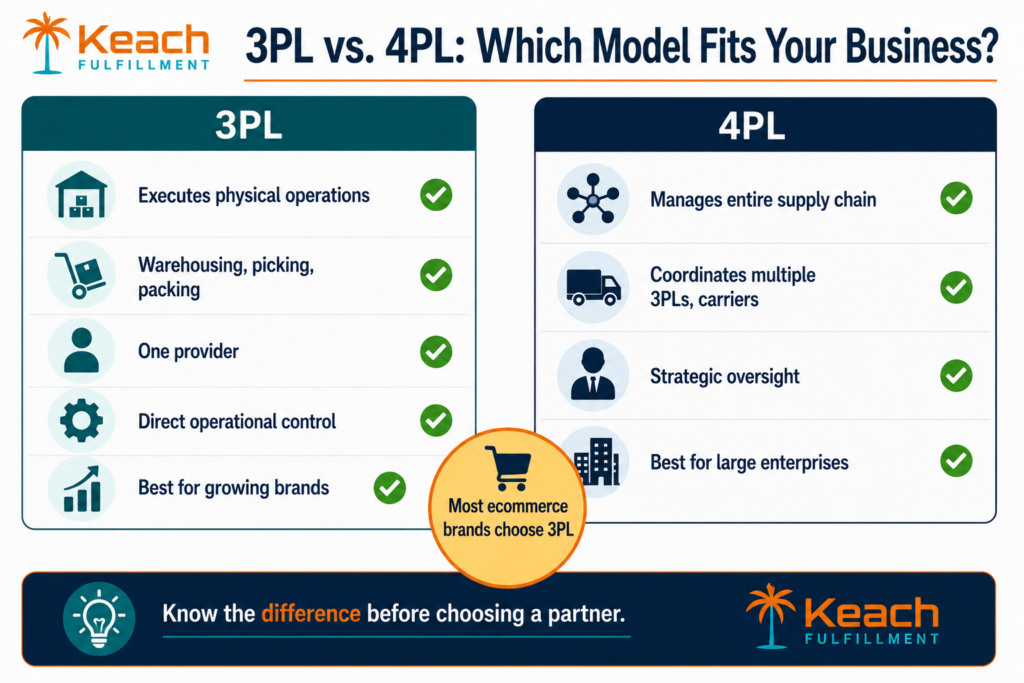
3pl vs 4pl logistics difference benefits comparison reveals two distinct service models.
3PL (Third Party Logistics)
3PL providers handle physical operations. They store your inventory, pick orders, pack boxes, and arrange shipping. They execute the work directly.
4PL (Fourth Party Logistics)
4PL providers manage your entire supply chain. They coordinate multiple 3PLs, carriers, and warehouses. They serve as your logistics department.
Think of 3PL as the worker and 4PL as the manager. Most ecommerce brands need 3PL services. Only large enterprises require 4PL oversight.
The benefits comparison shows 3PL offers direct operational support. 4PL offers strategic supply chain management. For growing brands, 3PL provides the right balance of support and control.
What Should You Look for in 3PL Fulfillment Services?
Choosing 3pl fulfillment services requires evaluating several factors beyond price.
Integration Capabilities
Integration capabilities determine how smoothly orders flow. Your provider should connect directly to your sales channels. No manual entry. No spreadsheets.
Accuracy Rates
Accuracy rates affect customer satisfaction. Top providers exceed 99.5 percent. Fewer wrong items mean fewer returns.
Warehouse Locations
Warehouse locations influence delivery speed. Multiple facilities near your customers reduce shipping times.
Scalability
Scalability ensures your partner handles growth. Can they absorb seasonal spikes without delays?
Transparent Pricing
Transparent pricing prevents surprises. The best providers explain every fee clearly.
In our previous guide, Outsourced Fulfillment Decoded: Is a 3PL Worth the Investment?, we explored the ROI of outsourcing. Use those insights when evaluating 3PL fulfillment services.
How Do You Choose Between 3PL and 4PL?
Most ecommerce brands should choose a 3PL. 4PL makes sense only for very large operations.
Choose 3PL if you handle your own logistics strategy but need operational support. You decide which carriers to use and where to store inventory. The 3PL executes your decisions.
Choose 4PL if you want someone else to manage your entire logistics strategy. They select carriers, choose warehouse locations, and coordinate multiple 3PLs. You focus entirely on sales and product.
For growing brands, 3PL provides the right balance. You maintain strategic control while outsourcing physical work.
Conclusion
3pl fulfillment services transform growing ecommerce brands. Understanding what is 3pl fulfillment helps you make better decisions. Knowing how much does 3pl software cost prevents budget surprises. Evaluating the 3pl vs 4pl logistics difference benefits comparison ensures you choose the right model.
At Keach Fulfillment, we provide comprehensive 3pl fulfillment services for ecommerce brands. Our transparent pricing, seamless integration, and high accuracy rates deliver the value you need.
Let us answer your questions and provide transparent pricing.
Contact Keach Fulfillment