
In modern e-commerce, “I need it now” is not a whim. It is a logistical command. When a shopper clicks buy with next-day delivery in mind, a high-speed ballet begins behind the scenes. This is not just moving boxes. It is about shaving seconds off every touch to meet rigid carrier deadlines. For brands working with Keach Fulfilment, understanding the mechanics of a warehouse fulfillment center is key to seeing why speed is not just a metric. It is the whole model.
This article explains how fulfillment centers handle same-day shipping cutoff times and why those deadlines shape every decision on the floor. The journey from cart to doorstep in 24 hours relies on software, human precision, and smart layout. It is a race where the finish line is the courier’s truck.
The Moment the Order Lands
Before an order is placed, the groundwork for speed is laid. This is what separates a professional operation from a standard storage facility. A common question is: What’s the difference between a regular warehouse and a fulfillment center? A traditional warehouse stores goods in bulk, often palletized and untouched for weeks. A fulfillment center operates on a just-in-time inventory philosophy. Items sit in accessible bins, ready to be plucked the moment a notification hits the system.
The moment a customer completes a purchase, the clock starts ticking. The same-day pick-and-pack order fulfillment process begins with the Order Management System. This software talks to the Warehouse Management System to prioritize orders based on shipping speed. If the order is flagged for same-day dispatch, it jumps to the front of the digital queue. This integration is what allows centers to slash the warehouse order processing time from checkout to dispatch.
Let Keach Fulfillment that loves deadlines, handle the heavy lifting.
Reach out today and reclaim your evenings.Choosing the Fastest Path
Once the order hits the floor, the physical race begins. The most critical phase is the pick. In a high-volume environment, how items are retrieved dictates the efficiency of the entire operation. This is where batch picking vs. zone picking in e-commerce fulfillment comes into play.
In a zone picking setup, the warehouse is divided into specific areas. A picker is assigned to one zone and picks only the items in that area for various orders. This reduces the distance a single picker walks, but it can create bottlenecks if one zone is slower than another.
Batch picking is a strategy built for speed. A picker is assigned multiple orders at once and travels the warehouse collecting all the items for those orders in one trip. This minimizes travel time between aisles, which is often the most time-consuming part of the process. For same-day shipping, batching lets one associate gather items for ten or twenty customers at once.
Handheld scanners guide the picker through the most efficient route and beep to confirm the correct SKU. This keeps accuracy high while the pace stays frantic. When people ask how fast fulfillment warehouses pack orders, the answer is usually minutes per item, largely due to these optimized routes.
Packing with Purpose
Once items are picked, they move to the packing stations. This is the quality control checkpoint. The packer scans the items again to make sure the picker did not grab a medium instead of a large. The system then tells the packer which box size to use and how much void fill is needed to protect the goods. This step is vital for reducing shipping costs. Shipping air is expensive.
For same-day shipping, packing must be swift but secure. The packer applies the shipping label, which is generated based on the carrier’s cutoff times. If a package misses the 2 PM cutoff for FedEx, it sits overnight, and the same-day promise is broken. Packers are often measured by speed and accuracy. The goal is to get the package from the packing table to the outbound dock as fast as possible, so it can join the stream of parcels heading to the sorting facility.
The Final Sprint Before the Truck Leaves
The cutoff time is the immovable object in e-commerce. It is the specific time of day when a carrier truck arrives and departs. If a package is not scanned onto that truck, it is not arriving tomorrow. A warehouse fulfillment center runs its entire day around this deadline.
To handle this, centers often run waves. Instead of processing orders as they come in, they release orders in batches to the floor. The final wave of the day is usually the same-day wave. This requires a surge in manpower and coordination. The outbound dock becomes a scene of organized chaos. Packages are sorted by carrier and shipping method. Conveyor belts move parcels directly into waiting trucks. Scanners update tracking information in real time and trigger the shipping email to the customer.
Inside the Order Fulfillment Process
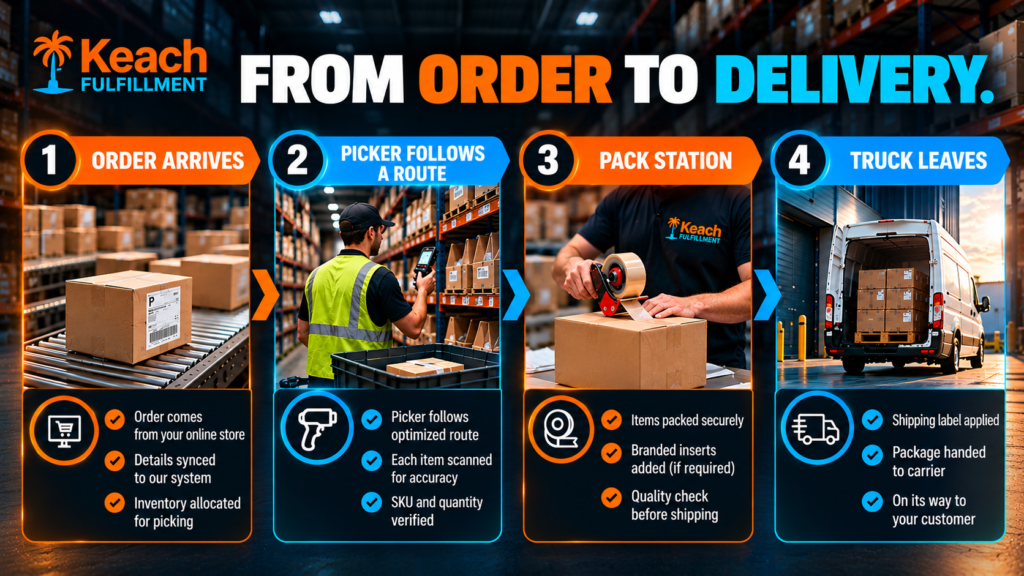
This entire process, from the click of a mouse to the scan on a truck, is a testament to logistical engineering. It requires coordination that most business owners cannot manage from a garage. By outsourcing to a specialized warehouse fulfillment center, brands buy into a system that has already perfected the art of the rush. The result is a satisfied customer who receives a package on time, unaware of the complex ballet that made it happen.
They care that the box shows up when promised.
Let us make that promise easy to keep. Setup.