
As you drive by any industrial park facility, you will find one very similar thing there. Low, long buildings with loading docks, trailers that come and go, piles of boxes and pallets right next to the entrances. Outside, a storage warehouse facility looks almost the same as a fulfillment center; that’s why many businessmen believe they are the same, only with different names.
In fact, they are not the same thing, but the differences between them can be crucial only when they become clear after you have already leased an office or signed a contract for services and noticed that you don’t get exactly what you need. The answer to the question of what a fulfillment center is lies inside.
The Basic Difference Between Warehouse and Fulfillment Center
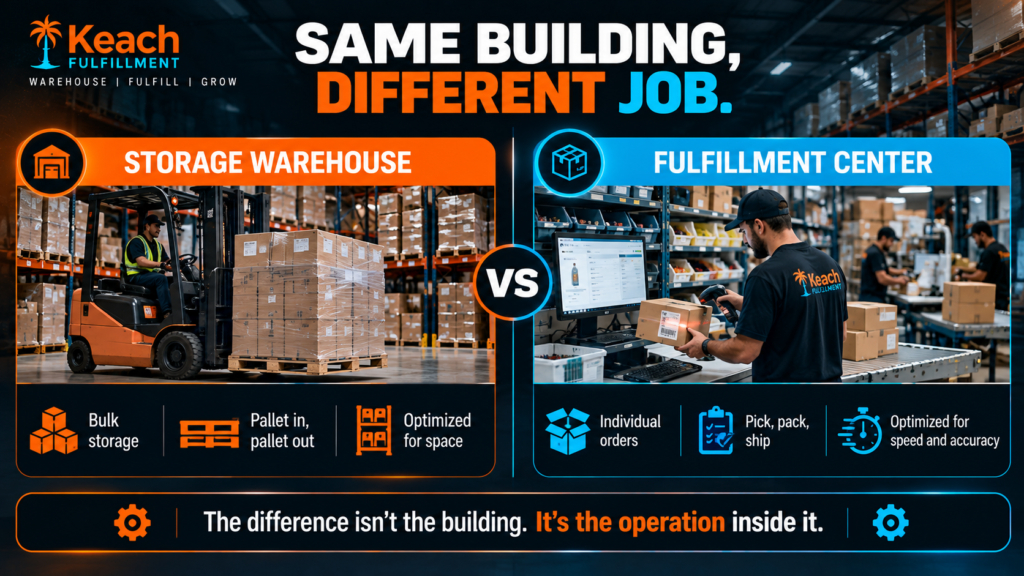
A warehouse stores things. A fulfillment center stores things and then ships them, one order at a time, to individual customers.
It might seem like a subtle difference until one considers what each of those requires. The storage warehouse would be designed to accommodate pallets, bulk inventory, and space usage. It should contain inventory until someone arranges to retrieve or relocate it. On the other hand, the fulfillment center would be set up to process individual orders, which requires receiving, storing, picking, packaging according to the brand standards, and transferring the inventory to carriers.
Different equipment and people resources should be used in each of those places accordingly. The warehouse would use forklifts and racks. The fulfillment center would use pick carts, packing stations, label printers, conveyors, as well as the software connecting the sales channel with inventory processing.
Why the Two Get Confused
The confusion isn’t unreasonable, because most fulfillment centers do function as warehouses in the technical sense. They store inventory. They manage space. They handle receiving and returns. The warehouse part is real.
What separates them is what happens after storage. A traditional warehouse typically operates on bulk movement. Pallets in, pallets out. A fulfillment center operates on individual orders, which means it might process hundreds or thousands of small shipments in a single day, each one going to a different address.
This is why asking whether a fulfillment center is just a warehouse usually produces an unsatisfying answer. It’s a warehouse plus a shipping operation plus an inventory management system plus a customer-facing service layer, all working together. Take away any one of those parts, and it stops functioning as a fulfillment center, even if the building itself stays the same.
Storage Warehouse vs. Fulfillment Center
Do I Need a Warehouse or Fulfillment Center?
That question tends to come up once a business starts scaling, and the answer depends entirely on what you’re actually doing with the inventory.
In case of holding stock intended for subsequent distribution, maintaining seasonal stocks, or storing raw materials that travel in large volumes, a storage warehouse would be a more appropriate solution. In case you have your products distributed via an online store or other platforms such as marketplaces or subscription box services, the chances are high that you need a fulfillment center since this type of business is built entirely around fulfilling orders one by one and not moving any bulk stock.
It should be noted that there is also a combination of these two options that is sometimes necessary for some businesses. Such businesses store their bulk inventory in one place while shipping some smaller amounts to the fulfillment center as necessary. This option is often utilized by businesses selling their products both wholesale and direct to consumers.
The wrong choice is making a decision on price alone. The fact is that a storage warehouse is cheaper on a per-square-foot basis, but if you need the services of a fulfillment center, it does not matter, as this center cannot perform them.
For a deeper look at what outsourcing order fulfillment involves, understanding the broader benefits of using a 3PL provider to handle fulfillment is a useful place to start before comparing individual facilities.
Keach Fulfillment handles the pick, pack, and ship side so orders move fast.
Clear answers, no confusion about what the space can do.How the Day-to-Day Operations Differ
Entering a storage warehouse, one will find racking and forklifts handling pallets, and the employees will be working on ensuring accuracy and proper organization of the inventory. Entering a fulfillment center, one will see pick carts going down aisles, packing stations working all day long, and shipping labels being printed continuously due to the incoming orders.
The difference between the staffing of these two warehouses is significant as well. The skills of the warehouse staff include equipment handling and inventory management. The skills of the fulfillment center personnel are associated with accurate picking, packaging, and using a system that allows them to work with a number of sales channels simultaneously.
The biggest difference is in the technology that is used. There may be an inventory management system in the warehouse. The fulfillment center has a warehouse management system integrated with Shopify, Amazon, WooCommerce, and other platforms, allowing tracking of the stock level in real time and generating labels using carrier integrations.
Matching the Facility to the Business
The right choice comes down to what the business actually needs, and that changes as the business evolves. Early-stage sellers might start with a small storage unit or a garage setup and move to a fulfillment center once order volume grows. Established brands might keep bulk inventory in a warehouse while using a fulfillment center for direct orders.
What matters is picking the setup that matches how your inventory actually moves. If your products leave in pallets, a warehouse works. If they leave one at a time, headed to customers who expect tracking updates and fast delivery, a fulfillment center is what you need. Getting this wrong doesn’t just waste money. It slows everything down, because a facility that isn’t built for your operation will always be working against you rather than with you.
Conclusion: The Right Space for the Right Job
The difference between a warehouse and a fulfillment center isn’t about the building itself. It’s about what happens inside it, and whether that matches what your business needs to do with the inventory it holds.
Keach Fulfillment operates as a true fulfillment center, with the systems, staffing, and carrier integrations required for direct-to-customer shipping at scale. Whether you’re deciding between warehouse vs. fulfillment center setups for the first time or expanding an operation that’s outgrown its current space, understanding where the two actually diverge makes the decision much clearer.
Keach Fulfillment works with DTC brands at every stage.
Talk to Us About Your Setup.