
Shipping costs consume your profits. Every box, every label, every mile eats into your margins. Many business owners accept these expenses as unavoidable. They are wrong. Ecommerce fulfillment can actually become a source of savings. The right systems and partners reduce your costs while improving delivery speed.
What Makes Ecommerce Fulfillment Logistics Costly?
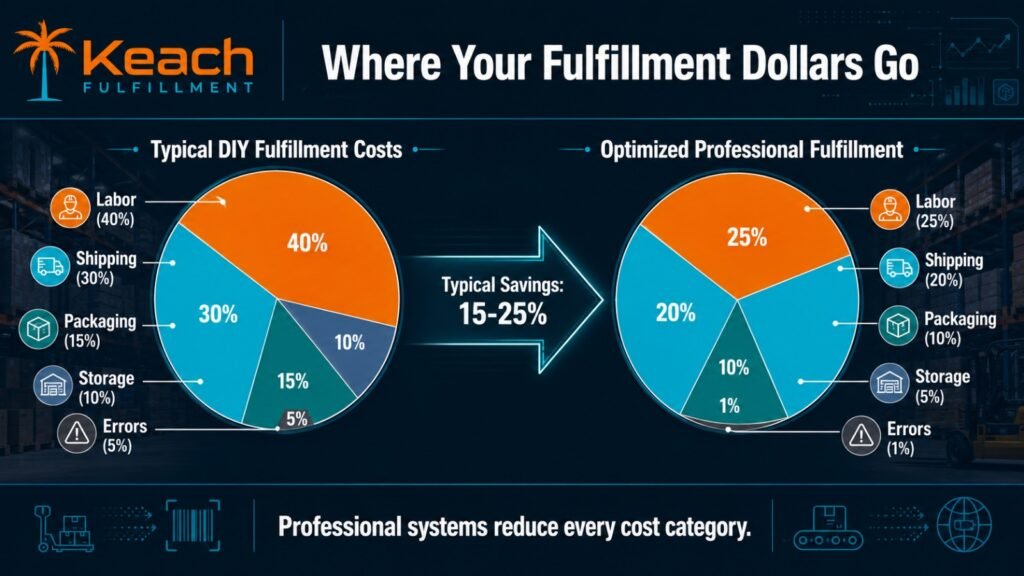
Ecommerce fulfillment logistics costs come from several places. Understanding each one helps you target savings.
- Labor represents the largest expense. Picking, packing, and shipping require human hands. Each order takes minutes of staff time. Multiply that by hundreds or thousands of orders daily.
- Packaging materials add up quickly. Boxes, tape, bubble wrap, and labels cost money. Using oversized boxes wastes materials and increases dimensional weight charges.
- Shipping rates vary dramatically. Retail rates cost much more than volume-discounted rates. Parcel carriers charge more for longer distances and faster delivery.
- Storage fees accumulate for slow-moving inventory. Every square foot costs money. Products sitting for months waste valuable space.
How Does Cost-Effective Fulfillment and Logistics Services for Ecommerce Work?
Cost-effective fulfillment and logistics services for ecommerce focus on eliminating waste. Professional fulfillment centers systematically attack every cost category.
- Labor efficiency comes from optimized pick paths. Workers walk less and pick more orders per hour. Barcode scanning prevents errors that create rework. Better training increases speed.
- Packaging optimization reduces material waste. Right-sized boxes eliminate space. Automated box recommendations prevent oversized packaging. Purchasing bulk material lowers per-unit costs.
- Shipping optimization mixes carriers for best rates. Different carriers excel in different regions. Software chooses the cheapest option for each destination.
- Inventory optimization prevents long-term storage fees. Real-time tracking shows slow-moving products. You can discount or return them before fees accumulate.
Professional systems eliminate costly inefficiencies.
Get Fulfillment Sorted!What Role Does Technology Play in Cost Reduction?
Ecommerce logistics and order fulfillment technology drives most cost savings. Software achieves what manual processes cannot. Warehouse management systems track every product and location. Pickers never search for items. The system directs them exactly where to go. This eliminates wasted walking time. Carrier rate shopping compares shipping costs automatically. The software evaluates UPS, FedEx, USPS, and regional carriers for each package.
It selects the cheapest option meeting delivery requirements. Inventory forecasting prevents both stockouts and overstock. The system analyzes sales patterns. It recommends optimal reorder quantities and timing. Performance analytics identify improvement opportunities. You see pick rates, pack times, and shipping costs per order. Data guides your continuous improvement efforts.
How Do You Start Reducing Fulfillment Costs?
Start by measuring your current costs. Calculate labor per order, packaging per order, and shipping per order. These baselines show where you stand. Next, identify your biggest expense category. Focus improvement efforts there first. Small changes in the largest category produce meaningful savings. Consider partnering with a professional fulfillment center. They already have efficient systems, volume carrier rates, and bulk material pricing. Most brands cannot match these advantages internally.
In our previous guide, From Checkout to Delivery: How Ecommerce Fulfillment Shipping Really Works, we explored the fulfillment journey. Cost reduction touches every step of that journey.
Why Do Professional Fulfillment Centers Achieve Lower Costs?
Professional ecommerce fulfillment centers spread fixed costs across many clients. This shared economy model reduces expenses for everyone. Consider carrier negotiations. A fulfillment center shipping thousands of packages daily commands deep discounts. An individual brand shipping hundreds weekly pays much higher rates.
Consider warehouse space. A fulfillment center uses its space continuously. Different clients’ seasonal peaks offset each other. Your space charges reflect only your actual usage. Consider technology investment. A fulfillment center builds sophisticated systems once. Hundreds of clients share the cost. You access enterprise-grade technology without enterprise-grade investment.
Wrap Up
Ecommerce fulfillment costs do not have to drain your profits. The right systems and partners reduce expenses through labor efficiency, packaging optimization, carrier mixing, and inventory management.
At Keach Fulfillment, we build cost-effective fulfillment and logistics services for ecommerce. Our ecommerce fulfillment logistics systems optimize every step. We pick faster, pack smarter, and ship cheaper. Your customers receive better service. You keep more profit.
Let our efficiency improve your margins.
Contact Keach Fulfillment