
You click “Place Order.” Your credit card processes. A confirmation email arrives seconds later. Magic, right?
Not exactly. What happens between that click and the package on your porch involves dozens of coordinated steps. Most customers never think about this journey. Understanding ecommerce fulfillment helps you appreciate what it takes to deliver orders reliably. It also reveals why some brands ship faster than others.
Follow your package’s journey behind the scenes.
See The JourneyWhat Happens Immediately After Checkout?
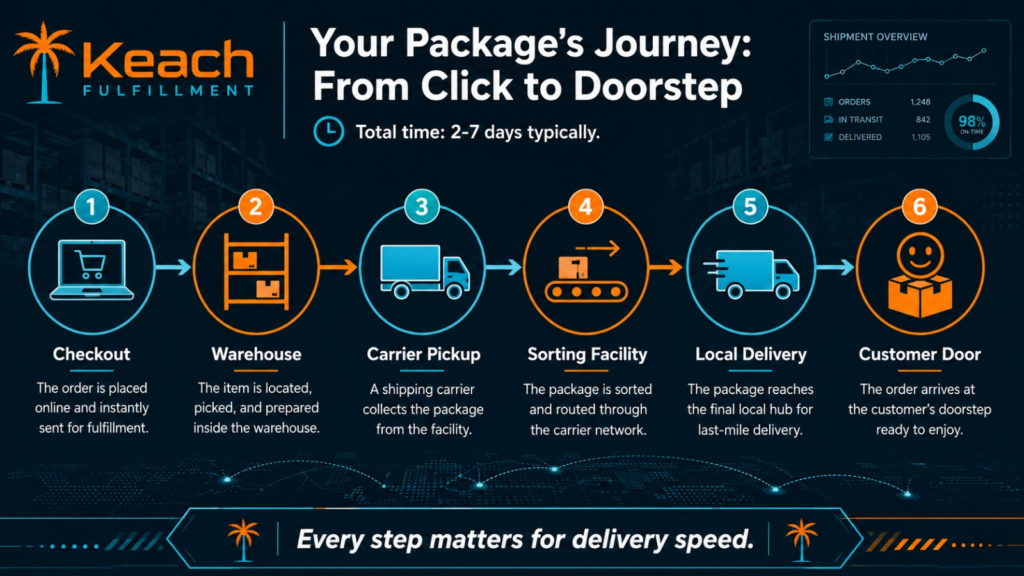
The ecommerce fulfillment shipping process starts the moment a customer completes checkout. Your website sends that order to your fulfillment partner instantly. A warehouse management system receives the order and checks inventory availability. It reserves the products so other customers cannot buy them. This prevents overselling.
The system then groups the order with other orders going to similar warehouse locations. It creates optimized pick paths. Pickers receive assignments on handheld scanners. All of this happens within seconds. Your customer receives their confirmation email while warehouse workers already prepare to pick their order.
How Do Products Move From Shelf to Box?
Ecommerce order fulfillment shipping involves several physical steps once the order reaches the warehouse. A picker walks to the shelf location displayed on their scanner. They scan the shelf barcode to confirm the correct location. Then they scan the product barcode. The system verifies they grabbed the right item.
The picker places products in a tote or cart. They repeat this process for multiple orders simultaneously. Efficient pick paths group nearby products together. Next, the tote arrives at a packing station. A packer scans each product one final time. The system prints the correct box size and shipping label. The packer places products in the box with appropriate dunnage. They close and seal the box. They apply the shipping label. Finally, they place the box on an outbound conveyor belt.
Learn how professional fulfillment speeds up every step.
Get Efficient with Keach Fulfillment!What Happens Between Warehouse and Customer?
Ecommerce shipping & fulfillment does not end when the box leaves the warehouse. The carrier journey involves multiple scans and transfers. A carrier truck picks up packages from the fulfillment center daily. Drivers scan each package during pickup. This scan triggers the first tracking notification to your customer.
The truck transports packages to a regional sorting facility. Conveyor belts and automated scanners sort packages by destination. Your package joins others heading toward your customer’s region. Sorting facilities transfer packages to local delivery trucks. These trucks carry packages to final destinations. Drivers scan packages again before loading.
The final scan occurs at delivery. The driver scans the package, takes a photo, and leaves it at the customer’s door. Your customer receives their delivery notification.
Why Do Some Orders Arrive Faster Than Others?
The speed of ecommerce fulfillment depends on several factors. Warehouse location tops the list. Fulfillment centers close to customers ship faster. A package traveling two hundred miles arrives sooner than one traveling two thousand miles. This explains why brands with multiple warehouse locations deliver faster.
Order cutoff times also matter. Orders placed before the daily cutoff ship the same day. Orders after the cutoff wait until tomorrow. Some fulfillment centers offer late cutoffs for faster service. Carrier selection affects speed too. Priority services cost more but deliver faster. Ground services cost less but take longer. Professional fulfillment partners help you balance speed and cost.
In our previous guide, Beyond Shipping The Real Value of 3PL Ecommerce Fulfillment, we explored how professional partners deliver value beyond just moving boxes. Speed and reliability represent key parts of that value.
How Can You Improve Your Own Fulfillment Speed?
Improving your ecommerce fulfillment shipping starts with measuring current performance.Track your order cutoff time and processing duration. Calculate the time between order placement and carrier pickup. Identify your longest delays.
Consider partnering with a professional fulfillment center. They maintain efficient warehouse layouts, trained staff, and carrier relationships. Most brands cannot match their speed internally. Choose a partner with warehouse locations near your customers. Shorter shipping distances mean faster delivery times.
Conclusion
Ecommerce fulfillment involves much more than dropping boxes at the post office. Behind every fast delivery lies an efficient warehouse, coordinated carrier network, and sophisticated software. Understanding this journey helps you appreciate professional fulfillment partners. They handle the complexity so your customers enjoy fast, reliable delivery.
At Keach Fulfillment, we master every step of ecommerce order fulfillment shipping. Our warehouse locations sit near major customer centers. Our systems process orders instantly. Our carrier relationships ensure reliable delivery.
Let us handle the journey from checkout to delivery.
Contact Keach Fulfillment Today