
Software companies love complicated language. They throw around acronyms and buzzwords. You feel confused rather than informed. Let us skip all that. What is a warehouse management system in plain English?
Simply put, it is a digital assistant for your warehouse. This assistant remembers where you put everything. It tells your team exactly what to grab. It catches mistakes before they ship. No technical degree required.
What Is a Warehouse Management System in Plain English?
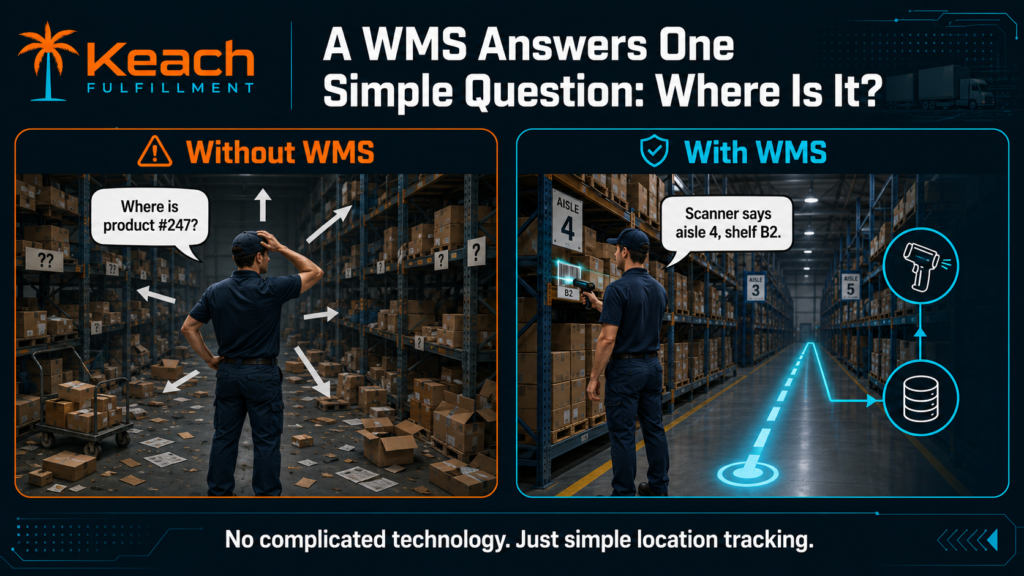
A warehouse management system (or warehouse management system (wms) ) acts like a GPS for your inventory. It knows where every product sits. Imagine you have five hundred different products scattered across a large warehouse. Without a system, finding a specific item takes time. Staff wander the aisles searching. Frustration builds.
With a system, staff scan a barcode on the shelf. They scan the product. The system confirms they have the right item. No guessing. No searching. Think of it as Google Maps for your warehouse. Just as Maps tells you the fastest route to a restaurant, a WMS tells pickers the fastest route to products.
What Are Some Warehouse Management System Examples?
Warehouse management system examples appear throughout ecommerce. Every major online retailer uses one. Consider what happens when you order a phone case from a popular brand. Their WMS receives your order instantly. The system locates the exact shelf holding that phone case. It directs a picker to that location.
The picker scans the shelf barcode, then the product barcode. The system verifies the match. It then directs the picker to the packing station. This entire process takes minutes. The WMS makes it possible by tracking every product and every location.
Another example involves seasonal spikes. A candy company ships most of its annual volume during Halloween. Their WMS helps them prepare. They store extra inventory in temporary locations. The system remembers those locations. Pickers find products even when stored in unusual spots.
No complex software to learn or manage.
See How It WorksHow Does a Warehouse Management System Actually Work?
Let me walk you through a typical day using what is warehouse management system is in action. Morning arrives. A truck backs into the receiving dock. Staff unloads boxes of new inventory. They scan each product using a handheld scanner. The warehouse management system asks, “Where should I store this?”
Staff place products on shelves. They scan the shelf location barcode. The system now knows exactly where every item sits. Later, orders start coming in from your website. The WMS groups similar orders together. It creates efficient pick paths.
Picklers receive their assignments on scanners. The scanner shows them which products to grab and where to find them. They walk to each location, scan the shelf, then scan the product. The system confirms each pick. Finally, packers prepare shipments. The WMS prints the correct shipping label for each order. Tracking numbers flow back to your customers automatically.
How Does a WMS Prevent Costly Mistakes?
Mistakes cost money. Sending the wrong item frustrates customers. Running out of bestsellers loses sales. A warehouse management system prevents these errors through simple verification. Consider wrong item picks. Without a WMS, a picker grabs what looks correct. Similar products get confused easily. Black shirt versus navy shirt. Size medium versus size large.
With a WMS, the picker scans each product before placing it in an order. The system rejects wrong items immediately. “You scanned a medium. The customer ordered a large.” The picker corrects the mistake before it ships. Stock counts stay accurate, too. Every time someone picks a product, the WMS deducts it from inventory. Every time new products arrive, the WMS adds them. Your system always reflects reality.
In our previous guide, From Inventory Chaos to Control With Warehouse Management Systems, we explored how WMS transforms chaotic warehouses. The same principles apply regardless of your warehouse size.
Do You Really Need a Warehouse Management System?
Not every business needs a WMS immediately. Small operations with fifty products might manage fine with basic methods. However, once you pass two hundred products or fifty daily orders, the case for a WMS grows strong.
The signs appear clearly. Staff spend more time searching than picking. Inventory counts never match your records. Customer complaints about wrong items are increasing. Professional fulfillment centers like Keach Fulfillment include WMS technology as part of their service. You gain the benefits without managing any software yourself.
Wrap Up
A warehouse management system brings order to chaos. It remembers where every product sits. It directs pickers efficiently. It prevents costly mistakes. No technical jargon changes these basic facts. A WMS simply helps you find things faster and ship orders more accurately.
At Keach Fulfillment, we use advanced warehouse management system technology to power our operations. You never need to learn complicated software. Our team handles everything while you enjoy accurate, fast fulfillment.
Let our technology power your fulfillment.
Contact Keach Fulfillment