
You imagine a warehouse. Rows of shelves. Workers walking aisles. Boxes stacked everywhere. That image is a thing of the past. Modern 3PL warehouses rely not only on labor, but also software for automation, real-time data and workflows meticulously optimized to create the best efficiency possible. Today’s fulfillment centers are built to handle thousands of orders at a fast pace with high accuracy and transparency throughout every step in the process.
These facilities are not only storage warehouses for ecommerce brands anymore. There are both, being tech powered Warehouses as Logistics Hubs to enable growth and customer experience while making fulfillment more seamless. But technology is changing how logistics works, as we’ll see in this inside peek at a modern 3PL warehouse.
What Makes a Modern 3PL Warehouse Different?
A contemporary 3PL warehouse is a combination of physical infrastructure and cutting-edge technology. The storage space is key, but the true value comes with systems that govern every movement within your facility.
Warehouse management software keeps track of where inventory is located, when certain stock levels are running low and logs every time a product moves. Every step of the fulfillment process includes staff placing a scanner overhead and scanning products.
Packages flow from one workstation to another with automated conveyors and sorting systems. The reliance on technological methods minimizes the idle time and movement in warehouses instead of just manual work.
And it also allows managers to track inventory, productivity and order volume in real-time reporting. Teams get this visibility to catch issues before they reach customers.
This results in a fulfillment operation that is much faster and more precise than traditional warehouse models.
Discover how technology-driven fulfillment improves speed, accuracy, and scalability for growing ecommerce brands.
Take The TourHow Does 3PL Warehouse Management Software Work?
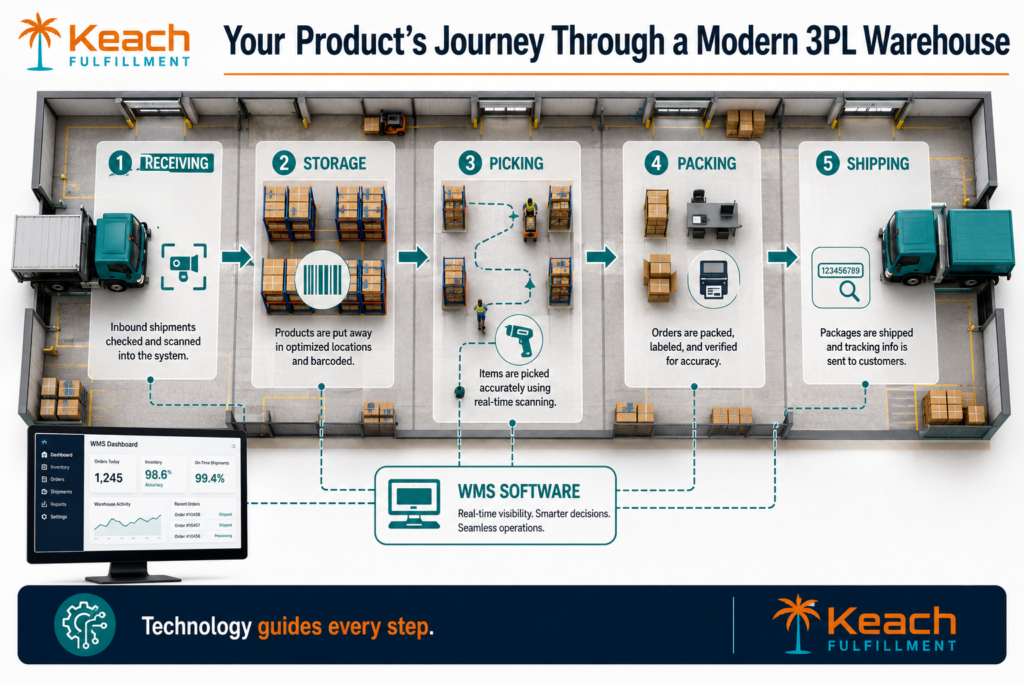
3PL warehouse management software is the heart of every modern fulfillment operation. That software is the digital warehouse brain, optimizing everything from inventory receipt to completed order delivery. Inventory coming into the warehouse is scanned by warehousing staff. It does this by allocating storage locations and instantly updating inventory records.
The picker routes are developed as and when customer orders arrive. Using handheld scanners, employees receive directions on where to find products without rummaging through the aisles. It suggests packaging, prints out the shipping labels and checks that all products ordered are in on a packing station before they leave for delivery.
And finally, tracking information is automatically passed onto customers and ecommerce platforms. As every single step is linked by a common, centralized system, businesses get 100% visibility on their inventory and fulfillment operations.
In our previous guide, The Hidden Link Between 3PL Fulfillment and Ecommerce Scalability, we explored how professional fulfillment removes growth barriers. That guide showed how DIY operations hit limits as order volume increases. We discussed how 3PLs provide the flexible capacity, technology, and expertise needed to scale without breaking. The same principles apply when considering warehouse technology. Scalability depends on systems that can handle growth. Modern warehouses deliver that capability through advanced technology integration.
What 3PL Warehouse Services Should You Expect?
Modern 3PL warehouse services are much more than just storage.
The partner for your professional fulfillment must offer comprehensive support throughout the product lifecycle.
Receiving and Inspection
When new inventory arrives, it is unpacked and counted. Products that are defective or incorrect, and discovered as such before they enter active inventory.
Inventory Storage
Products are organized strategically within the warehouse. High-demand items are placed in easily accessible locations to improve picking efficiency.
Inventory Management
It allows businesses to keep an eye on their holding position without necessarily having 100% constant visibility into stock levels (though core infra, elastic compute and PaaS do make some level of real time inventory tracking possible).
Pick and Pack Fulfillment
This involves teams in the warehouse picking and packing products, putting shipping labels on them, then preparing orders for pickup by carriers.
Returns Processing
Returned items are checked and either restocked, repaired or disposed of according to established guidelines.
These all combine to create an expedient fulfilment experience which is essential for business growth.
Modern warehouse systems eliminate manual work, reduce errors, and provide complete inventory visibility.
Explore Modern TechnologyA Typical Day Inside a Modern 3PL Warehouse
While no two facilities operate the same, the day-to-day processes for most modern warehouses are fairly uniform.
The day typically kicks off with receiving inventory shipments. Products are received from manufacturers or suppliers and scanned into the warehouse management systems.
Afterwards, the warehouse staff can start picking products based on optimized paths build by their software as orders piles up. This reduces the time spent traveling and can thus boost working output.
Selected products end up at packing stations, where workers check the contents of an order; seal these goods in boxes or other containers; and print shipping labels.
Your completed package is then routed to shipping docks where carriers pick it up for delivery.
When it comes around to the end of a shift after warehouse teams are finished reviewing performance metrics replenishing supplies and making sure they have everything in place for another day of operations.
Each phase is coordinated by technology to ensure that inventory flows from you inbound and your shipments outbound.
What Does the Future Hold for 3PL Warehouses?
This technology for the warehouse is changing quickly.
AI in warehouses: New-age technologies such as artificial intelligence help the warehouse to predict demand, optimize labor allocation and enhance picking.
Robocs are getting more common now, they perform repetitive transportation duties and ease the labor load on operations.
IoT sensors maintain environmental conditions (temperature and humidity) that can help protect sensitive inventory.
For operational insights, advanced analytics platforms go deeper so warehouse managers can spot trends and some issues before they arise.
Because of the maturing nature of these technologies, fulfillment operations will become even more efficient, scalable and customer-centric.
Conclusion
Modern 3PL warehouses have evolved beyond basic storage locations. These are Fulfillment centers powered by technology that to help the fast-growing ecommerce Businesses.
Be it impactful warehouse management software or efficient picking and shipping processes, everything in such a modern facility is designed to be best-in-class operationally for speed, accuracy and scalability.
Brands aiming to steadily increase their fulfillment performance may gain from collaboration with a technology led 3PL that can provide the necessary systems, expertise and infrastructure for long-term development.
At Keach Fulfillment, we combine experienced warehouse teams with advanced fulfillment technology to deliver accurate, efficient, and scalable logistics solutions. From receiving and storage to picking, packing, and returns management, we help ecommerce businesses fulfill orders with confidence.
Let our systems, processes, and team help your business scale faster.
Contact Keach Fulfillment